Randomly controlled roulette game operation

US20050014550A1Inactive Publication Date: 2005-01-20RHOTEN LARRY J
0 Cites 54 Cited by

Patent Information

Authority / Receiving Office
US · United States
Current Assignee / Owner
Publication Date
2005-01-20
Estimated Expiration
Not applicable · inactive patent

Smart Images

  • Figure 1
    Figure 1
  • Figure 2
    Figure 2
  • Figure 3
    Figure 3
Patent Text Reader

Abstract

A method of controlling at least one of the launch time of the ball, the speed of rotation of the wheel, and the speed of movement of the ball, in such a way that none of those factors is under the immediate control of a game manager; and displaying information to confirm the randomness of the operation.
Need to check novelty before this filing date? Find Prior Art

Description

PRIORITY CLAIM

[0001]

[0001] I claim priority of my copending U.S. patent application Ser. No. 10 / 693,741 filed Oct. 24, 2003; and of my three U.S. Provisional Applications Ser. No. 60\484990 filed Jul. 3, 2003; Ser. No. 60\495641 filed Aug. 15, 2003; and Ser. No. 60\502456 filed Sep. 11, 2003.FIELD OF THE INVENTION

[0002] This invention relates to improvements in gaming devices, and particularly to roulette table games, or video simulations thereof, or in coin operated gaming devices or in internet gaming. BACKGROUND OF THE INVENTION

[0003] In the game of roulette, which is played at many gaming houses in the United States and elsewhere, a dealer employed by the gaming house releases a ball which then travels around the periphery of a rotating wheel having circumferentially arranged stopping places, until the ball finally stops at a particular stop. The stopping place of the ball, and a number associated with that stopping place, determines whether particular players have won or los...

Examples

Embodiment Construction

(FIG. 1-4)

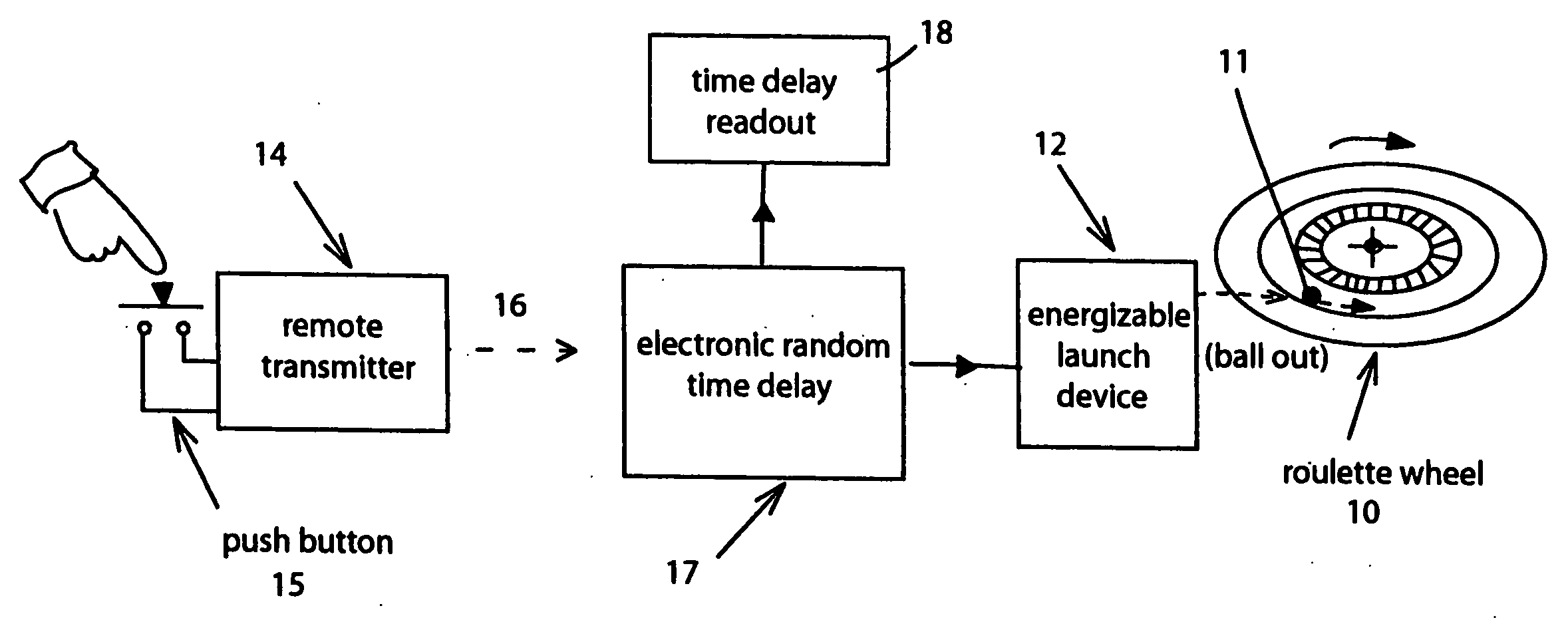
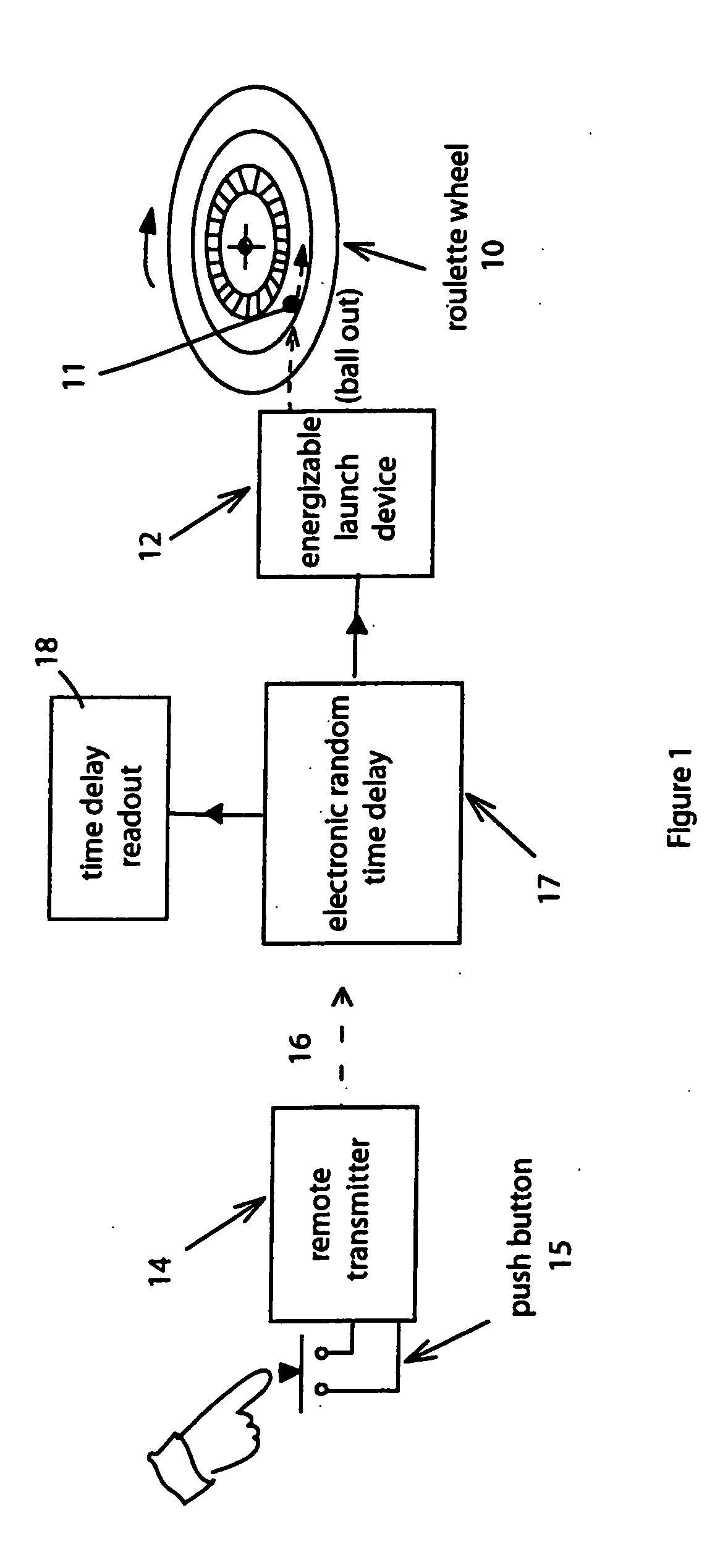
[0028] Referring now to the drawings, FIG. 1 shows a roulette wheel 10 onto which a ball 11 is to be launched. An energizable launch device or mechanism 12 is available to provide the actual launching of the ball. A remote transmitter 14 is controlled by a push button 15. When the button 15 is pushed the transmitter generates a Start Game signal 16 that is then transmitted to an electronic random time delay circuit 17. The transmission of the Start Signal 16 is represented in FIG. 1 by a dotted line and arrow, indicative of the fact that any of several different means may be utilized for communicating a Start Game signal to the electronic random time delay circuit 17. Also associated with the time delay circuit 17 is a time delay readout 18 which visibly indicate the actual amount of time that transpires after the start button 15 is pressed and before a Launch Signal is generated to energize the launch mechanism 12.

[0029] In accordance with the invention a random time per...