Method and system for selecting an access network in a heterogeneous network environment

a network environment and access network technology, applied in the field of network selection scheme, can solve the problems of affecting qos and wasting more tim

US20060030319A1Inactive Publication Date: 2006-02-09IND TECH RES INST
4 Cites 44 Cited by

Patent Information

Authority / Receiving Office
US · United States
Patent Type
Applications(United States)
Current Assignee / Owner
Publication Date
2006-02-09
Estimated Expiration
Not applicable · inactive patent

Smart Images

  • Figure 1
    Figure 1
  • Figure 2
    Figure 2
  • Figure 3
    Figure 3
Patent Text Reader

Abstract

The present invention provides a method and system for selecting an access network in a heterogeneous network environment. The method records user configuration information in a mobile device and applies the mobile device to first collect and record current status information of each access network, then determines a network stability coefficient for each access network based on both the user configuration information and the current status information, and finally selects an access network with a maximum network stability coefficient to thus establish a connection with the access network selected.
Need to check novelty before this filing date? Find Prior Art

Description

BACKGROUND OF THE INVENTION

[0001] 1. Field of the Invention

[0002] The invention relates to a network selecting scheme and, more particularly, to a method and system for selecting an access network in a heterogeneous network environment.

[0003] 2. Description of Related Art

[0004] Since current heterogeneous access networks typically have features respectively, it is a very important target that a mobile user can obtain the best quality of services (QoS) on mobile communications by means of the features. For example, the series of wireless local area network (WLAN) IEEE 802.11 generally has a high transmission rate but a very small covered area. By contrast, other networks like General Packet Radio Service (GPRS) and Universal Mobile Telecommunication (UMTS) have a low transmission rate but a wide covered area. Accordingly, when the mobile user is roaming between the networks with different features, the change of transmission rate is approximately 100 times, which greatly affects ...

Examples

Embodiment Construction

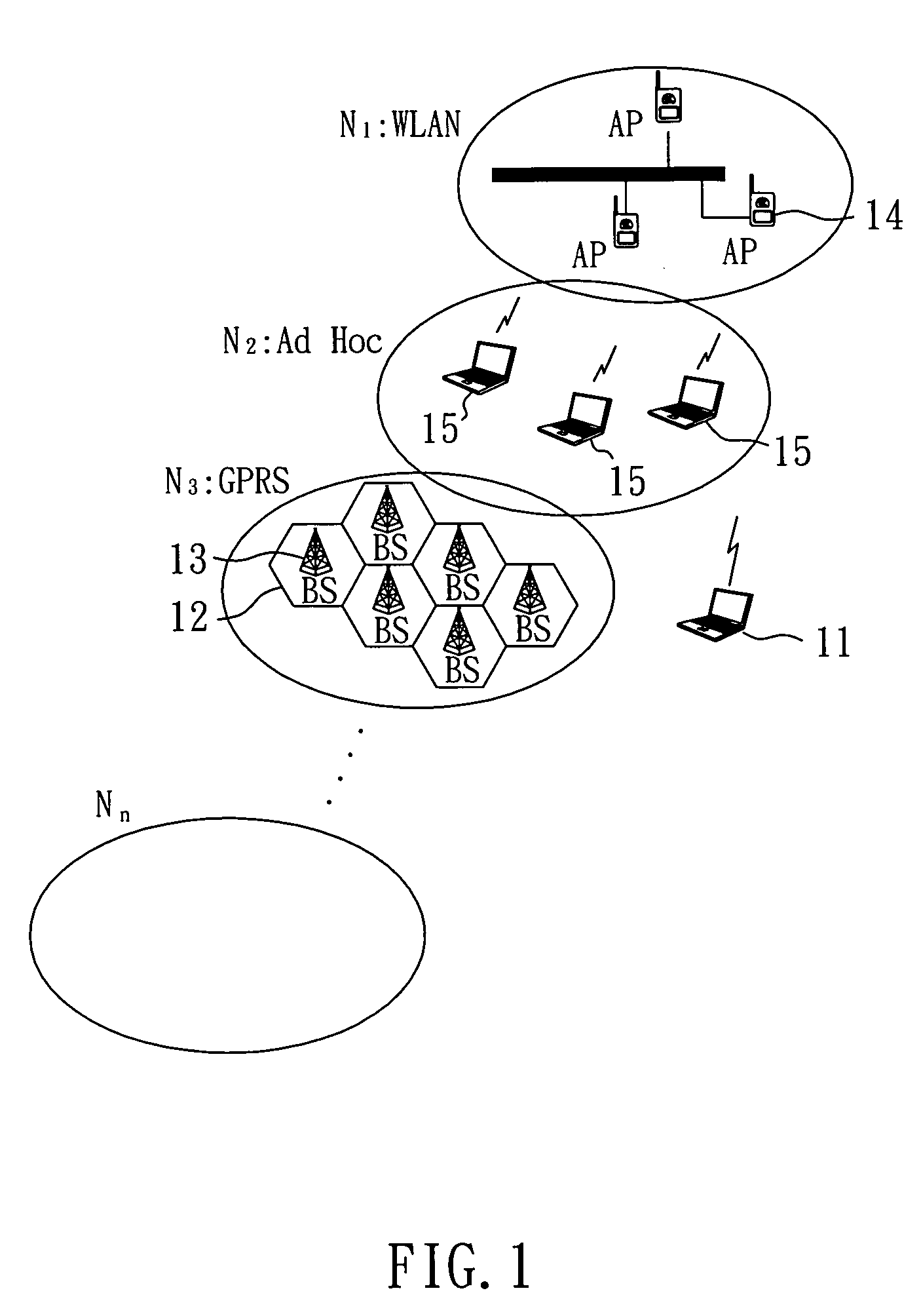
[0017]FIG. 1 is a diagram of a network architecture in a heterogeneous network environment according to the invention. As shown in FIG. 1, the heterogeneous network environment can include multiple access networks Ni(i=1 to N) such as a WLAN N1, an ad hoc N2, and a GPRS network N3. In the heterogeneous network environment, a mobile device 11 may stay in an area covered by an access point (AP) 14 of the WLAN N1 or in a cell 12 of the GPRS network N3 for accessing network through a base station (BS) 13 of the cell 12, or connects with other mobile device(s) 15 to construct the ad hoc N2 for transferring its packets by way of the mobile device 15.

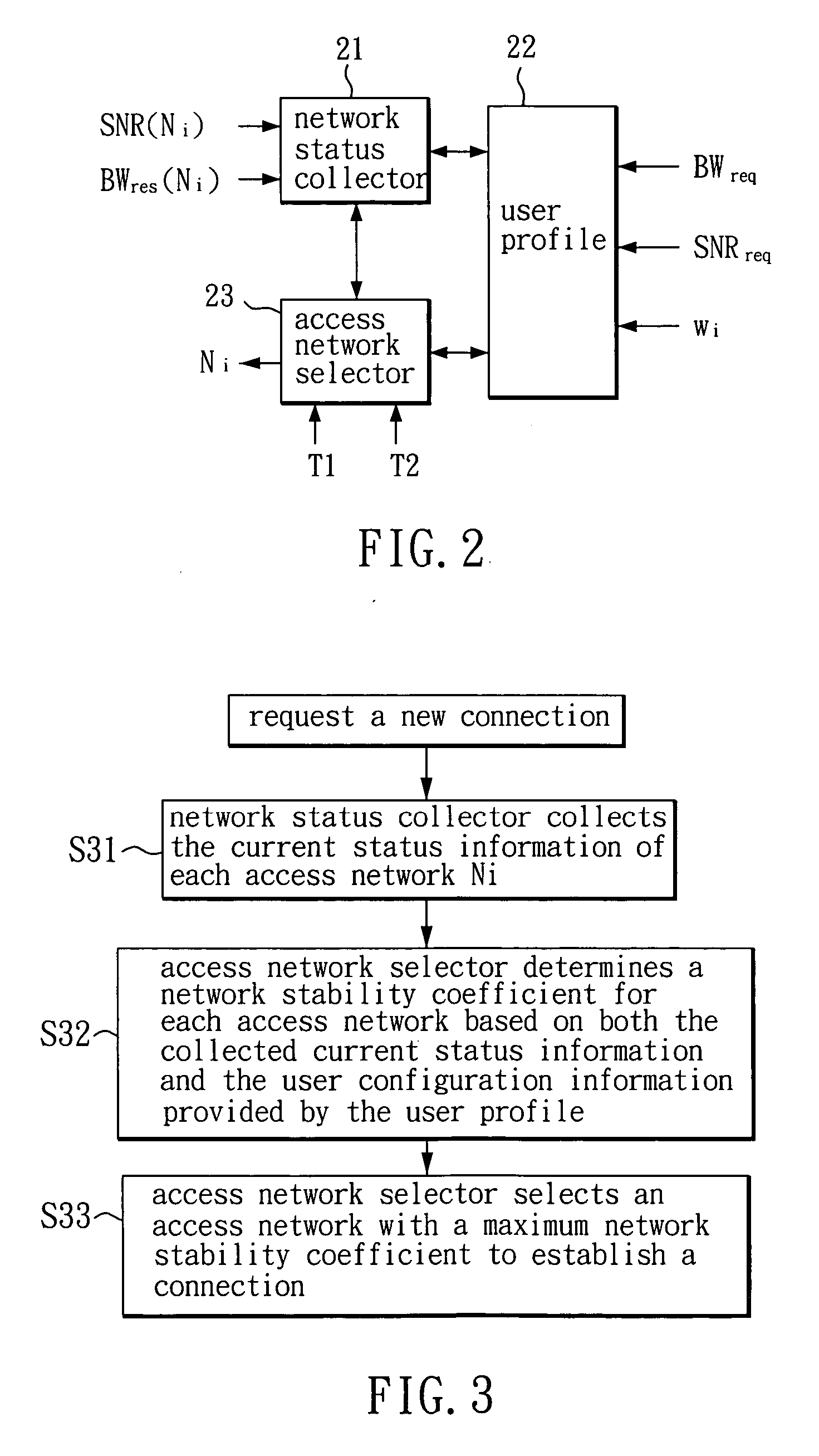
[0018] For selecting an appropriate access network in the heterogeneous network environment, as shown in FIG. 2, the mobile device 11 includes a network status collector (NSC) 21, a user profile (UP) 22 and an access network selector (ANS) 23. The NSC 21 can detect or collect and record current status information of each access network Ni, wh...