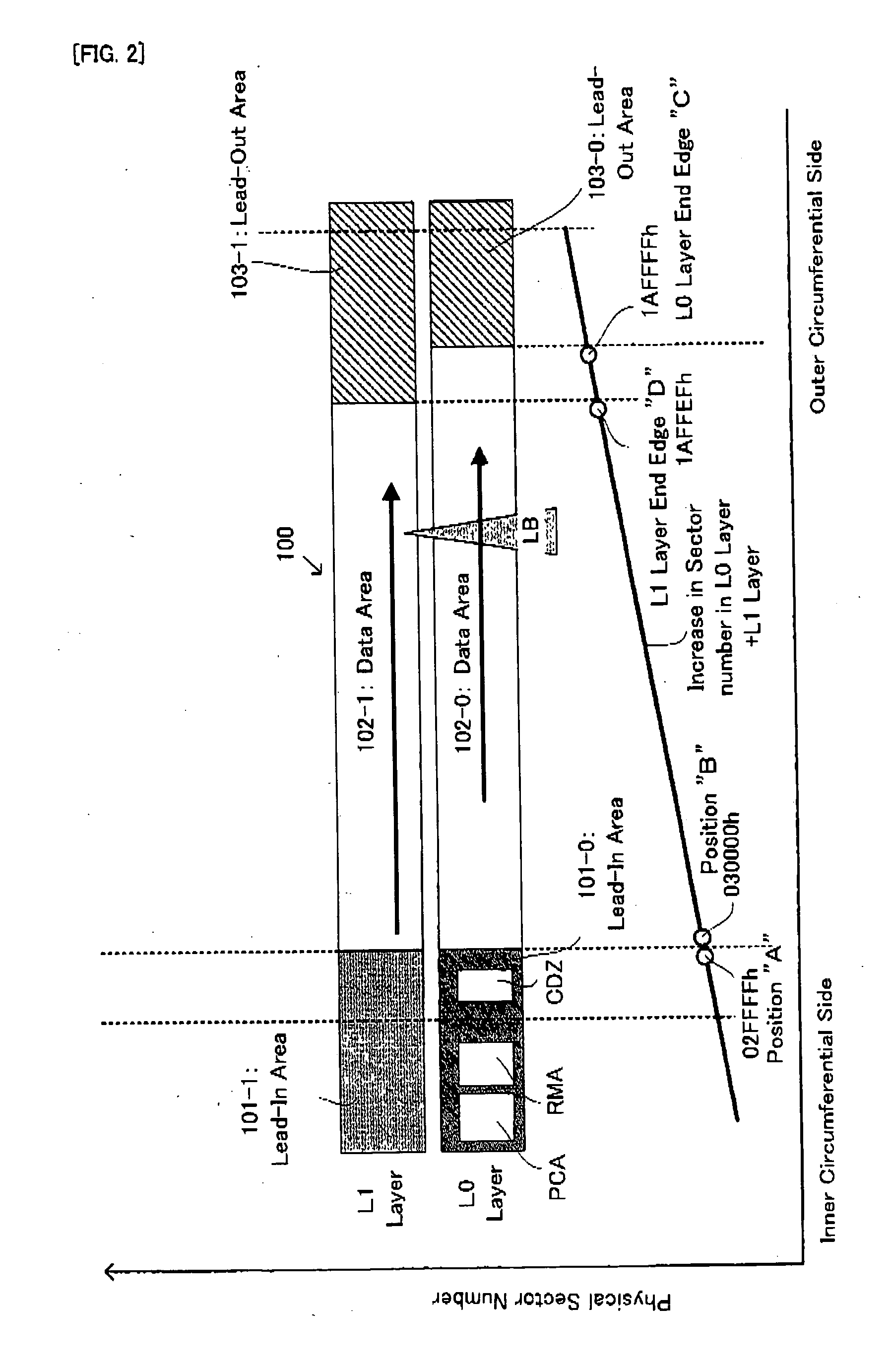
[0011] More specifically, particularly, the first recording track may be directed from one to the other side, out of the inner circumferential side and the outer circumferential side of the above-described substrate. The second recording track may be directed from the one to the other side, as with the first recording track. Namely, on the two-layer type or multiple-layer type information recording medium, it is possible to perform
continuous recording in a “parallel manner” in which the recording tracks are directed in the same direction between the two recording
layers. In the “parallel manner”, if the recording or
reproduction is ended in the first recording layer, an
optical pickup that is on the most outer circumference of the optical disc needs to be displaced again to the most inner circumference when the recording or
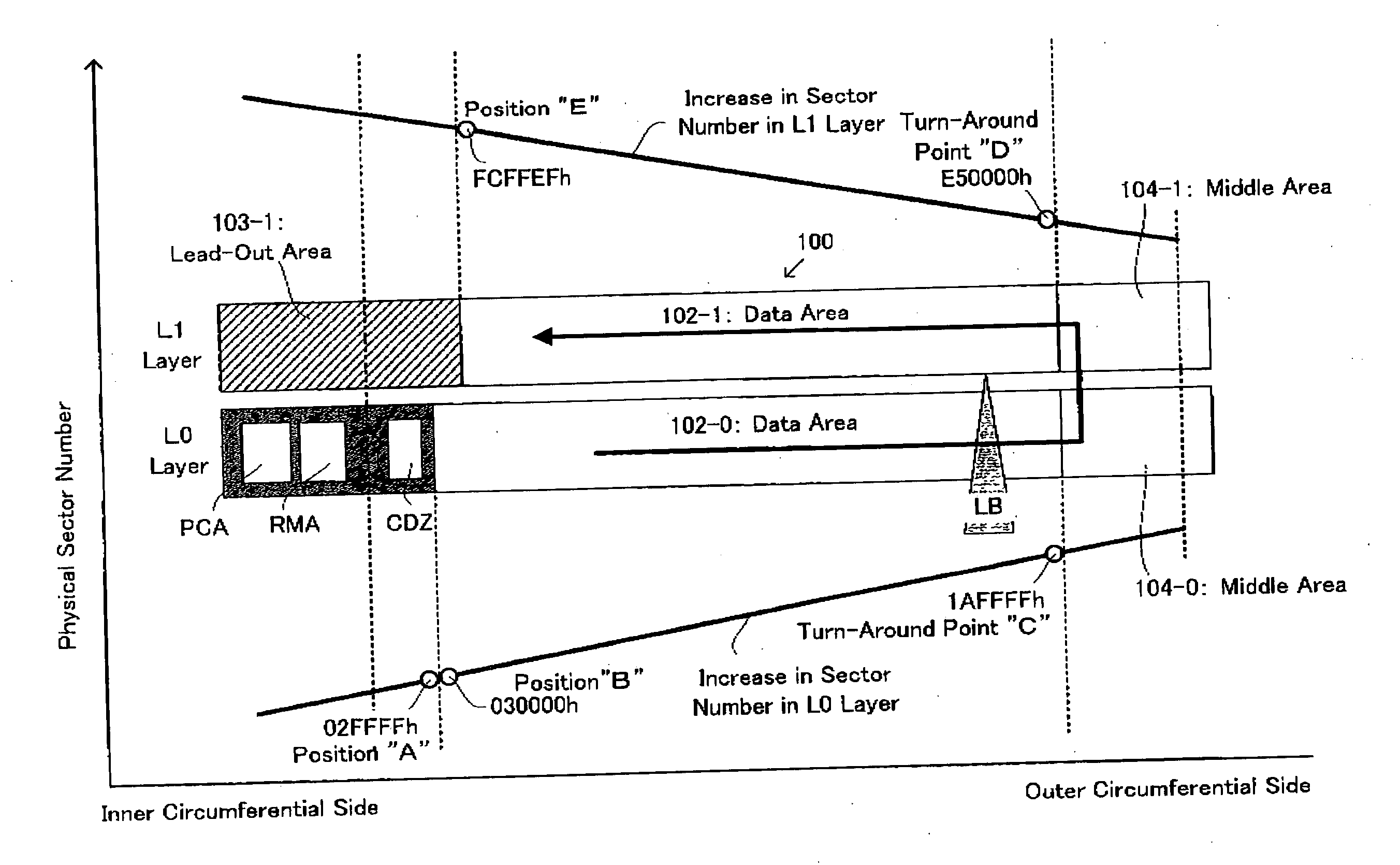
reproduction is started in the second recording layer. Thus, as compared to an “opposite manner”, it takes more time by that much to change from the L0 layer to the L1 layer. Alternatively, the first recording track may be directed from one to the other side, out of the inner circumferential side and the outer circumferential side of the above-described substrate. As opposed to this, the second recording track may be directed from the other to the one side. Namely, on the two-layer type or multiple-layer type information recording medium, it is possible to perform
continuous recording in the “opposite manner” in which the recording tracks are directed in the opposite directions between the two recording layers. Therefore, if the recording is continuously performed from the end edge of the first recording layer, i.e. an edge on the other side of the first recording layer, such as an outer circumferential end portion of the first recording layer, to the start edge of the second recording layer, i.e. an edge on the other side of the second recording layer, such as an outer circumferential end portion of the second recording layer, it is hardly necessary or not necessary at all to change the
irradiation position of the
laser light in the
substrate surface, in the radial direction, in changing the recording layers which is the object of recording
processing or
reproduction processing associated with the information. This allows the quick layer-to-layer jump (i.e. a layer-to-layer changing operation). This does not need a special buffer function to change the recording layers, in recording the continuous
record information, such as a movie, for example. Moreover, this facilitates the reproduction without a stop, so that it is extremely useful in practice.
[0073] According to the second
computer program of the present invention, the above-described second information recording apparatus of the present invention can be relatively easily realized as a computer reads and executes the second
computer program from a program storage device, such as a ROM, a CD-ROM, a DVD-ROM, and a hard disk, or as it executes the second computer program after downloading the program through a
communication device.


 Login to View More
  Login to View More