

Aminocyclohexanes as Dipeptidyl Peptidase-Iv Inhibitors for the Treatment or Prevention of Diabetes
a technology of dipeptidyl peptidase and dipeptidyl peptidase, which is applied in the field of substituted aminocyclohexanes, can solve the problems of increased and premature morbidity and mortality, increased risk of macrovascular and microvascular complications in patients with type 2 diabetes mellitus, and increased plasma insulin levels
Patent Information
- Authority / Receiving Office
- US · United States
- Patent Type
- Applications(United States)
- Current Assignee / Owner
- Publication Date
- 2007-11-01
Smart Images
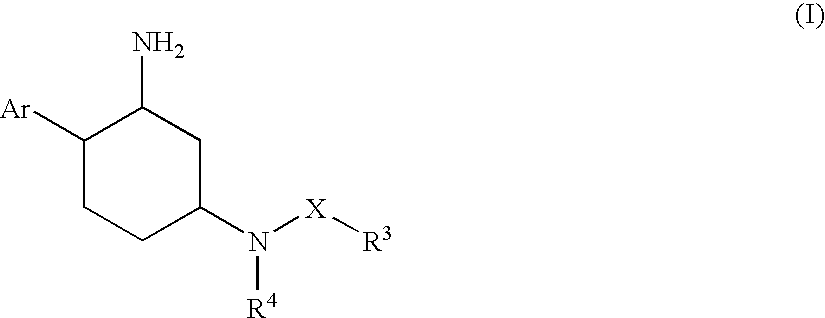
Figure 1 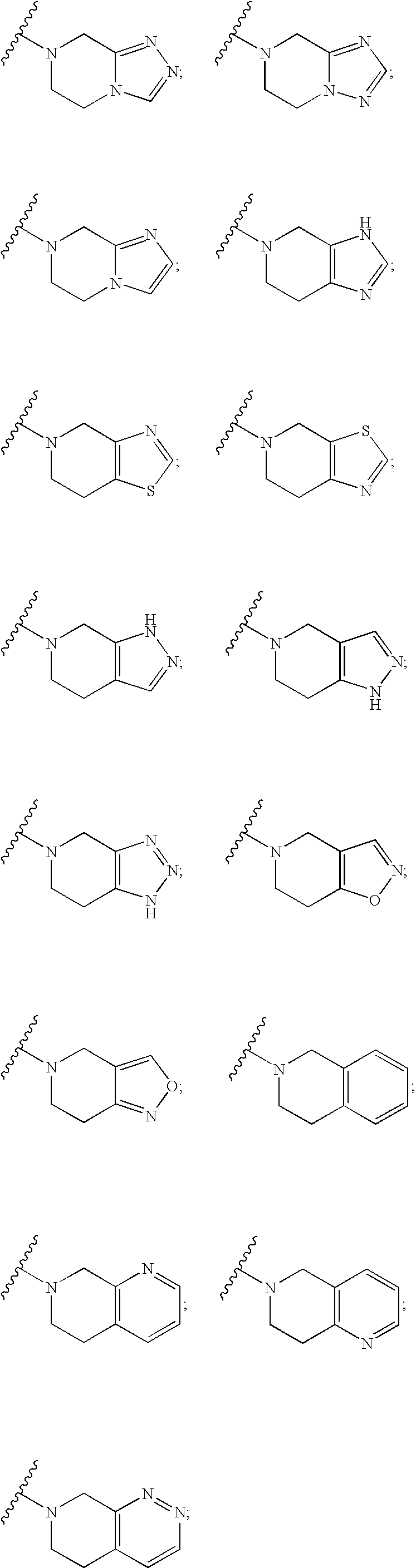
Figure 2 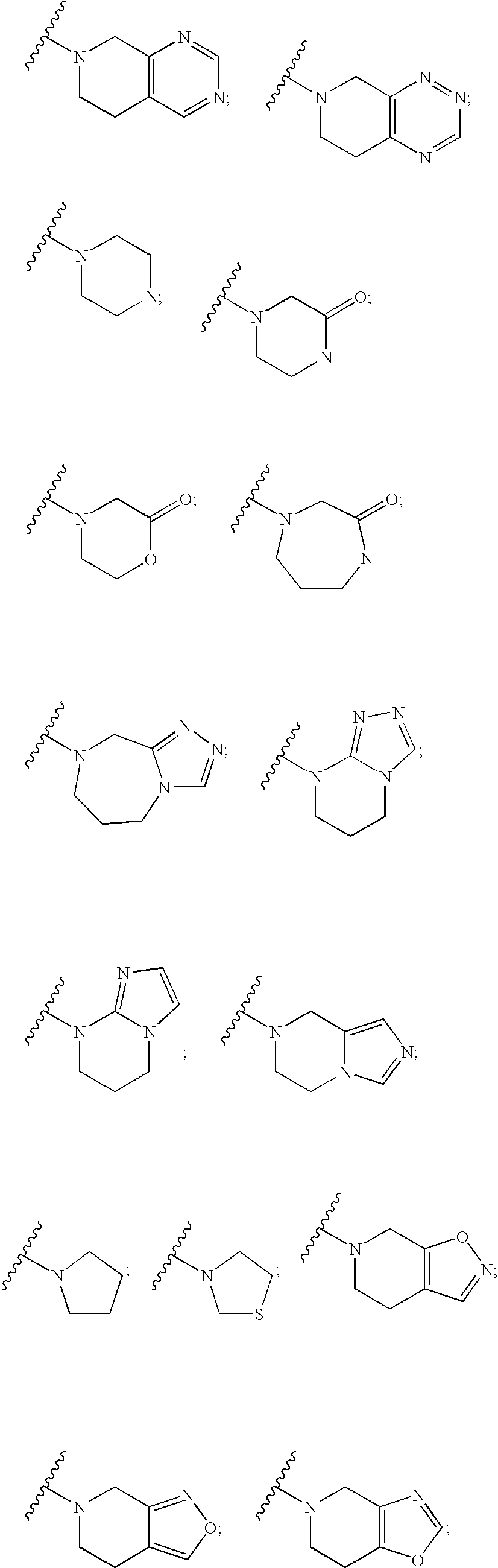
Figure 3
Abstract
Description
FIELD OF THE INVENTION
[0001] The present invention relates to novel substituted aminocyclohexanes which are inhibitors of the dipeptidyl peptidase-IV enzyme (“DPP-IV inhibitors”) and which are useful in the treatment or prevention of diseases in which the dipeptidyl peptidase-IV enzyme is involved, such as diabetes and particularly Type 2 diabetes. The invention is also directed to pharmaceutical compositions comprising these compounds and the use of these compounds and compositions in the prevention or treatment of such diseases in which the dipeptidyl peptidase-IV enzyme is involved. BACKGROUND OF THE INVENTION
[0002] Diabetes refers to a disease process derived from multiple causative factors and characterized by elevated levels of plasma glucose or hyperglycemia in the fasting state or after administration of glucose during an oral glucose tolerance test. Persistent or uncontrolled hyperglycemia is associated with increased and premature morbidity and mortality. Often abnormal ...
Examples
example 1
[0223]
[(1S,2R,5S)-5-[3-(Trifluoromethyl)-5,6,7,8-tetrahydro[1,2,4]triazolo[4,3-α]pyrazin-7-yl]-2-(2,4,5-trifluorophenyl)cyclohexyl]amine, bis trifluoroacetic acid salt
Step A: tert-Butyl [(1S,2R,5S)-5-[3-(trifluoromethyl)-5,6,7,8-tetrahydro-[1,2,4]triazolo[4,3-α]pyrazin-7-yl]-2-(2,4,5-trifluorophenyl)cyclohexyl]carbamate and tert-butyl [(1S,2R,5R)-5-[3-(trifluoromethyl)-5,6,7,8-tetrahydro-[1,2,4]triazolo[4,3-α]pyrazin-7-yl]-2-(2,4,5-trifluorophenyl)cyclohexyl]carbamate
[0224] A solution of tert-butyl [(1S,2R)-5-oxo-2-(2,4,5-trifluorophenyl)cyclohexyl]carbamate (Intermediate 1, 70 mg) and 3-(trifluoromethyl)-5,6,7,8-tetrahydro-1,2,4-triazolo[4,3-α]pyrazine (Intermediate 4, 39 mg) in dichloromethane (5 mL) was treated with titanium tetrachloride (1M in dichloromethane, 0.1 mL). The reaction mixture was stirred at room temperature overnight and then treated with a solution of sodium cyanoborohydride (38 mg) in methanol (2 mL). After stirring for 15 min, the solution was brought to pH...
example 2
[0226]
[(1S,2R,5R)-5-[3-(Trifluoromethyl)-5,6,7,8-tetrahydro[1,2,4]triazolo[4,3-α]pyrazin-7-yl]-2-(2,4,5-trifluorophenyl)cyclohexyl]amine, bis-trifluoroacetic acid salt
[0227] Essentially following the procedure outlined in Example 1, Step B, the faster eluting (1S,2R,5R) isomer from Example 1, Step A was converted to the title compound. 1H NMR (600 MHz, CD3OD): δ 7.35 (m, 1H), 7.16 (m, 1H), 4.28 (m, 2H), 4.04 (d, 1H, J=15.7 Hz), 3.96 (d, 1H, J=15.7 Hz), 3.77 (dt, 1H, J=2.7,11.8 Hz), 3.16 (m, 1H), 3.09 (br, 1H), 3.06 (m, 1H), 2.88 (quintet, 1H, J=3.0 Hz), 2.54 (dq, 1H, J=14.0,2.9 Hz), 2.28 (dm, 1H, J=14.1 Hz), 1.98 (qm, 1H, J=12.4 Hz), 1.78 (ddd, 1H, J=2.6,13.5,14.4 Hz), 1.74 (m, 1H), 1.70 (m, 1H).
[0228] Following essentially the procedures outlined for Example 1, the Examples listed in Table 1 were prepared.
TABLE 1MSExampleR1NR4(XR3)(M + 1)32-F, 5-F402.242-F, 5-F338.152-F, 4-F, 5-F347.162-F, 4-F, 5-F420.172-F, 4-F, 5-F—NMeCH2Ph349.282-F, 4-F, 5-F415.192-F, 4-F, 5-F419.1
example 10
[0229]
[(1S,2R,5S)-5-(5,6-Dihydro[1,2,4]triazolo[1,5-α]pyrazin-7(8H)-yl)-2-(2,4,5-trifluorophenyl)cyclohexyl]amine
[0230] To a solution of tert-butyl [(1S,2R)-5-oxo-2-(2,4,5-trifluorophenyl)cyclohexyl]carbamate (Intermediate 1, 200mg) in anhydrous methanol (8.0 mL) under nitrogen was added 5,6,7,8-tetrahydro[1,2,4]triazolo[1,5-α]pyrazine hydrochloride (55 mg), triethylamine (0.081 mL) and decaborane (22 mg). After stirring at 50° C. for 24 h, the reaction mixture was concentrated and chromatographed by preparative TLC (silica gel, 1:4:95 ammonium hydroxide / methanol / dichloromethane). The slow moving desired compound was recovered, stirred in 4N hydrogen chloride in 1,4-dioxane for 50 min, and concentrated. The residue was purified by preparative TLC (silica, 1:9:90 ammonium hydroxide / methanol / dichloromethane) to afford the title compound. LC-MS 352.1 (M+1).