
T4 bacteriophage bound to a substrate
a bacteriophage and substrate technology, applied in the field of antigen carriers, can solve the problems of limited commercial potential and difficult manufacture of liposomes
Active Publication Date: 2008-11-06
CATHOLIC UNIV OF AMERICA +1
View PDF4 Cites 21 Cited by
- Summary
- Abstract
- Description
- Claims
- Application Information
AI Technical Summary
Benefits of technology
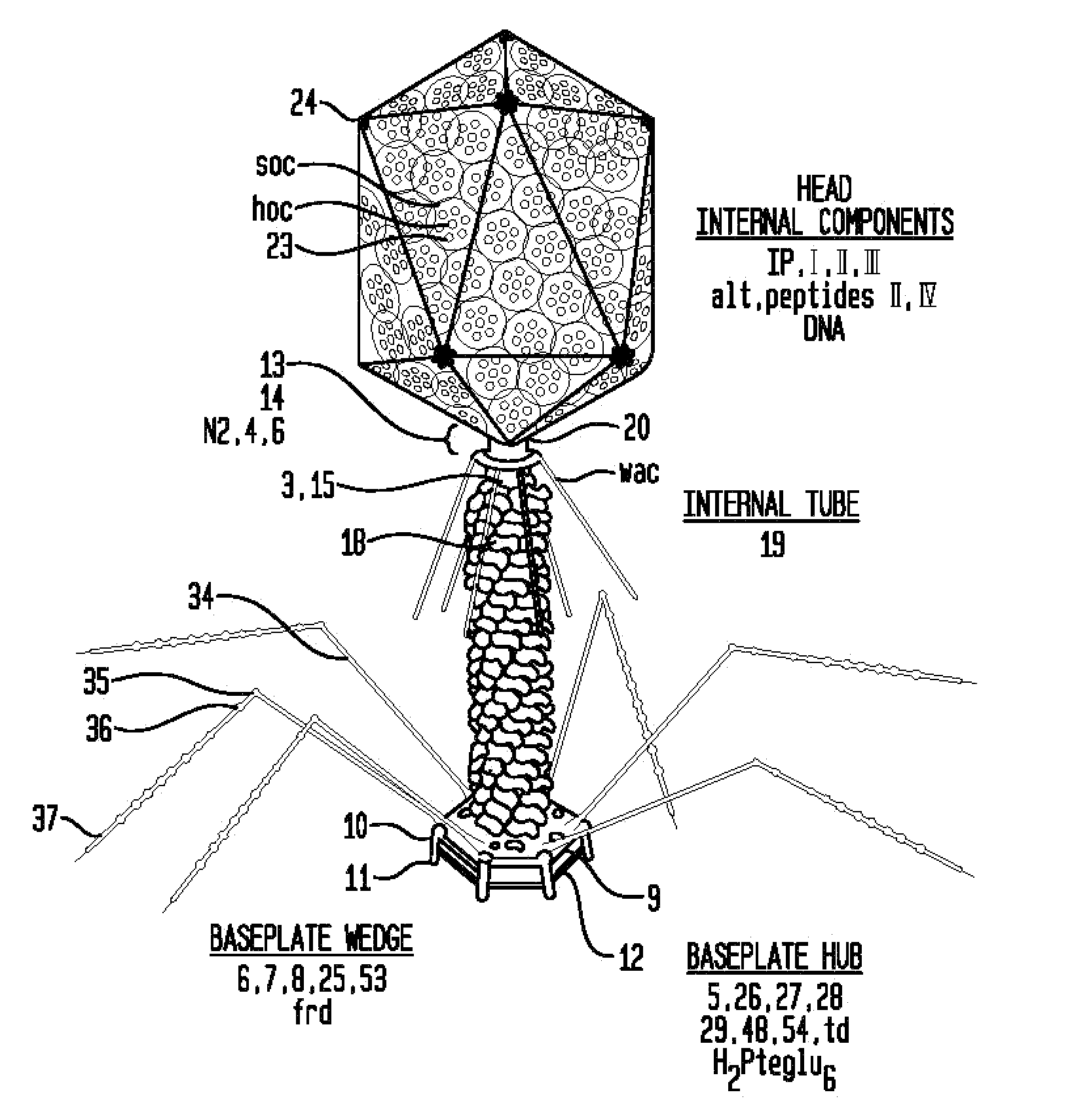
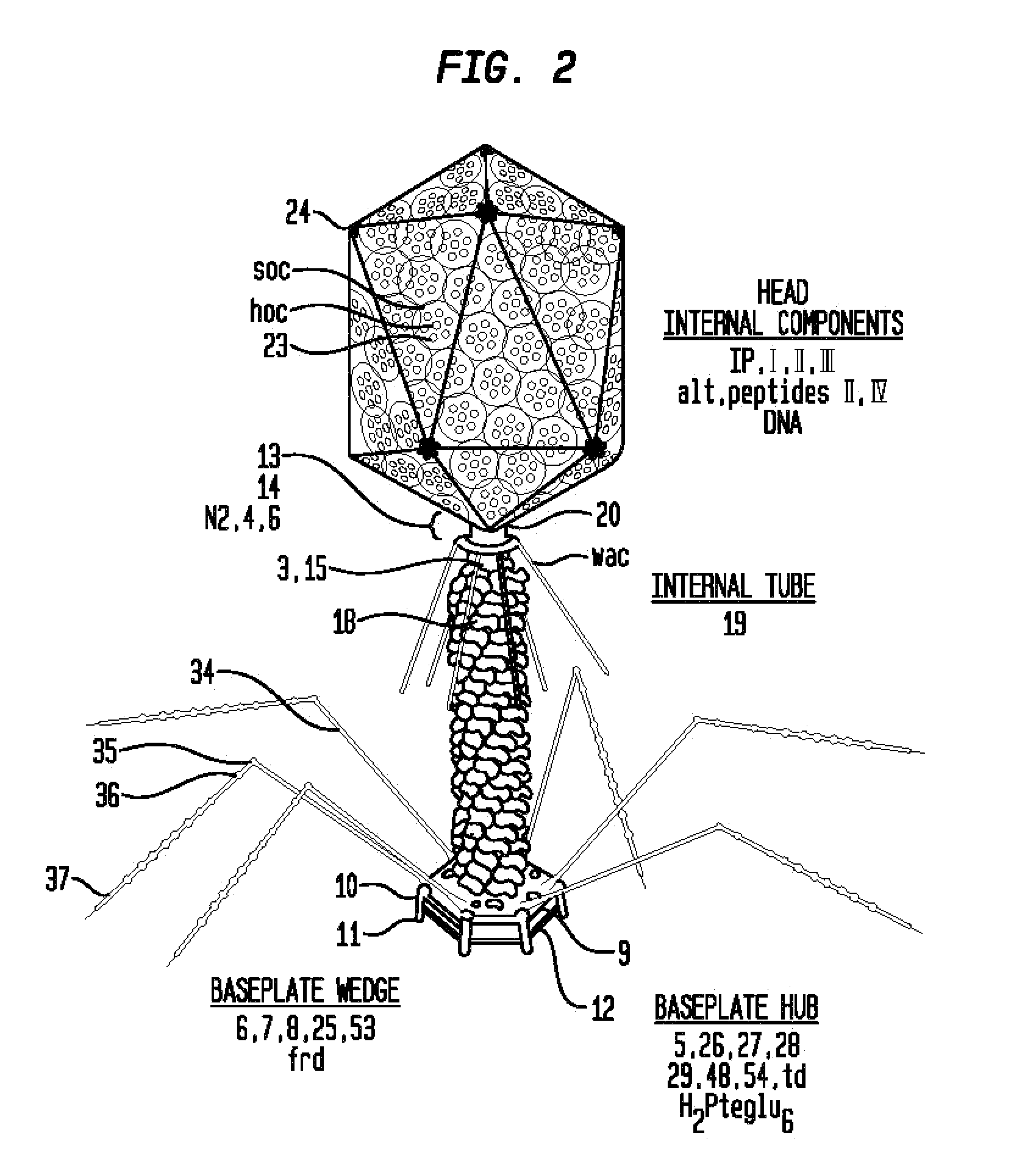
[0115]In one embodiment, a customized T4 bacteriophage of the present invention has the advantage of having a defined copy number of Hoc and Soc binding sites (combined total of about 1025 copies per particle). With such a large number of defined binding sites, the T4 bacteriophages provide a unique nanoplatform upon which it may be possible to customize the display of a specific molecule or multiplicity of molecules. By manipulating the ratios of components in the in vitro assembly reaction (i.e., manipulating the ratio of Hoc and / or Soc fusion proteins to T4 bacteriophage particles) before or during the incubation period described above, the copy number of fusion proteins bound to the T4 bacteriophage can be controlled. Similarly, by using two or more Hoc and / or Soc fusion proteins in the in vitro assembly system and by adjusting the molar ratios of the different fusion proteins to the T4 bacteriophage, it may be possible to control the proportion of fusion proteins bound to the T4 bacteriophage to create a defined T4 bacteriophage. For example, a given T4 bacteriophage may display combinations of the HIV antigens, tat and nef, as well as other fusion proteins. By changing the ratios tat-Hoc and nef-Hoc fusion proteins to phage particles before or during the incubation period, the copy number of proteins displayed on phage will be proportionally altered. The fusion proteins bind to the binding sites independently and no interference or cooperativity between the binding of different proteins has been observed. The methods for controlling the copy number has been described in Li, Q., Shivachandra, S. B., Zhang, Z. and Rao, V. B. Assembly of the Small Outer Capsid protein, Soc, on bacteriophage T4: a novel system for high density display of multiple large anthrax toxins and foreign proteins on phage capsid. J. Mol. Biol., 370:1006-1019 (2007), and Shivachandra, S. B., Li, Q., Peachman, K. K., Matyas, G. R., Leppla S. H., Alving C. R., Rao, M., Rao V. B. Multicomponent anthrax toxin display and delivery using bacteriophage T4. Vaccine, 25:1225-35 (2007).
Problems solved by technology
However, despite their many advantages, liposomes are difficult to manufacture and may have limited commercial potential for many vaccines.
Method used
the structure of the environmentally friendly knitted fabric provided by the present invention; figure 2 Flow chart of the yarn wrapping machine for environmentally friendly knitted fabrics and storage devices; image 3 Is the parameter map of the yarn covering machine
View moreImage
Smart Image Click on the blue labels to locate them in the text.
Smart ImageViewing Examples

Examples
Experimental program
Comparison scheme
Effect test
example 1
[0131]Liposomes containing glucosyl ceramide and bound T4 bacteriophage are made in accordance with one embodiment of the present invention. FIG. 6 is an electron micrograph of the liposomes.
example 2
[0132]Large multilamellar liposomes are made in accordance with one embodiment of the present invention. FIG. 7 is an electron micrograph of one of these liposomes.
example 3
[0133]A T4 bacteriophage is bound to a large multilamellar liposome of Example 2 to form a complex. FIG. 8 is an electron micrograph of the complex.
the structure of the environmentally friendly knitted fabric provided by the present invention; figure 2 Flow chart of the yarn wrapping machine for environmentally friendly knitted fabrics and storage devices; image 3 Is the parameter map of the yarn covering machine
Login to View More PUM
| Property | Measurement | Unit |
|---|---|---|
| Composition | aaaaa | aaaaa |
| Antigenicity | aaaaa | aaaaa |
Login to View More
Abstract
T4 bacteriophages are bound to substrates such as liposomes using a binder.
Description
CROSS-REFERENCE TO RELATED APPLICATIONS[0001]This application claims the priority of U.S. Provisional patent Application No. 60 / 904,168 entitled “Liposome-Bacteriophage Complex As Vaccine Adjuvant;” filed Mar. 1, 2007, the entire disclosure and contents of which is hereby incorporated by reference.GOVERNMENT INTEREST STATEMENT[0002]The United States Government has rights in this invention pursuant to Contract No. U01-AI056443-01 between Walter Reed Army Institute of Research and The Catholic University of America through a Cooperative Research Agreement.STATEMENT OF JOINT RESEARCH AGREEMENT[0003]In compliance with 37 C.F.R. §1.71(g) (1), disclosure is herein made that the claimed invention was made pursuant to a Joint Research Agreement as defined in 35 U.S.C. 103 (c) (3), that was in effect on or before the date the claimed invention was made, and as a result of activities undertaken within the scope of the Joint Research Agreement, by or on the behalf of The Catholic University of...
Claims
the structure of the environmentally friendly knitted fabric provided by the present invention; figure 2 Flow chart of the yarn wrapping machine for environmentally friendly knitted fabrics and storage devices; image 3 Is the parameter map of the yarn covering machine
Login to View More Application Information
Patent Timeline
 Login to View More
 IPC IPC(8): C12N7/01A61K39/00
CPCA61K39/21A61K39/385A61K39/39A61K2039/55555A61K2039/6075C12N2740/16134C07K2319/735C12N2740/16122C12N2795/10122A61K2039/55572C07K14/005A61K39/12
InventorALVING, CARL R.RAO, VENIGALLA
OwnerCATHOLIC UNIV OF AMERICA