Ophthalmologic apparatus

US20090207378A1Inactive Publication Date: 2009-08-20KK TOPCON
5 Cites 15 Cited by

Patent Information

Authority / Receiving Office
US · United States
Current Assignee / Owner
Publication Date
2009-08-20
Estimated Expiration
Not applicable · inactive patent

Smart Images

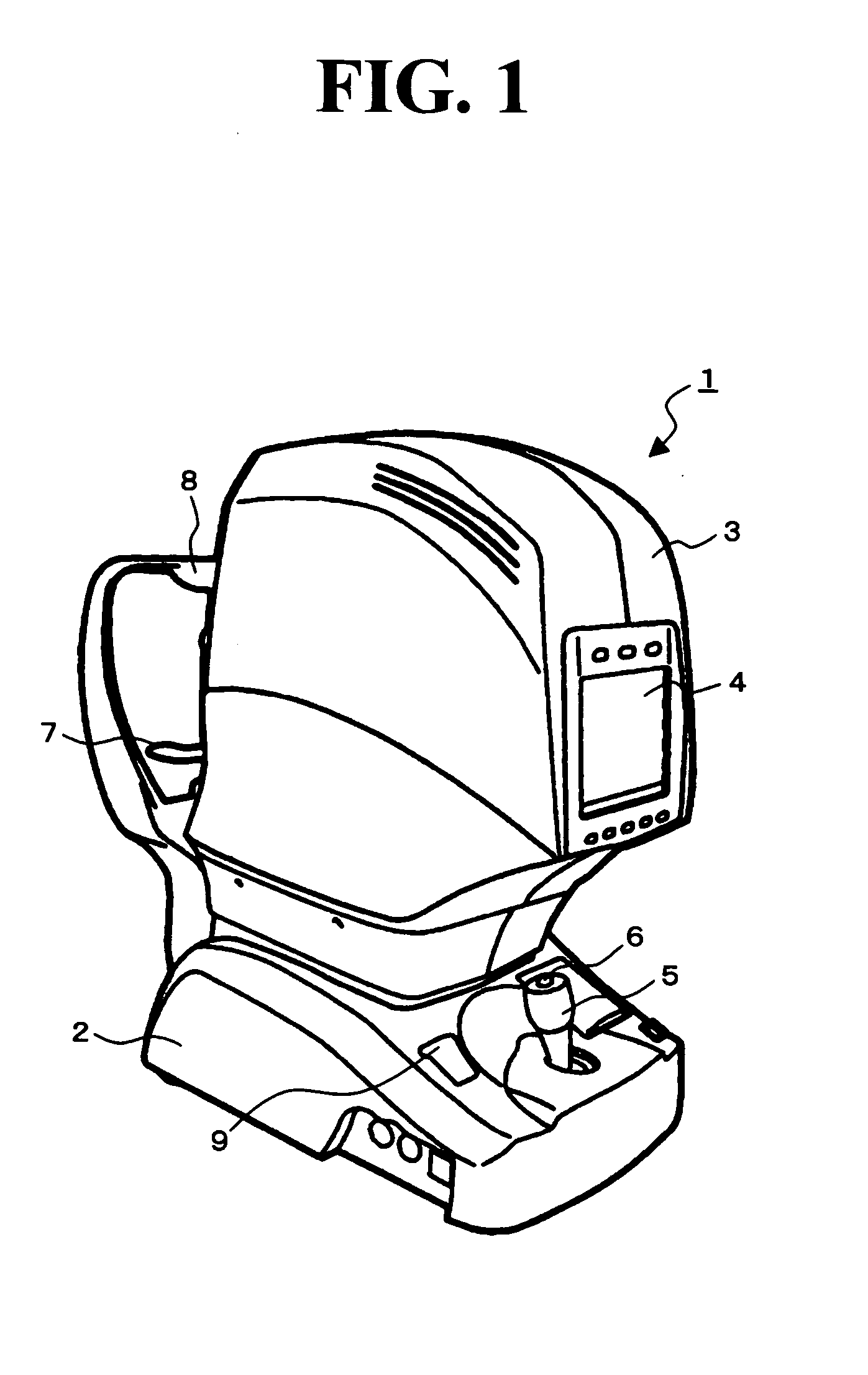
  • Figure 1
    Figure 1
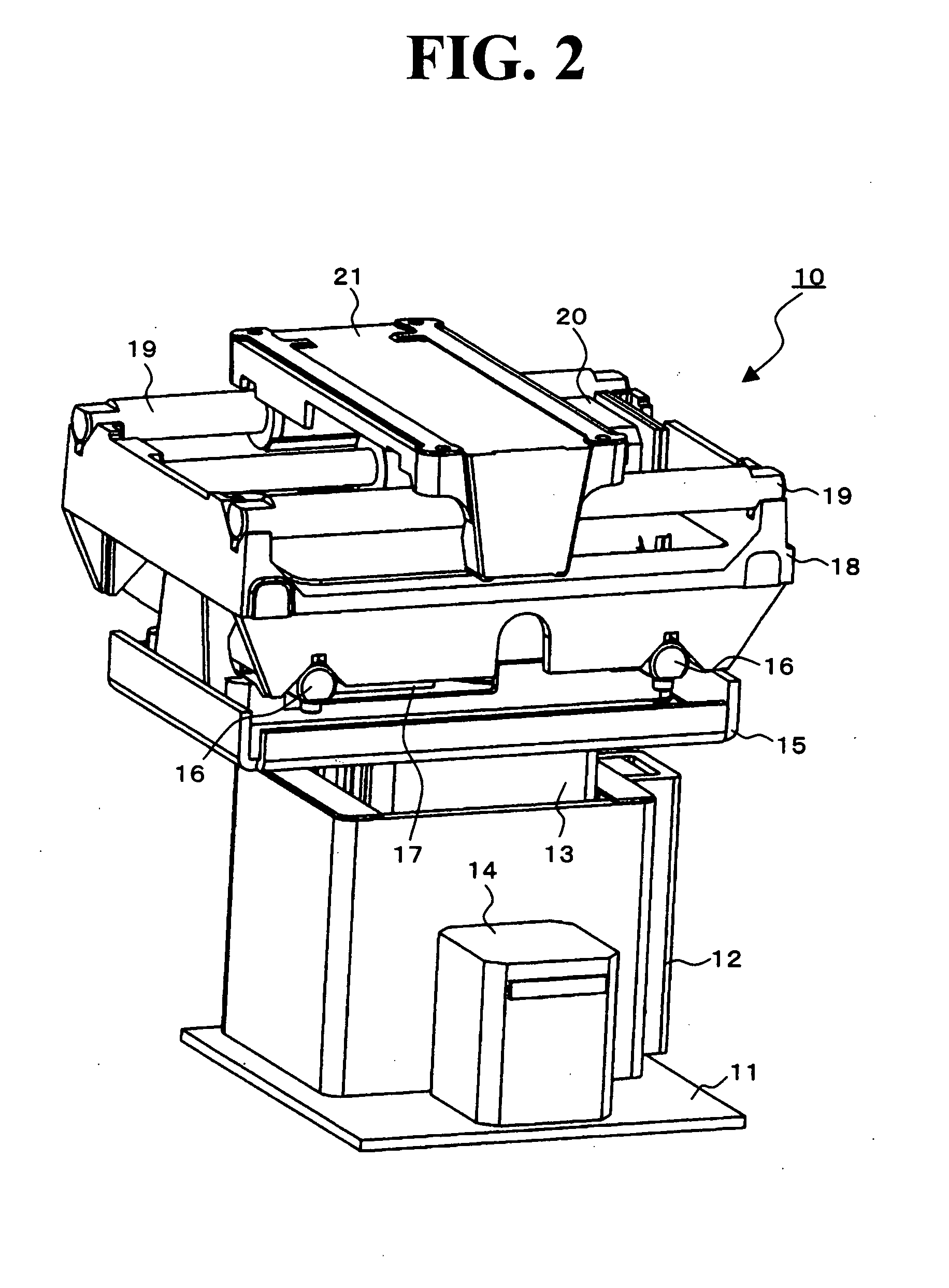
  • Figure 2
    Figure 2
  • Figure 3
    Figure 3
Patent Text Reader

Abstract

An ophthalmologic apparatus has a setting part configured to acquire position information of a first examining part at the time of execution of a first examination and set a movable range of a second examining part in a direction of a second working distance based on the position information and distance information. This ophthalmologic apparatus controls so that an examining unit moves within the movable range set based on the position information of the first examining part and the distance information when an examination by the examining unit is switched from the first examination to a second examination.Accordingly, it is possible to set an accurate movable range with respect to the position of the eye of a subject, and it is also possible to increase safety by preventing the examining part from coming in contact with the subject.
Need to check novelty before this filing date? Find Prior Art

Description

BACKGROUND OF THE INVENTION

[0001] 1. Field of the Invention

[0002] The present invention relates to an ophthalmologic apparatus that executes a plurality of examinations on an eye.

[0003] 2. Description of the Related Art

[0004] As an ophthalmologic apparatus that executes a plurality of examinations on an eye, an apparatus described in Japanese Unexamined Patent Application Publication No. 2007-282671 is known, for example. This ophthalmologic apparatus incorporates a first measuring part (an eye-refractive-power / corneal-shape measuring part) and a second measuring part (a tonometry part). These measuring parts are arranged next to each other in the vertical direction.

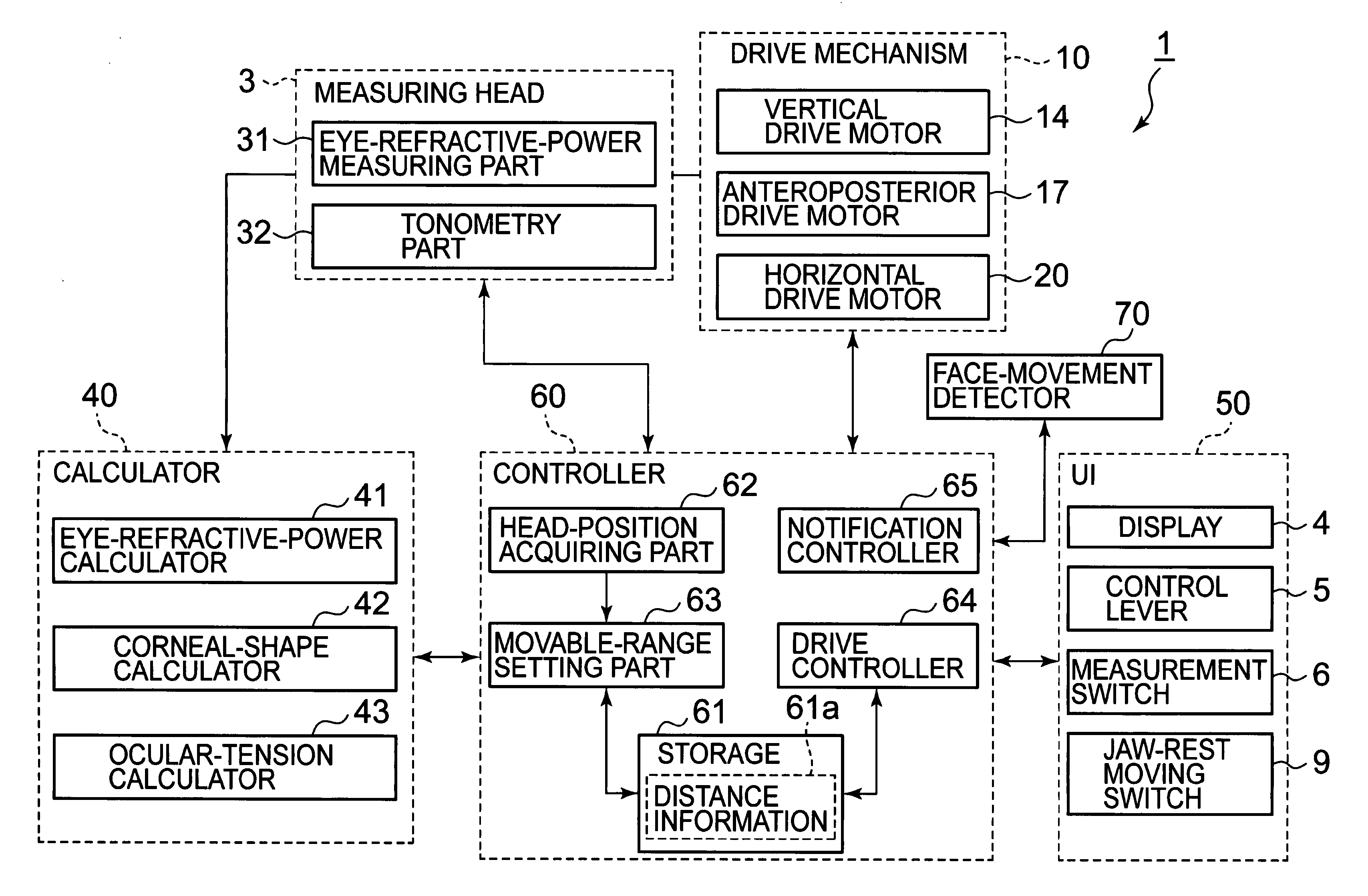
[0005] A working distance in tonometry is generally shorter than a working distance in eye-refractive-power measurement and corneal-shape measurement. For example, the former working distance is set to approximately 11 mm, and the latter working distance is set to approximately 35 mm.

[0006] In tonometry with a rather short wor...

Examples

Embodiment Construction

[0027]An embodiment of an ophthalmologic apparatus according to the present invention will be described in detail with reference to the drawings.

[Configuration]

[0028]FIGS. 1 to 6 show a configuration example of the ophthalmologic apparatus according to the present embodiment. The exterior of an ophthalmologic apparatus 1 is shown in FIG. 1. As in the conventional technique, the ophthalmologic apparatus 1 includes a base 2, a measuring head 3, a display 4, a control lever 5, a measurement switch 6, a jaw rest 7, a forehead rest 8, a jaw-rest moving switch 9, etc.

[0029]A subject puts his / her jaw on the jaw rest 7 and faces the measuring head 3 with his / her forehead contact with the forehead rest 8.

[0030]The jaw rest 7 and / or the forehead rest 8 is an example of a “retaining part” that retains the face of the subject. An operator operates the jaw-rest moving switch 9 to vertically move the jaw rest 7, thereby adjusting the position of the face of the subject. It is also possible to con...