
Method for producing a crunchy food product
a food product and crunchy technology, applied in the field of panning, can solve the problems of difficult to produce baked products which exhibit the desired attributes, many consumer preferences are difficult to achieve, and the selection of baking materials has previously been limited, so as to achieve sufficient adhesiveness, increase the nutritional content of food products, and improve the effect of adhesive qualities
- Summary
- Abstract
- Description
- Claims
- Application Information
AI Technical Summary
Benefits of technology
Problems solved by technology
Method used
Image

Examples
Embodiment Construction
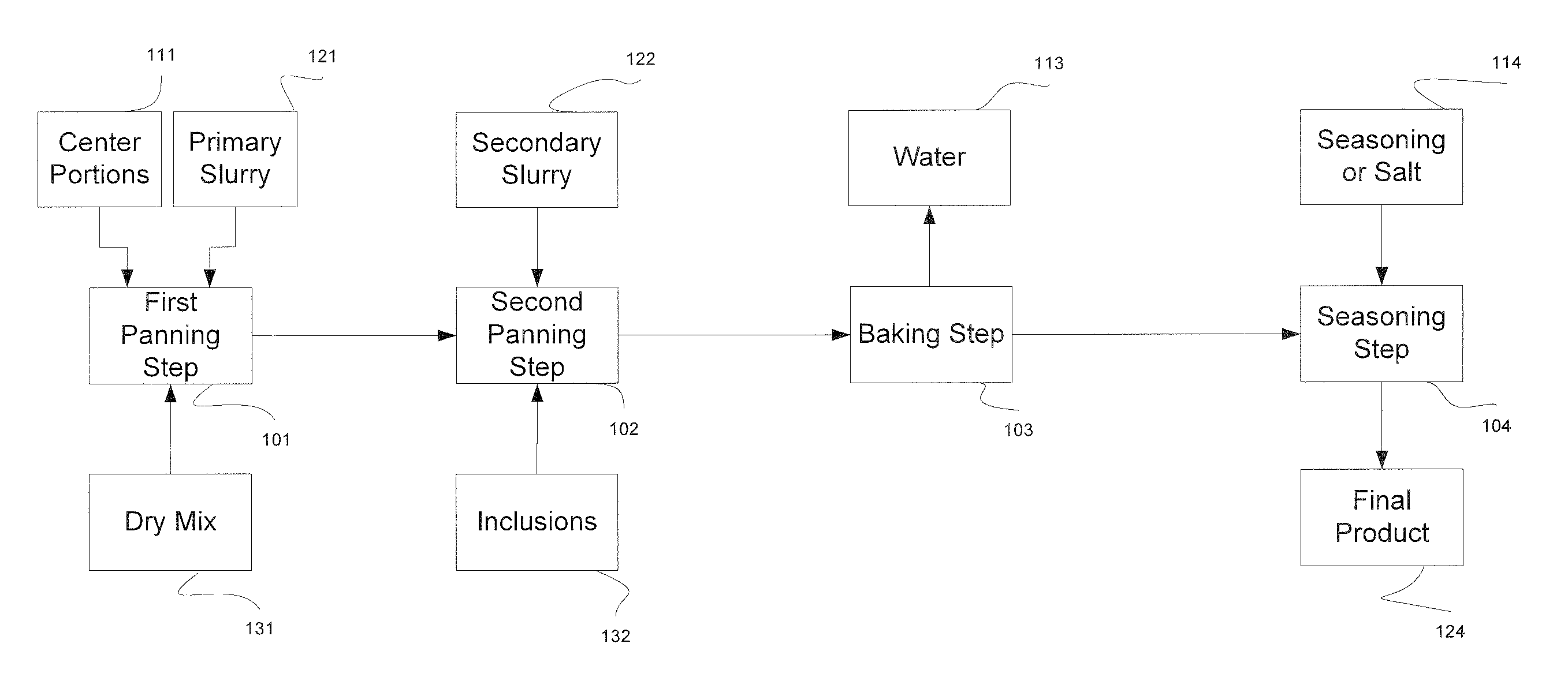
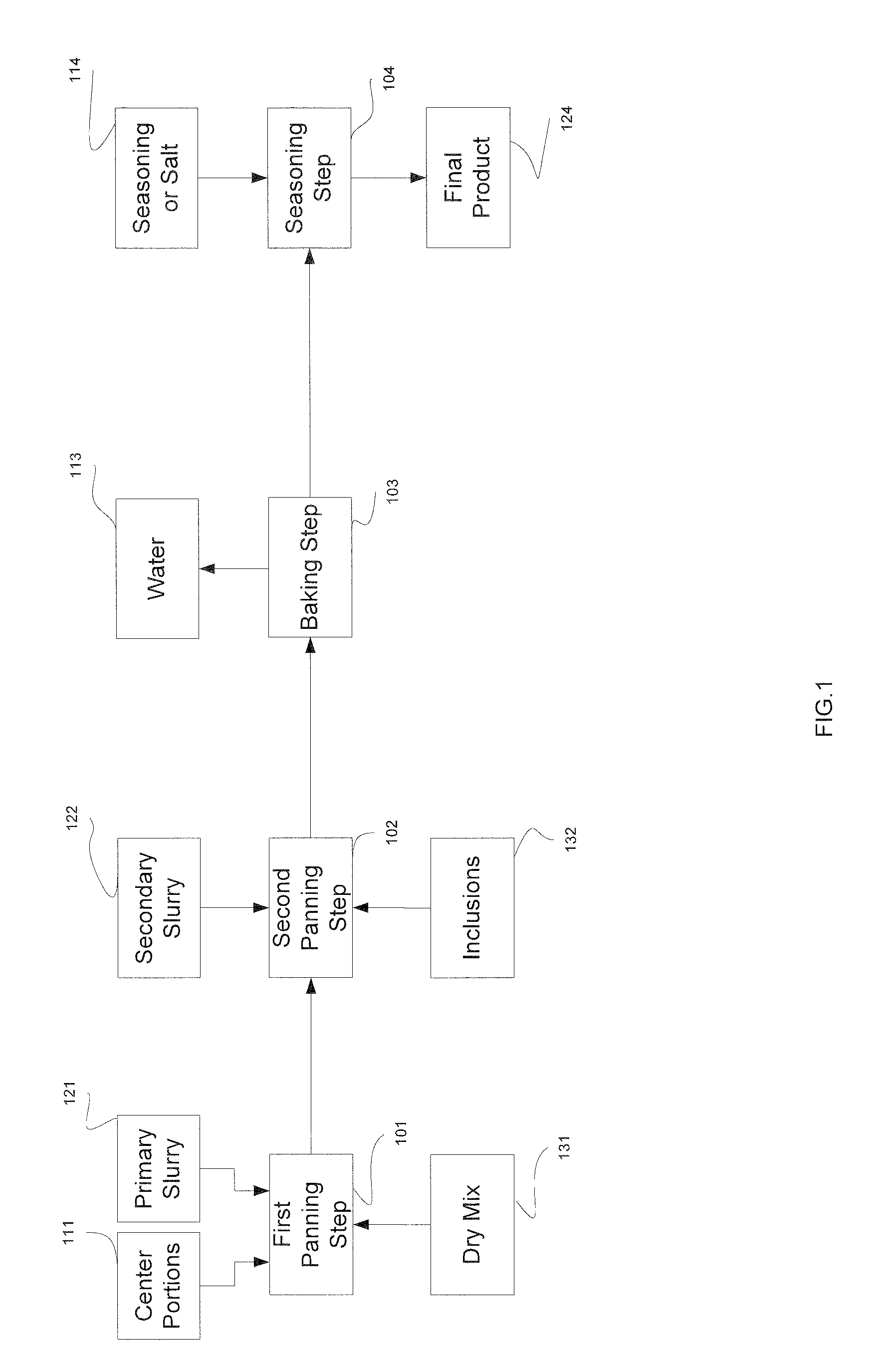
[0017]Several embodiments of Applicants' invention will now be described with reference to FIG. 1. Unless stated otherwise, all percentages are deemed to be weight percentages.
[0018]FIG. 1 depicts a process diagram of one embodiment of the current invention. While FIG. 1 will be discussed as a batch operation, the method disclosed can successfully be performed with a semi-batch or continuous operation as well. The middle horizontal section of FIG. 1 refers to the four processing steps and includes the first panning step 101, the second panning step 102, the baking step 103, and the seasoning step 104. Thus, moving from left to right on FIG. 1 follows the processing of the food product from the first step of panning 101 through the final seasoning step 104. The addition of or removal of an ingredient is shown with vertical arrows. Thus, as shown in the first panning step 101, primary slurry 121, center portion 111, and dry mix 131 are all added during the first panning step. Each of ...
PUM
| Property | Measurement | Unit |
|---|---|---|
| temperatures | aaaaa | aaaaa |
| diameters | aaaaa | aaaaa |
| diameter | aaaaa | aaaaa |
Abstract
Description
Claims
Application Information
 Login to View More