
Method and system for scheduling execution of activities
a scheduling execution and activity technology, applied in the field of methods and systems for scheduling the execution of activities, can solve the problems of not providing an accurate prediction of the duration of a new instance of a job, workload scheduler planning execution of jobs and controlling their running may operate incorrectly, and alarms are raised
- Summary
- Abstract
- Description
- Claims
- Application Information
AI Technical Summary
Problems solved by technology
Method used
Image

Examples
Embodiment Construction
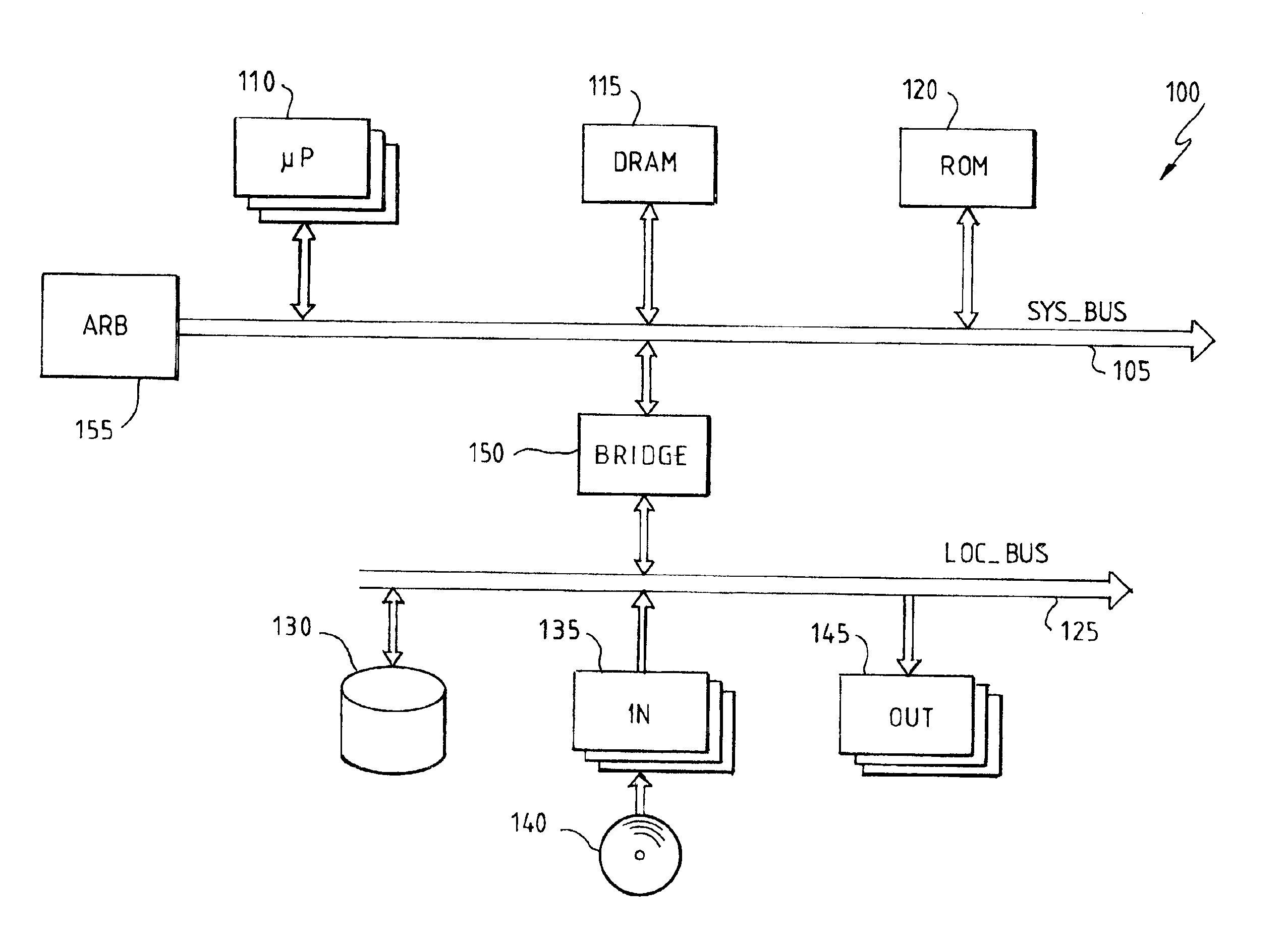
[0014]With reference in particular to FIG. 1, there is shown a data processing system 100, for example a mainframe. The system 100 includes several units, which are connected in parallel to a system bus (SYS_BUS) 105. Particularly, multiple microprocessors (μP) 110 control operation of the system 100. The microprocessors 110 access a shared working memory 115, generally formed by a DRAM with interleaved modules; a read-only memory (ROM) 120 stores a basic program for starting the system 100.
[0015]Various peripheral units are clustered around a local bus (LOC_BUS) 125. More specifically, a bulk memory consists of a hard-disk 130; the system 100 further includes input units (IN) 135, which consist for example of keyboards and drivers for CD-ROMs 140, and output units (OUT) 145, which consist for example of monitors and printers. A bridge unit (BRIDGE) 150 interfaces the system bus 105 with the local bus 125.
[0016]Each microprocessor 105 and the bridge unit 150 can operate as master ag...
PUM
 Login to View More
 Abstract
Description
Claims
Application Information
 Login to View More