
Switched ethernet networks
a technology of ethernet networks and switches, applied in data switching networks, frequency-division multiplexes, instruments, etc., can solve the problems of system not providing qos guarantees qos cannot be guaranteed even for high-priority data, etc., and achieve the effect of effectively deactivating those groups
- Summary
- Abstract
- Description
- Claims
- Application Information
AI Technical Summary
Benefits of technology
Problems solved by technology
Method used
Image

Examples
Embodiment Construction
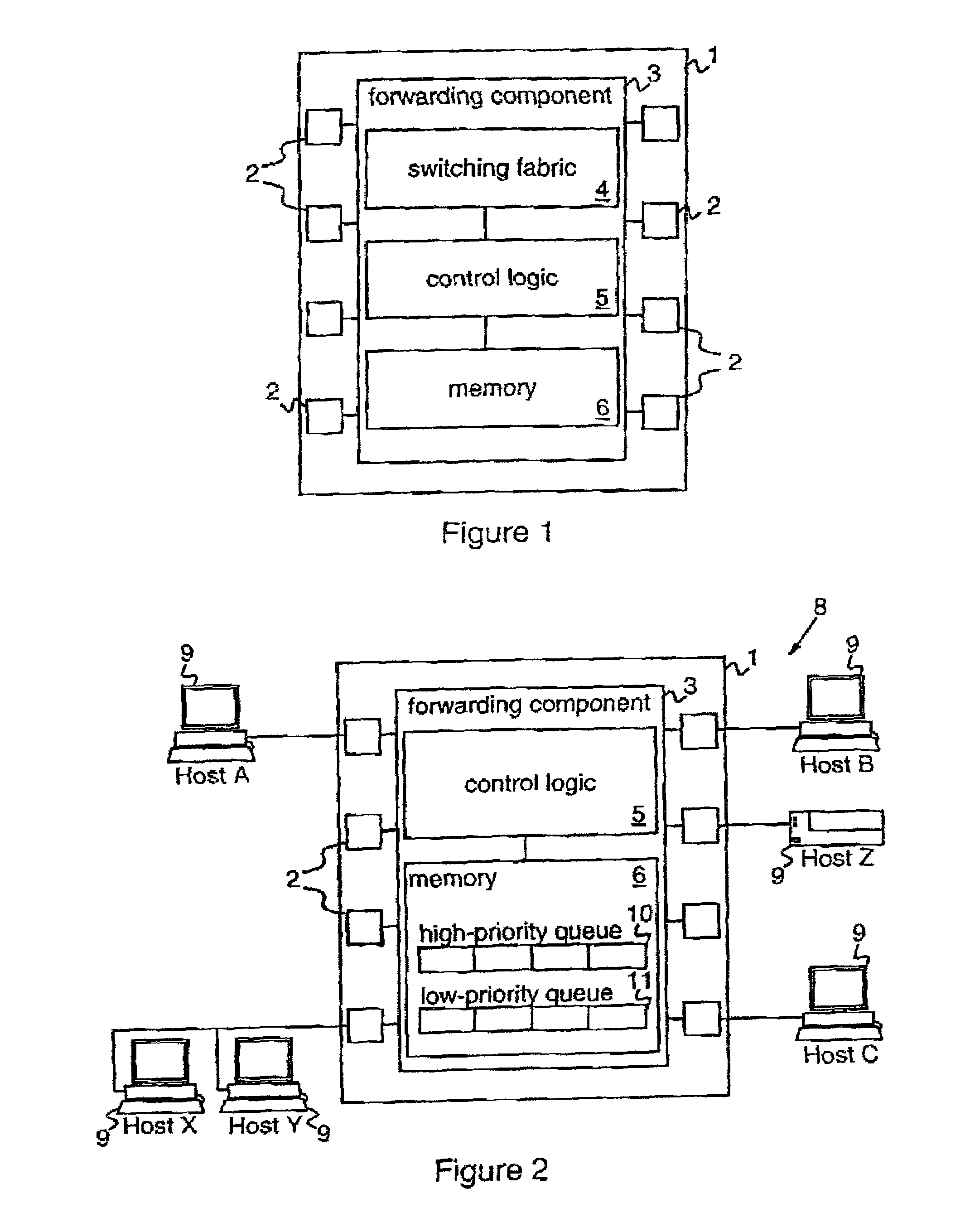
[0035]FIG. 1 is a generalized schematic of an Ethernet switch 1 showing the main elements involved in operation of embodiments of the invention. For the purposes of this description, the switch 1 can be considered to comprises a plurality of ports 2 (eight being shown here) to which LAN segments can be connected in the usual way, and a forwarding component indicated generally at 3. The forwarding component 3 serves to forward data received at a switch port 2 across the switch onto the requires LAN segment via the appropriate outbound port 2. The forwarding component 3 is illustrated here as comprising switching fabric 4, control logic 5 and memory 6. The switching fabric 4 here comprises switching circuitry providing the physical mechanism via which data is transmitted across the switch, typically a shared bus or switching-matrix structure of known form. The control logic 5 controls operation of the forwarding component generally, and performs the functions described in detail below...
PUM
 Login to View More
 Abstract
Description
Claims
Application Information
 Login to View More