
Golf club head with alignment system
a technology of alignment system and club head, which is applied in the field of golf club head, can solve the problems of reducing the moi, reducing the control, and reducing the control, so as to enhance the control, increase the moi, and improve the control
- Summary
- Abstract
- Description
- Claims
- Application Information
AI Technical Summary
Benefits of technology
Problems solved by technology
Method used
Image

Examples
Embodiment Construction
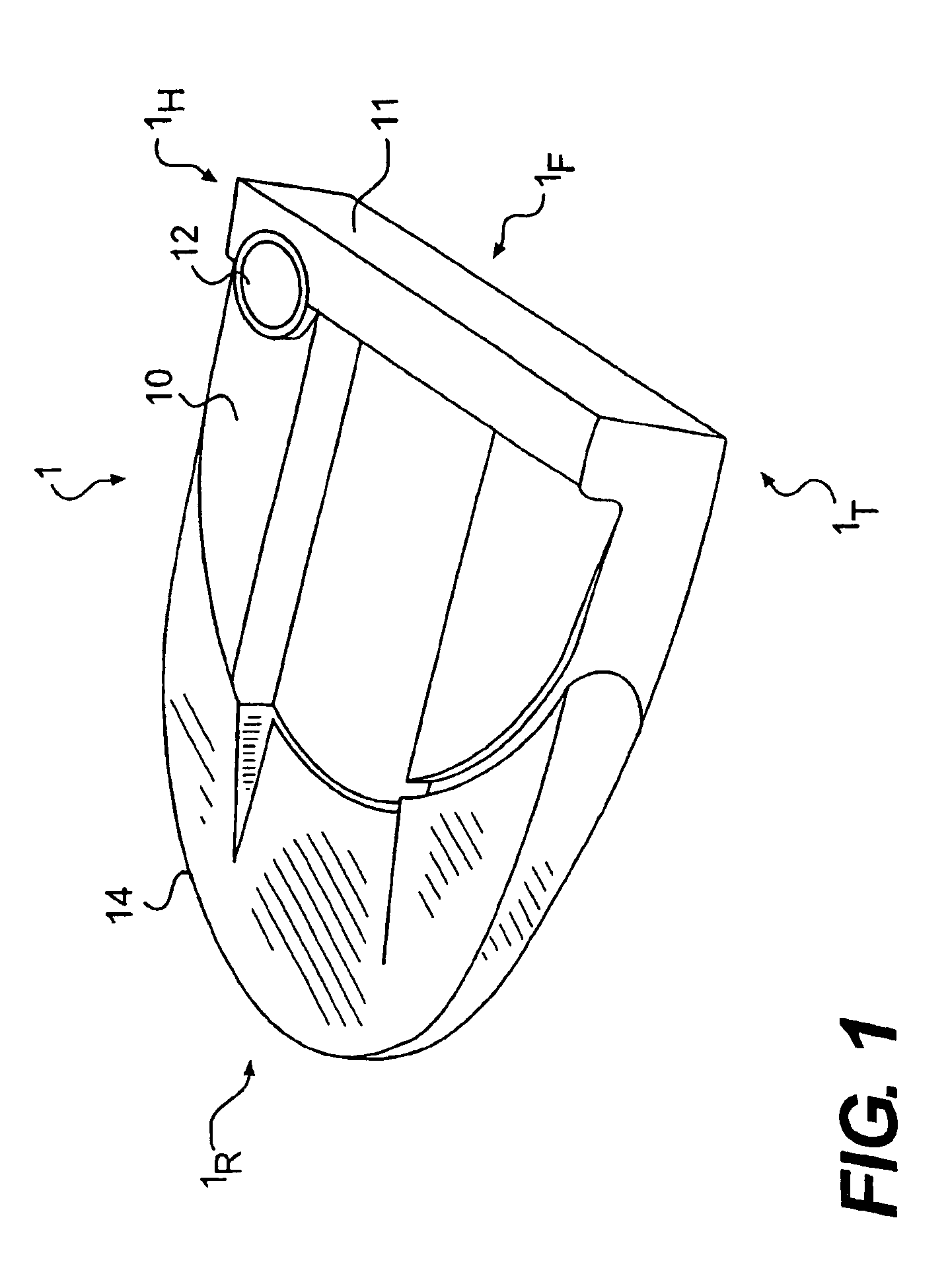
[0035]FIG. 1 shows a top view of a golf club head 1 of the present invention. The illustrated golf club is a putter. Club head 1 includes a first body member 10 and a second body member 14. First body member 10 includes a strike face 11 that contacts a golf ball during normal use. Strike face 11 may be integral with first body member 10. Alternatively, strike face 11 may be independent of and coupled to first body member 10. Preferred means of coupling include use of an adhesive, brazing, and welding. Other coupling means, such as mechanical fasteners, may also be used. Furthermore, a combination of these coupling modes could be used. First body member 10 contains a bore 12 for connecting a shaft thereto. Club head 1 has a heel 1H, a toe 1T, a face 1F, and a rear 1R.
[0036]Second body member 14 extends away from a rearward portion of first body member 10. Second body member 14 is preferably integral with first body member 10. Alternatively, second body member 14 may be independent of...
PUM
 Login to View More
 Abstract
Description
Claims
Application Information
 Login to View More