Use of S-nitrosothiol signaling to treat disordered control of breathing

a technology of s-nitrosothiol and signaling, which is applied in the direction of nitro compound active ingredients, drug compositions, peptide/protein ingredients, etc., can solve the abnormality of central control of ventilation, contribute to respiratory distress in newborn mammals and sleep apnea, and fail to breathe more often when oxygen levels are low, so as to increase the minute ventilation

US7432301B2Inactive Publication Date: 2008-10-07VIRGINIA UNIV OF PATENT FOUND +1
15 Cites 21 Cited by

Patent Information

Authority / Receiving Office
US · United States
Patent Type
Patents(United States)
Current Assignee / Owner
Publication Date
2008-10-07
Estimated Expiration
Not applicable · inactive patent

Smart Images

  • Figure 1
    Figure 1
  • Figure 2
    Figure 2
Patent Text Reader

Abstract

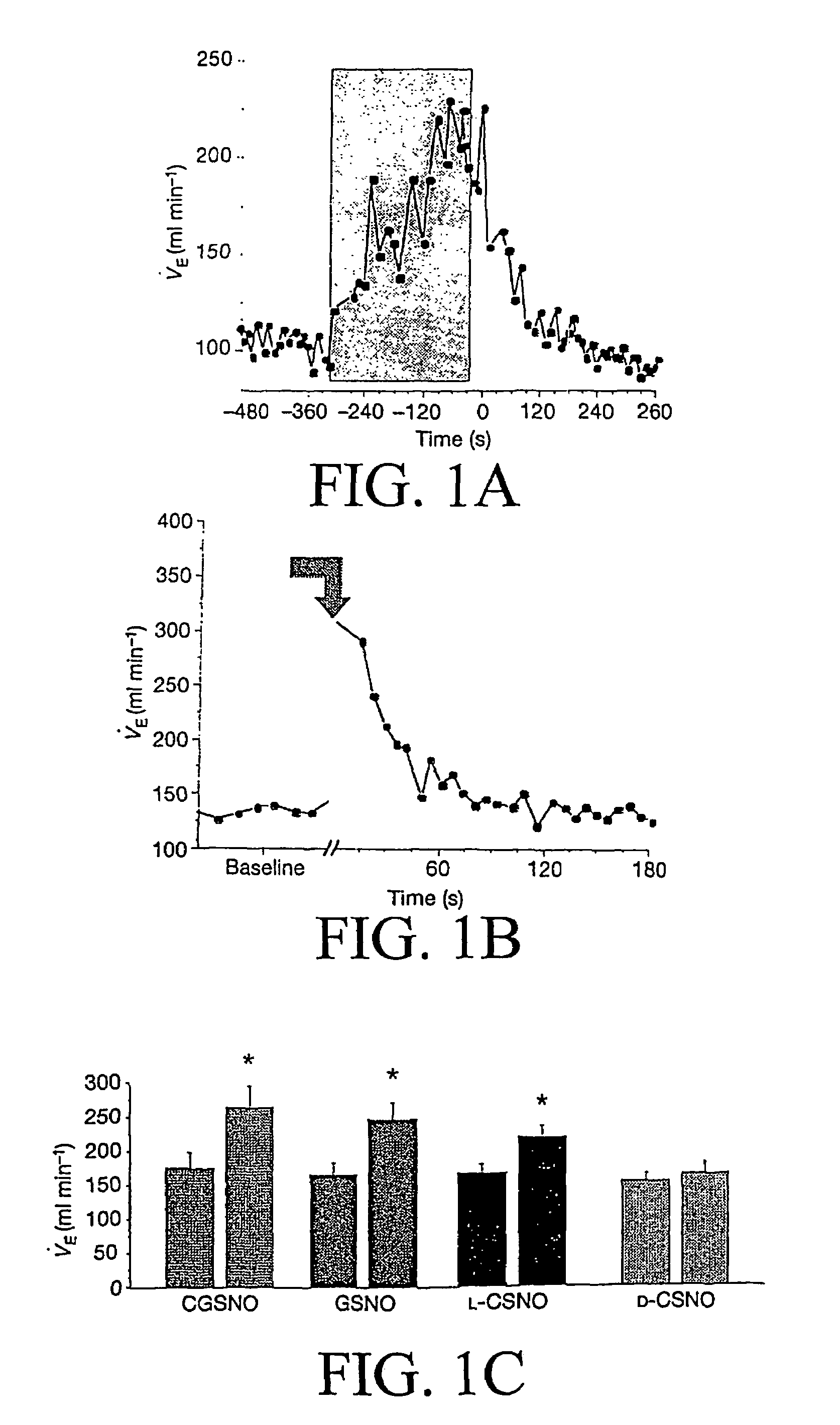
The present invention is directed to a method of treating disordered control of breathing including the treatment of apnea and hypoventilation associated with congenital or acquired brain stem abnormalities. Specifically the invention is directed to treating disordered control of breathing by administering an S-nitrosylating agent selected from the group consisting of ethyl nitrite, glutathione, nitric oxide, S-nitrosocysteine, S-nitrosoglutathione, S-nitro-N-acetyl cysteine. As shown in FIG. 1C the ability of endogenous SNOg to increase VE in freely behaving, conscious rates using whole-body plethysmography revealed that CSNO, GSNO and CGSNO (1 nmol each) caused equivalent increases in VE, whereas D-CSNO had no effect (left bar graph is the equivalent increases in VE, whereas D-CSNO had no effect (left bar graph is the control whereas the right bar represents administration of the respective SNO).
Need to check novelty before this filing date? Find Prior Art

Description

RELATED APPLICATION

[0001] This application is a national stage filing of International Application No. PCT / US02 / 25199, filed Aug. 12, 2002, which claims priority under 35 U.S.C. §119(e) to U.S. Provisional Patent Application No. 60 / 313,548, filed Aug. 20, 2001, the disclosure of which is incorporated herein by reference in its entirety.US GOVERNMENT RIGHTS

[0002] This invention was made with United States Government support under Grant Nos. HL 59337, awarded by the National Institutes of Health. The United States Government has certain rights in the invention.FIELD OF THE INVENTION

[0003] The present invention is directed to compositions and methods for treating disordered control of breathing. More particularly, the present invention is directed to the use of S-nitrosothiols or other S-nitrosylating agents to enhance ventilation in patients suffering from a congenital or acquired brain stem abnormality.BACKGROUND OF THE INVENTION

[0004] The ability to increase minute ventilation (VE=respi...

Examples

example 1

SNOs stimulate respiratory centers of the NTS to increase VE.

[0034]To test the hypothesis that SNOs stimulate respiratory centers of the NTS to increase VE, the ability of endogenous SNOs to increase VE in freely behaving, conscious rats using whole-body plethysmography was examined. CSNO, GSNO and CGSNO (1 nmol each) caused equivalent increases in VE, whereas D-CSNO had no effect (see FIG. 1; dose threshold for L-SNOs is 0.1 pmol). The exogenous NO donor, S-nitroso-N-acetyl-L-penicillamine, had similar but reduced effects (not shown). The L- and D-isomers of CSNO decayed at identical rates in rat brainstem homogenates (26% min-1 mg -1 protein each; P=not significant (NS)). Furthermore, neither excess 8-bromocyclic GMP nor glutathione had any effect on VE (n=3;P=NS).

[0035]Next, a low-mass fraction (less than a relative molecular mass of 10,000 (Mr 10K)) derived from deoxygenated blood was studied to determine whether the fraction would similarly increase VE. This fraction reproduced...