
Mammalian cell lines for increasing longevity and protein yield from a cell culture
a cell culture and protein technology, applied in the field of mammalian cell lines for increasing longevity and protein yield from a cell culture, can solve the problems of unpredictable approaches and reduce the lifespan of the cells in culture, and achieve the effects of increasing longevity and/or recombinant protein yield, promoting cell survival, and increasing cell lifespan and viability
- Summary
- Abstract
- Description
- Claims
- Application Information
AI Technical Summary
Benefits of technology
Problems solved by technology
Method used
Image

Examples
example 1
Generation of Apoptosis-Resistance Cell Clones by Stable Expression of HPV-16 E6 and E7 Genes
[0082]Selection of Cell Clones Resistant to CHX Treatment
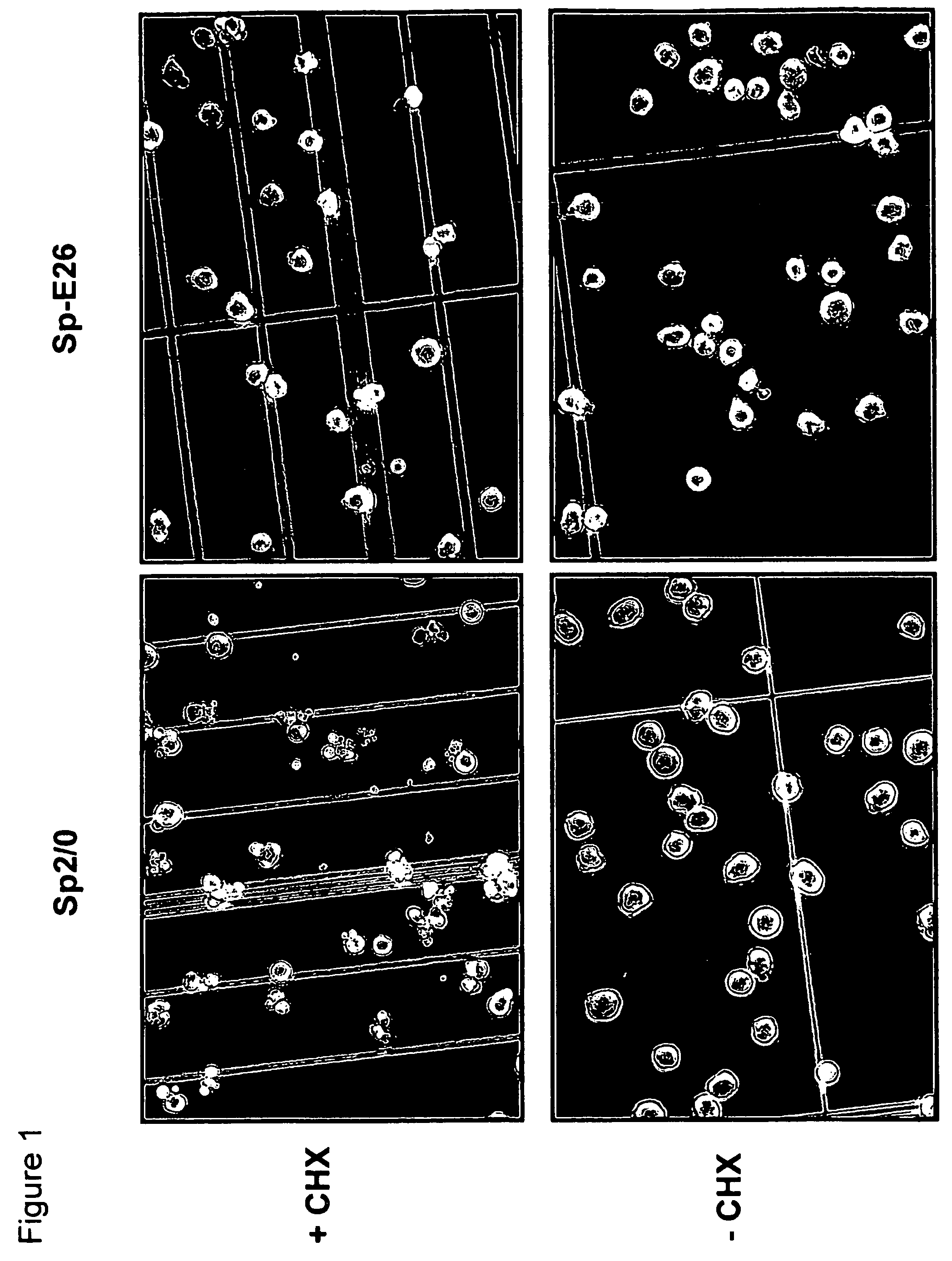
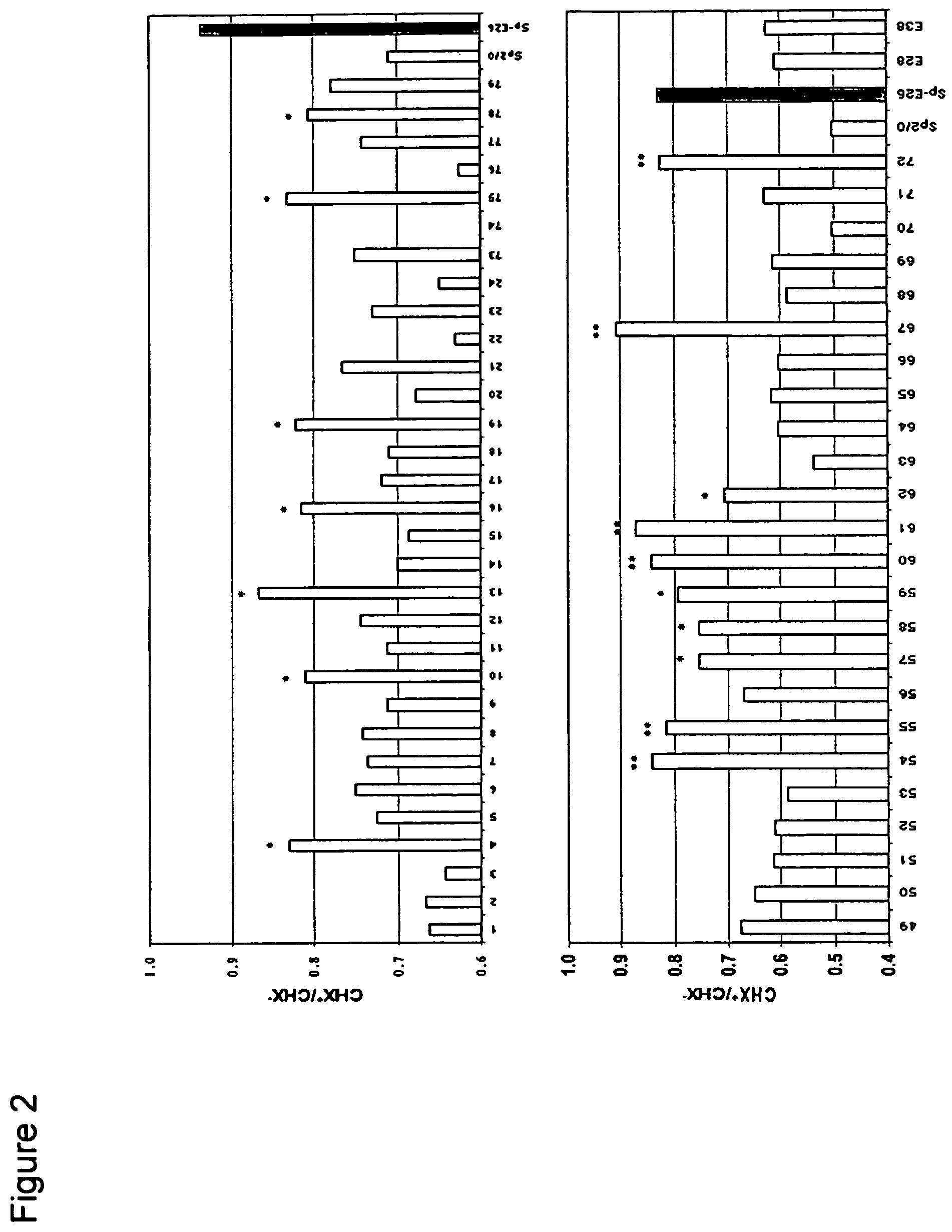
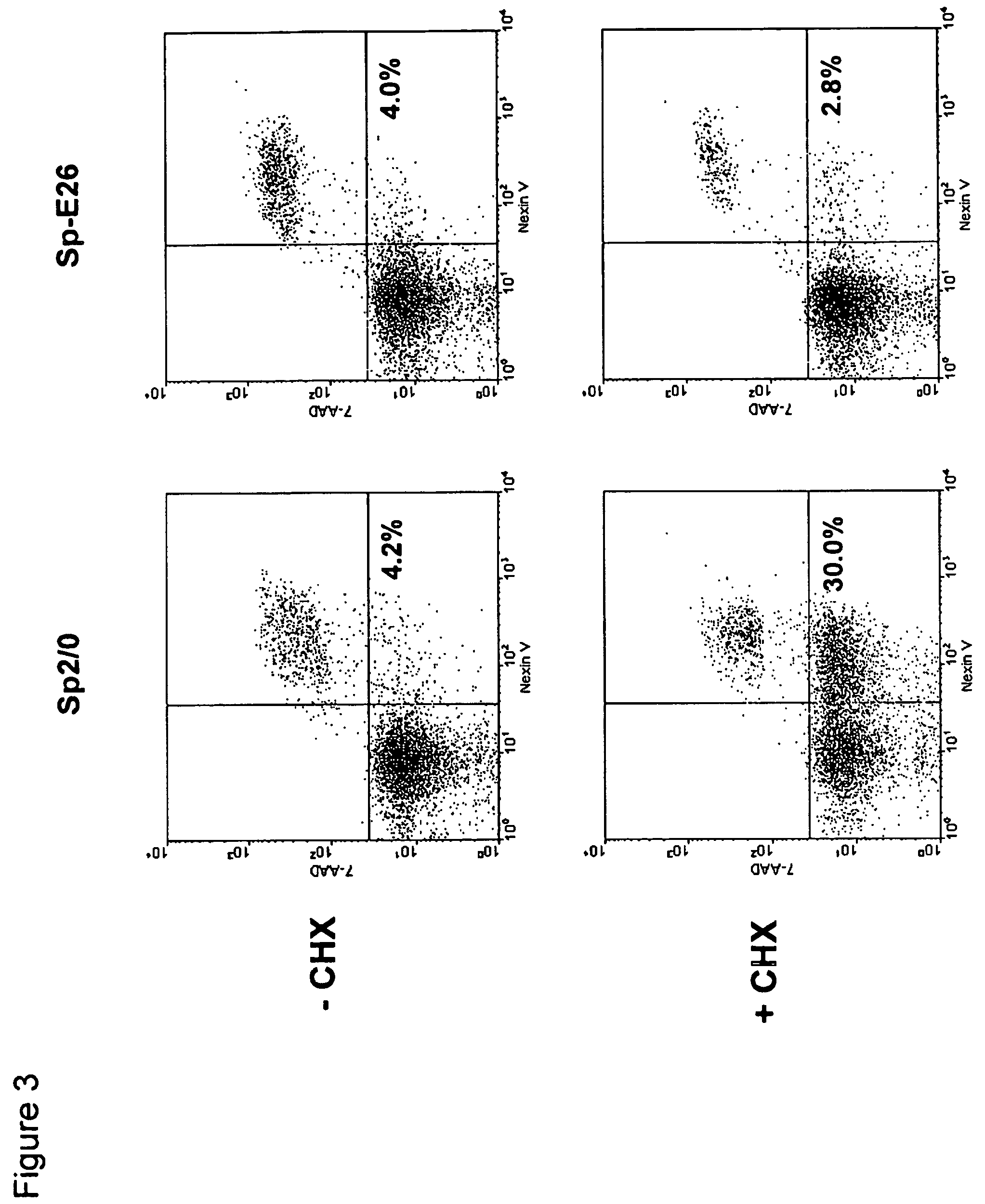
[0083]Sp2 / 0 cells were transduced with an LXSN retroviral vector containing the expression cassette of HPV-16 E6 and E7 genes at an MOI (multiple of infection) of 10:1. After recovery for 24 h, the infected cells were selected in G418 (1000 μg / ml) for 10 days. G418-resistant cells were cloned in 96-well cell culture plates by limiting dilution (0.5 cells / well). Stable infectants were screened for resistance to treatment by cycloheximide (CHX), a potent apoptosis-inducing agent. Briefly, healthy cells (viability>95%, FIGS. 1C and D) were incubated in medium containing 25 μg / ml of CHX and cell morphology was examined under a microscope. While more than 50% of parent Sp2 / 0 cells underwent morphology change after two to three hours of incubation and became fragmented (FIG. 1A), several E6 / E7 transfected clones showed less extent of morphol...
example 2
Generation of Apoptosis-Resistance Cell Clones by Stable Over-Expression of HPV16 E7 Gene
[0092]The structure of the poly-cistronic HPV 16 E6 and E7 genes integrated into the genome of clone Sp-E26 was analyzed by PCR using the primer pair E6-N8+ (ATGTTTCAGGACCCACAGGAGCGA; SEQ ID NO: 8) and E7-C8− (TTATGGTTTCTGAGA ACAGATGGG; SEQ ID NO: 9) and DNA sequencing. Since the sequences of primer E6-N8+ and E7-C8− match with the coding sequence for the N-terminal 8 amino acid residues of E6 and the complementary sequence for the C-terminal 8 codons of E7, respectively, the amplicon of full-length E6 and E7 is expected to be about 850 bp. However, amplification of the genomic DNA prepared from Sp-E26 cell with E6-N8+ and E7-C8− resulted a PCR fragment of only about 700 bp. DNA sequencing of the 700 bp PCR product revealed a deletion of a 182 poly-nucleotide fragment from the E6 gene. The defective E6 gene likely resulted from splicing and encodes a truncated E6 peptide with N-terminal 43 amino...
example 3
High-Level Expression of hLL2 IgG in Sp-E26
[0102]In this example, Sp-E26 is used as a host to generate cell clones producing hLL2, a humanized anti-CD22 Ab developed for treating patients with NHL and autoimmune diseases. An hLL2-producing clone, 87-2-C9, was previously generated by using Sp2 / 0 cell as a host (Losman et al., Cancer 80, 2660-2666, 1997), in which case, only one positive clone (a frequency of about 2.5×10⁻⁷) was identified after transfection, and the maximum productivity (Pmax), defined as the concentration of the antibody in conditioned terminal culture medium in T-flask, of the only hLL2-producing clone, before amplification, was 1.4 mg / L. Transfection of Sp-E26 cell with the same hLL2pdHL2 vector and by using similar procedures as described by Losman et al. (Cancer 80, 2660-2666, 1997) resulted in more than 200 stable hLL2-producing clones, a frequency of >10−4). The Pmax of 12 randomly selected clones was evaluated and found to be between 13 and 170 mg / L, with a m...
PUM
| Property | Measurement | Unit |
|---|---|---|
| concentration | aaaaa | aaaaa |
| density | aaaaa | aaaaa |
| cell density | aaaaa | aaaaa |
Abstract
Description
Claims
Application Information
 Login to View More