System and method for obscuring bit-wise and two's complement integer computations in software

a technology of bitwise and two's complement, applied in the software field, can solve the problems preventing hackers from trying to attack, and obscuring the analysis of software for unauthorized purposes, etc., and achieve the effect of obscuring the true nature of the original operation

US7966499B2Active Publication Date: 2011-06-21IRDETO ACCESS +1
7 Cites 32 Cited by

Patent Information

Authority / Receiving Office
US · United States
Patent Type
Patents(United States)
Current Assignee / Owner
Publication Date
2011-06-21

Smart Images

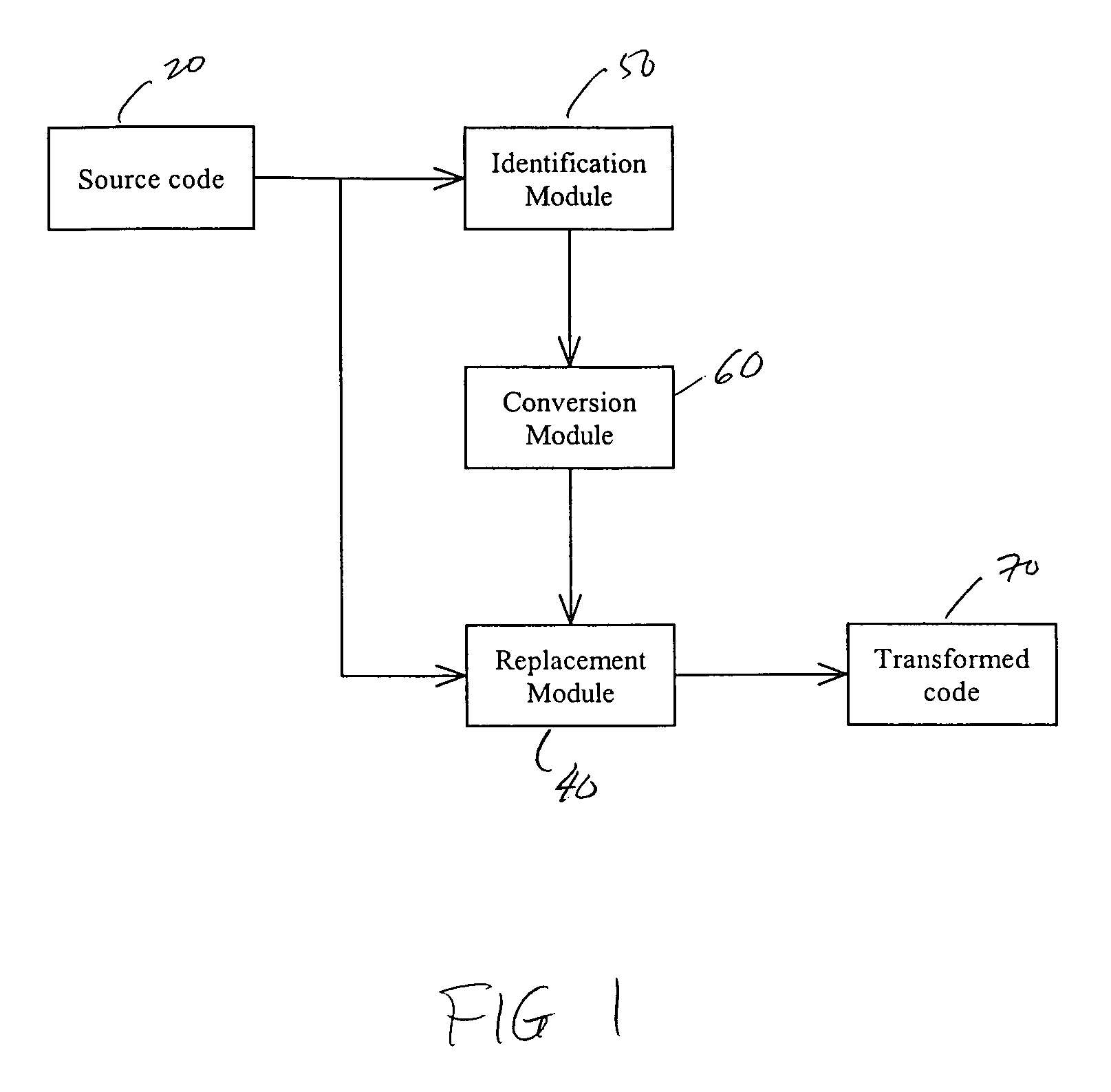
  • Figure 1
    Figure 1
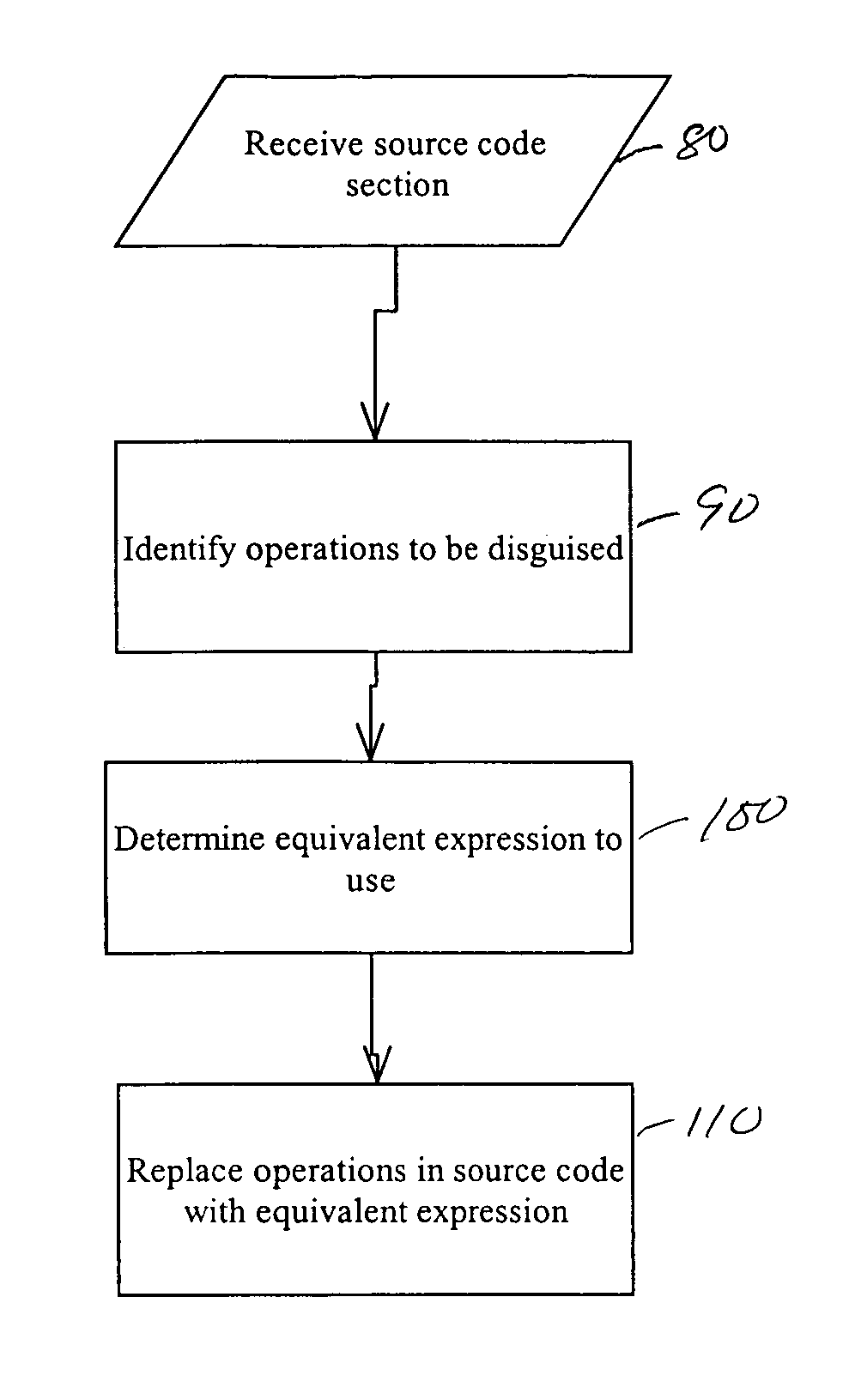
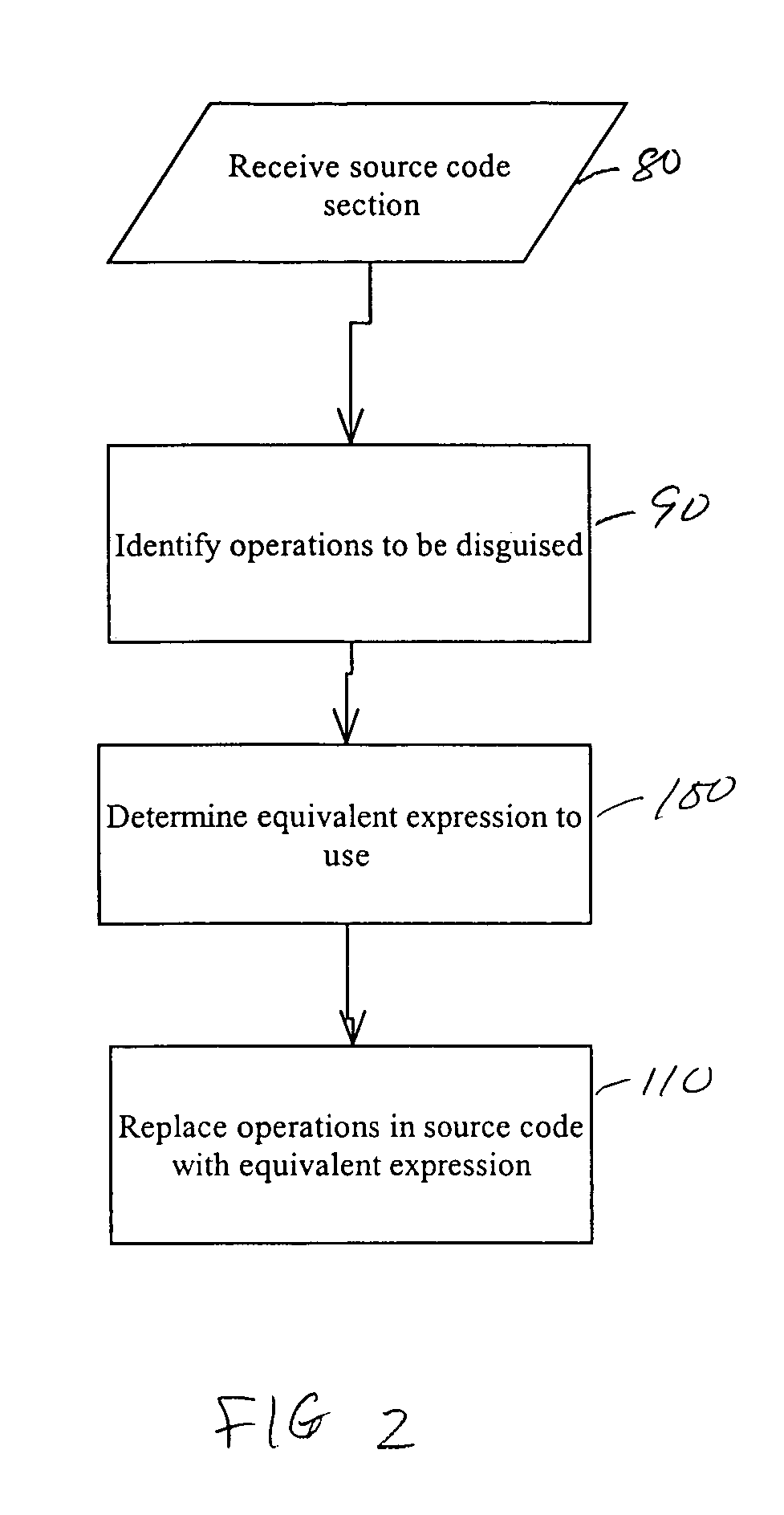
  • Figure 2
    Figure 2
  • Figure 3
    Figure 3
Patent Text Reader

Abstract

Systems and methods related to concealing mathematical and logical operations in software. Mathematical and logical operations are disguised by replacing them with logically equivalent expressions. Each equivalent expression has at least two expression constants whose values are based on scaling and bias constants assigned to variables in the original mathematical or logical operation. Each of the expression constants may also be based on additive or multiplicative inverses modulo n of the scaling and bias constants. By replacing the original operations with more complex but logically equivalent expressions containing variables that also involve more operations, the true nature of the original operations is disguised.
Need to check novelty before this filing date? Find Prior Art

Description

FIELD OF THE INVENTION

[0001] The present invention relates to software that is resistant to unauthorized analysis. More specifically, the present invention relates to methods and systems for the production of software code that disguises operations such that analysis of the code either during run-time or during an attempt of reverse engineering is made more difficult.BACKGROUND TO THE INVENTION

[0002] Software analysis for unauthorized purposes is old. Since the personal computer came of age, and perhaps even before that time, hackers and crackers have been analyzing software to subvert the software writer's goals. In one well-known scenario, dynamic software tracing (tracing the logic flow of a program as the program executes) has been used to determine which values or registers need to be adjusted to allow full functioning of a program. Patches or hacks (small and usually unauthorized programs designed to work with only one specific application) are then written to ensure that those ...

Examples

Embodiment Construction

[0029]The invention makes use of linear transformations to disguise or “hide” the original intent of a arithmetic, logical, or bitwise operation. A linear transformation substitutes a more complex expression for a simple one. As an example, a variable x can be disguised by assigning x′=sxx+bx with sx being a random scaling factor and bx being a random bias factor. The variable x, instead of being a simple variable, now becomes

[0030]x=x′-bxsx.

[0031]To illustrate how linear transformations may be used to disguise arithmetic, logical, or bitwise operations, an example will be given. We can assume z=x*y. If we assign random scaling and bias factors to each of the variables x, y, and z, such that

x′=sxx+bx

y′=syy+by

z′=szz+bz

then

[0032]x=x′-bxsx,y=y′-bysy.

This is done by isolating the variable x and y from its linear transforms. All scaling factors (sx, sy, and sz) and bias factors (bx, by, and bz) are assumed to be randomly selected by the user.

[0033]Since z′=szz+bz and z=x*y, then z′=sz...