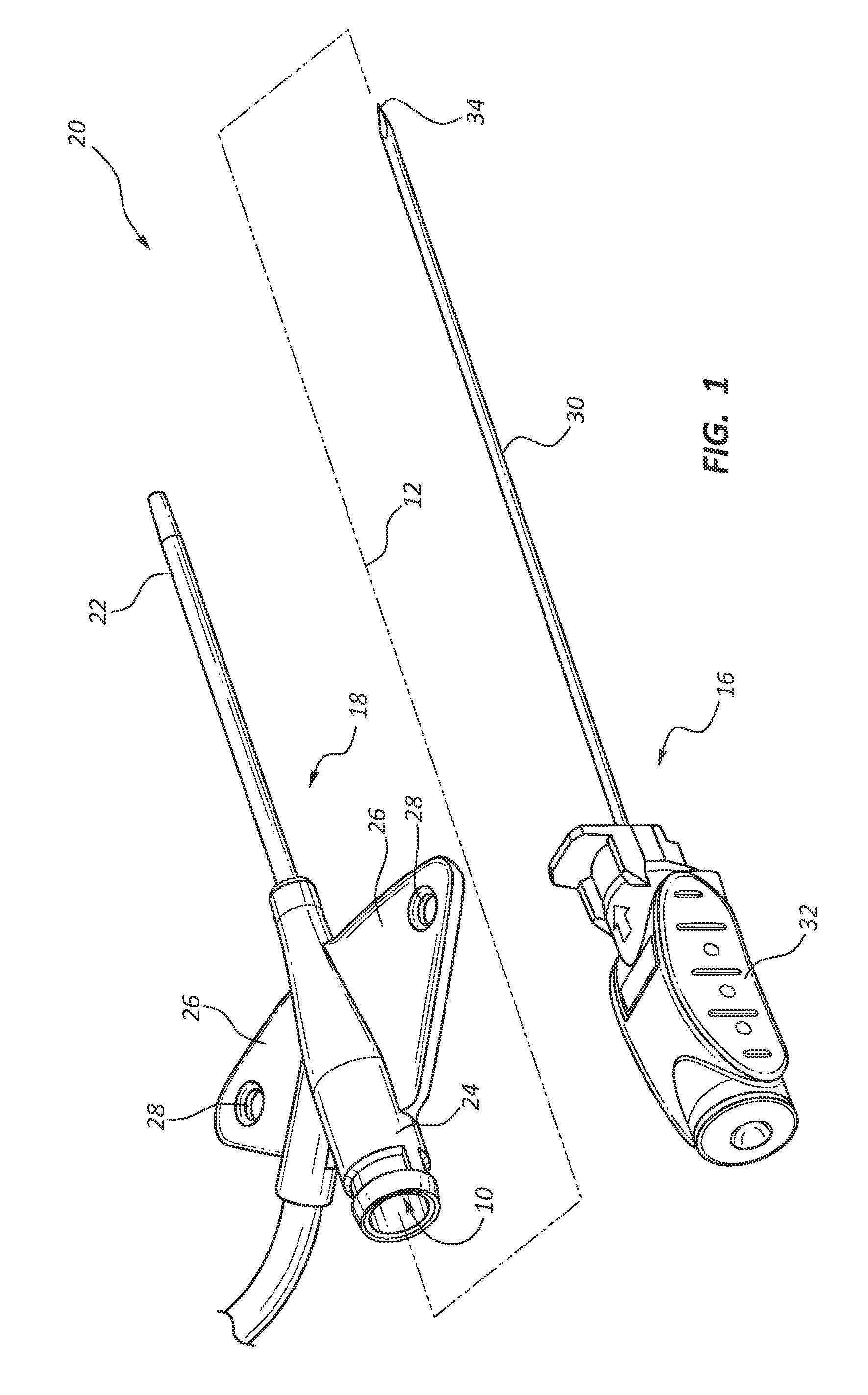
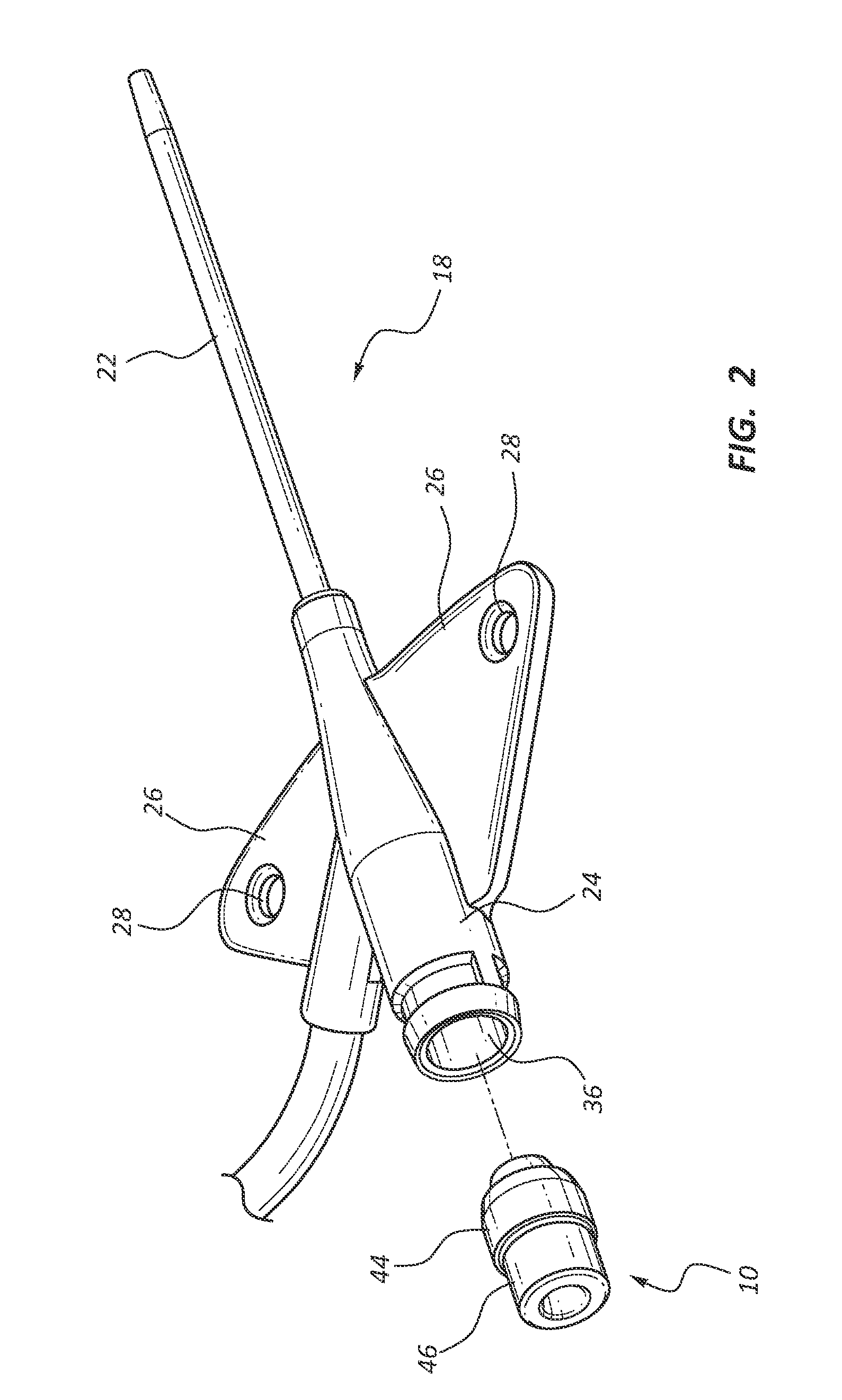
[0004]Accordingly, the present invention provides a septum for use in catheter and introducer needle assemblies. The septum can provide a seal about the introducer needle prior to and during needle removal, as well as providing a seal about the proximal opening of the catheter assembly following needle extraction. The septum is configured to provide minimized drag during needle extraction, while still providing an effective seal against high pressures within the catheter assembly, such as those involved in high-pressure fluid injections. These features are achieved, at least in part, by offsetting the slit of the septum such that the radial compression forces from the catheter adapter are applied to the slit are primarily indirect forces. In this offset configuration, the frictional forces on the needle at the needle-septum interface are minimized, facilitating needle withdrawal.
[0005]To provide improved sealing function during high-pressure fluid injections, the septum can be further configured to transition to a collapsed state, generally after the introducer needle is removed, when a relatively high pressure is applied to the distal face of the septum. In these instances, the portion of the septum containing the slit, a plug portion, can be collapsed, at least partially, into a tube portion of the septum, which can increase the compressive force on the slit, maintaining the slit closed despite the high pressures. In this collapsed state, the septum can withstand high pressures within the catheter assembly without compromising the seal provided by the septum. Thus, the septum can serve as a low-drag, high pressure septum.
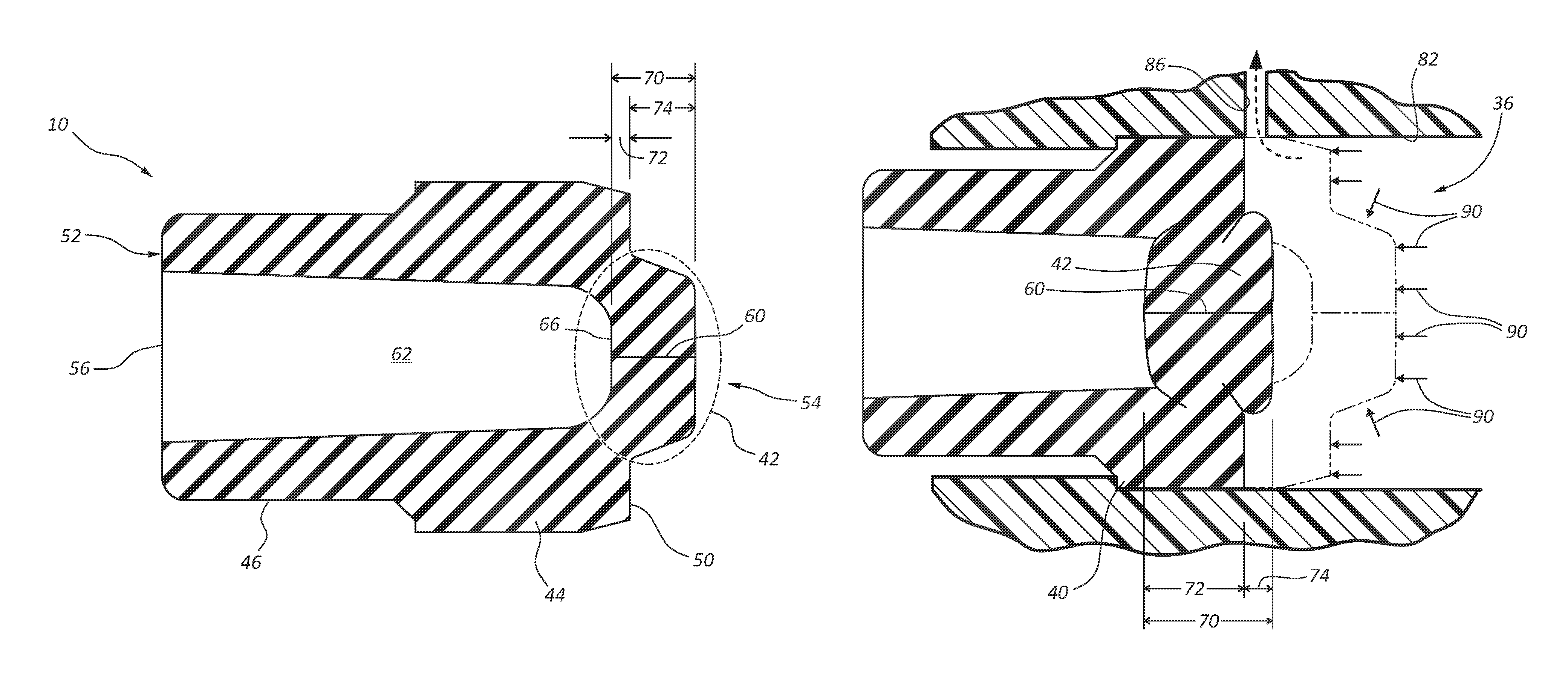
[0006]Accordingly, in some aspects of the invention, a septum is provided that can be utilized in a catheter assembly to selectively seal an opening in the catheter assembly. The septum has a tube portion and a plug portion. The plug portion has a slit extending through it. The septum can move from a non-collapsed state to a collapsed state. When the septum is in the non-collapsed state, the plug portion is offset from the tube portion such that some of the length of the slit extends outward from the distal end of the tube portion. When the septum is in a collapsed state, the plug portion is moved inwards into an internal cavity of the tube portion such that the length of the slit extending outward from the distal end of the tube portion is reduced.
[0007]In some implementations of the septum, the internal cavity can extend from a proximal end of the tube portion to the plug portion. The internal cavity can have a smaller cross-sectional area (taken perpendicular to a central axis of the tube portion) than the plug portion, such that the plug portion plugs the internal cavity when it is moved therein. Moreover, as the plug portion is moved into the internal cavity, it increases the compressive force on at least that portion of septum, which can improve the sealing capabilities of the septum. The plug portion of the septum can extend outwardly from a central portion of the distal end of the tube portion and can be surrounded by a portion of the distal end of the tube portion that forms an annular surface around the plug portion.
[0008]In some implementations of the septum, a first compressive force is applied to surfaces of the slit when the septum is in the non-collapsed state, but a second, greater compressive force is applied to the surfaces of the slit in the collapsed state, thus providing increased sealing capabilities around the slit, which can strengthen the septum's seal against high pressures. The septum can move from the non-collapsed state to the collapsed state in response to a threshold pressure on a distal face of the septum. This provides a seal against high pressures which might otherwise compromise the septum's seal. This threshold pressure can be greater than a pressure produced by withdrawing a needle through the slit in the plug portion, such that the septum is not collapsed during needle withdrawal.
[0009]In some implementations of the catheter assembly, one or more holes can be disposed through the sidewalls of the catheter adapter that extends between the inner lumen and the external environment. The one or more holes can be located along the inner lumen at one or more locations that are covered by the septum when the septum is in the non-collapsed state, and that are uncovered by the septum when in the collapsed state. In this configuration, when the internal pressure within the catheter adapter is sufficient to compress the septum backwards such that the one or more holes are exposed, this internal pressure can be reduced as fluids flow out the one or more holes.


 Login to View More
  Login to View More