

Methods and devices for crosslinking of corneal collagen and for treatment of disorders of the eye
a crosslinking and corneal technology, applied in the field of biotechnology, medicine, optics and electronics, can solve the problems of inability to achieve the effects of reducing the risk of post-surgical complications, requiring substantial recovery time, and affecting the shape of the cornea, so as to facilitate the distribution of photosensitizer and increase the permeability of the epithelial layer
- Summary
- Abstract
- Description
- Claims
- Application Information
AI Technical Summary
Benefits of technology
Problems solved by technology
Method used
Image

Examples
Embodiment Construction
[0029]The following detailed description and the accompanying drawings to which it refers are intended to describe so e, but not necessarily all, examples or embodiments of the invention. The described embodiments are to be considered in all respects only as illustrative and not restrictive. The contents of this detailed description and the accompanying drawings do not limit the scope of the invention in any way.
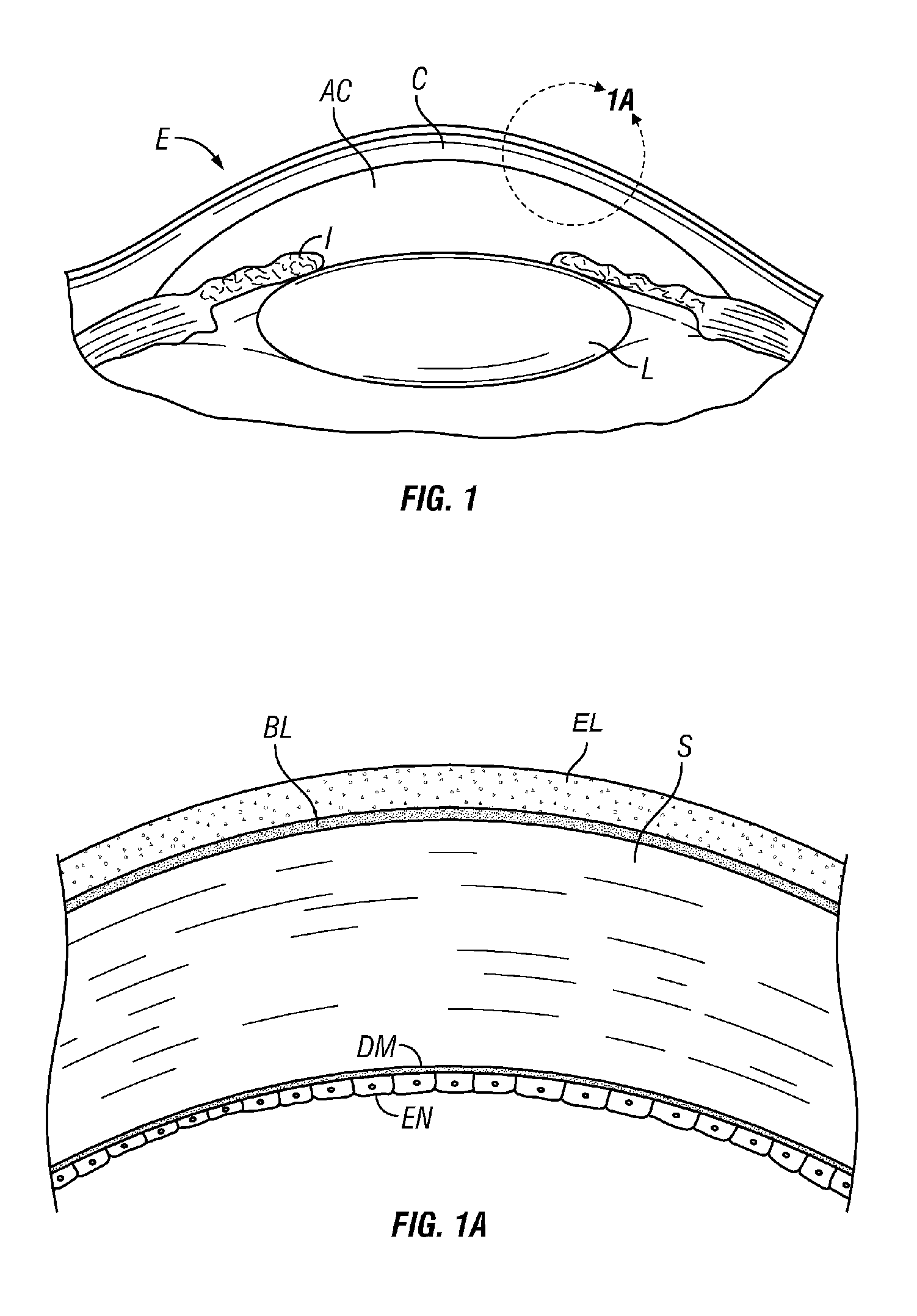
[0030]As shown in FIG. 1, the anterior aspect of a human eye E generally includes the cornea C, anterior chamber AC, iris I and lens L. The clear, dome-shaped cornea C covers the iris I.
[0031]The various layers of the cornea C are shown in the cross-sectional view of FIG. 1A. As shown, the cornea C has an outer (anterior) epithelial layer EL, an inner (posterior) endothelium EN and a relatively thick stroma S between the epithelial layer EL and endothelium EN. The membranous Bowman's Layer BL, lies between the epithelial layer EL and stroma S. Descemet's Layer DL is a thin b...
PUM
 Login to View More
 Abstract
Description
Claims
Application Information
 Login to View More