
Polycyclic-carbamoylpyridone compounds and their pharmaceutical use
a polycyclic carbamoylpyridone and compound technology, applied in the field of new polycyclic carbamoylpyridone compounds, can solve the problems of complex decisions regarding the treatment of hiv infected patients, limited usefulness of strains, and major public health problems, so as to reduce hiv replication, reduce the potential for drug-drug interactions, and inhibit the activity of hiv integrase
- Summary
- Abstract
- Description
- Claims
- Application Information
AI Technical Summary
Benefits of technology
Problems solved by technology
Method used
Image

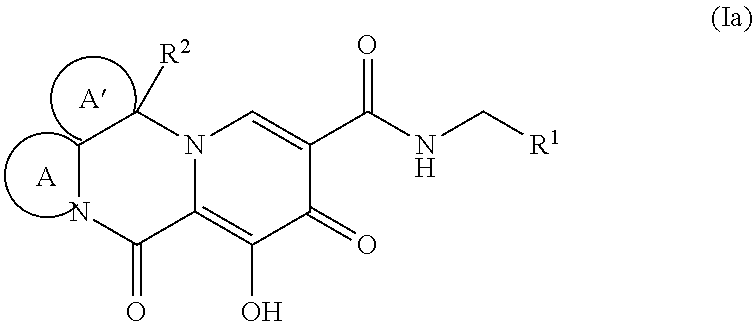
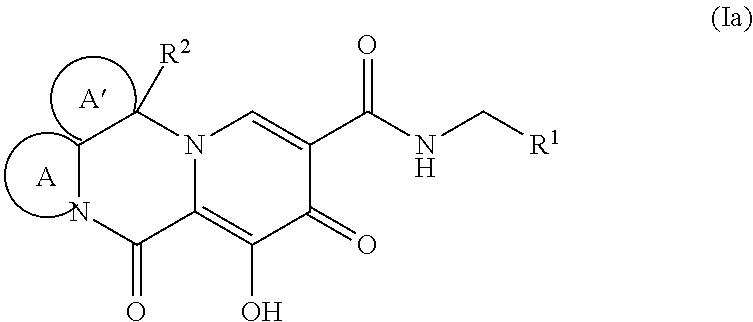
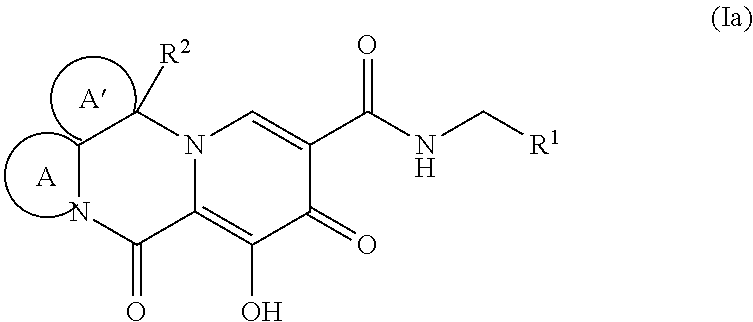
Examples
example 1
Preparation of Compound 14
[0297]
Step 1
[0298]A solution of (3S,4S)-3-aminotetrahydro-2H-pyran-4-ol (1, 2667 mg, 22.77 mmol) and triethylamine (4.76 mL, 34.15 mmol) in water (23 mL) and 1,4-dioxane (23 mL) was stirred at room temperature as 1-[(2-trimethylsilyl)ethoxycarbonyloxy]pyrrolidin-2,5-dione (2, 6498 mg, 25.06 mmol) was added. The resulting mixture was stirred at room temperature. After 71 h, the reaction mixture was diluted with water (˜125 mL) and extracted with ethyl acetate (˜125 mL×2). The extracts were washed with water (125 mL×1), combined, dried (Na2SO4) and concentrated. The residue was purified by column chromatography on silica gel (120 g column) using hexanes-ethyl acetate as eluents and the product containing fractions were pooled and concentrated to get compound 3: 1H NMR (400 MHz, Chloroform-d) δ 4.81 (s, 1H), 4.25-4.09 (m, 2H), 4.09-3.97 (m, 1H), 3.91 (dt, J=11.6, 4.7 Hz, 1H), 3.69 (s, 1H), 3.52 (d, J=9.5 Hz, 1H), 3.46 (ddd, J=11.9, 9.1, 3.1 Hz, 1H), 3.21 (t, J...
example 2
Preparation of Compound 15
[0311]
Step 1
[0312]A mixture of compound 13 (32 mg, 0.063 mmol) and 10% palladium on carbon (5 mg, 0.174 mmol) in ethanol (2 mL) was stirred under hydrogen atmosphere. After 2 h, the reaction mixture was filtered through celite pad and the celite was washed with ethanol. The combined filtrate and the washing were concentrated to dryness to get the crude saturated product, which was used for the next reaction: LCMS-ESI+ (m / z): [M+H]+ calculated for C24H25ClF2N3O5: 508.15. found: 508.14.
[0313]To a solution of the above crude saturated product in MeCN (3 mL) was added magnesium bromide (32 mg, 0.174 mmol) at room temperature and the resulting mixture was stirred for 30 min at 50° C. bath. The reaction mixture was stirred at 0° C. and added 1 N HCl (˜7 drops) to make the mixture a solution. After the solution was diluted with water, the product was extracted with dichloromethane (×3). The combined extracts were dried (MgSO4) and concentrated. The residue was pur...
example 3
Preparation of Compound 25
[0314]
Step 1
[0315]A solution of compound 16 (4.00 g, 26.04 mmol) and triethylamine (5.44 mL, 39.06 mmol) in water (35 mL) and 1,4-dioxane (35 mL) was stirred at room temperature as compound 2 (7.428 g, 28.64 mmol) was added. The resulting mixture was stirred at room temperature overnight. After 16 h, the reaction mixture was diluted with water (˜125 mL) and extracted with ethyl acetate (˜125 mL×2). The extracts were washed with water (125 mL×1), combined, dried (Na2SO4), and concentrated. The residue was purified by column chromatography on silica gel (120 g column used with cartridge) using hexanes-ethyl acetate as eluents to get compound 17: 1H NMR (400 MHz, Chloroform-d) δ 4.68 (s, 1H), 4.23-4.13 (m, 2H), 4.01 (ddd, J=11.4, 4.8, 1.1 Hz, 1H), 3.92 (dd, J=12.0, 4.8 Hz, 1H), 3.56 (ddd, J=12.3, 9.7, 5.4 Hz, 1H), 3.48 (td, J=9.3, 4.8 Hz, 1H), 3.41 (td, J=11.9, 2.3 Hz, 1H), 3.14 (dd, J=11.4, 9.5 Hz, 1H), 1.99-1.87 (m, 1H), 1.55 (dtd, J=13.2, 11.6, 4.8 Hz, 1H),...
PUM
| Property | Measurement | Unit |
|---|---|---|
| temperature | aaaaa | aaaaa |
| temperature | aaaaa | aaaaa |
| temperature | aaaaa | aaaaa |
Abstract
Description
Claims
Application Information
 Login to View More