User apparatus, base station, successive interference canceling process method, and successive interference canceling control method
a technology of user apparatus and process method, applied in the direction of electrical apparatus, multiplex communication, orthogonal multiplex, etc., can solve the problem of high processing load of sic receiver
- Summary
- Abstract
- Description
- Claims
- Application Information
AI Technical Summary
Benefits of technology
Problems solved by technology
Method used
Image

Examples
first embodiment
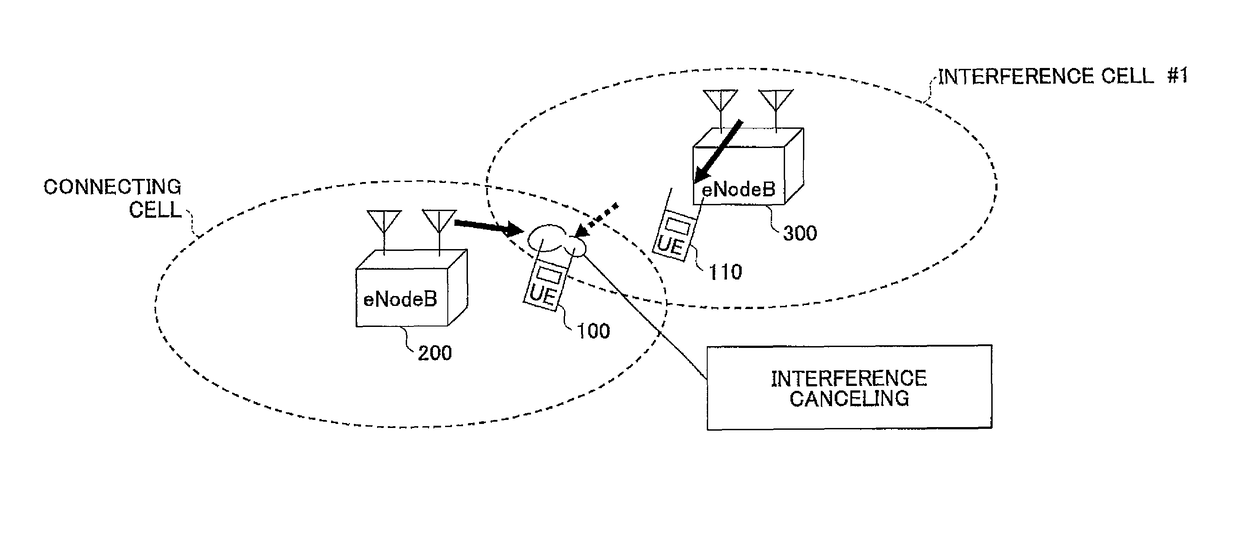
[0052]In the following, various methods for ordering are described. In the following examples, in a case where the user apparatus 100 uses rank, modulation scheme, MCS and the like of an interference signal, these pieces of information are transmitted from the connecting base station 200 to the user apparatus 100, for example, or these pieces of information are estimated by the user apparatus 100.
Example 1-1: Reception Quality Based in the User Apparatus 100
[0053]In the example 1-1, the user apparatus 100 measures reception quality of interference signals for each interference signal, and performs ordering in a descending order of goodness of the reception quality. In this example, as an example of reception quality, RSRP (Reference Signal Received Power) is used.
[0054]RSRP is an average received power of a reference signal (RS) within measurement band per 1 resource element (RE). In the example 1-1, since ordering is performed based on received power measurement for which process l...
example 1-3
[0058]In the example 1-3, the user apparatus 100 groups interference signals by using rank and / or MCS (Modulation and Coding Scheme, modulation scheme and coding scheme), then, for the grouped interference signals, the user apparatus 100 performs RSRP based grouping of example 1-1, or performs output SINR based grouping of example 1-2. The following example especially focuses on modulation scheme in the information of modulation scheme and coding scheme associated with MCS.
[0059]For example, the user apparatus 100 groups interference signals based on rank, then, after that, the user apparatus 100 performs RSRP based ordering for each group. In this example, the groups are ordered in an ascending order of rank number (the number of streams), that is, in an order of group of rank 1, group of rank 2, group of rank 3, for example, and performs RSRP based ordering for each group. For example, in a case where grouping is performed for rank 1 and rank 2, and when a descending order of RSRP...
example 1-4
uxiliary Information Reported From Base Station
[0063]In the example 1-4, the connecting base station 200 dynamically or semistatically notifies the user apparatus 100 of probability information (information indicating a ratio) of modulation scheme (or rank) of an interference signal as auxiliary information, and the user apparatus 100 performs RSRP based (or output SINR based, or BER based) ordering considering the probability information. For the dynamic notification, PDCCH is used, for example. For the semistatic notification, RRC signaling is used, for example.
[0064]An example of the auxiliary information transmitted from the connecting base station 200 is described with reference to FIG. 4. FIG. 4 shows interference signals #1 and #2 that become interference for assigned resources (resources assigned to the user apparatus 100) of a desired signal transmitted by the connecting base station 200. Then, as shown in FIG. 4, as for the interference signal #1, in the 7 assigned resourc...
PUM
 Login to View More
 Abstract
Description
Claims
Application Information
 Login to View More
 - R&D
- Intellectual Property
- Life Sciences
- Materials
- Tech Scout
- Unparalleled Data Quality
- Higher Quality Content
- 60% Fewer Hallucinations
Browse by: Latest US Patents, China's latest patents, Technical Efficacy Thesaurus, Application Domain, Technology Topic, Popular Technical Reports.
© 2025 PatSnap. All rights reserved.Legal|Privacy policy|Modern Slavery Act Transparency Statement|Sitemap|About US| Contact US: help@patsnap.com