
Multi-stage ordered medium hole/big hole composite material and preparation method thereof
A technology of composite carbon and carbon materials, applied in the fields of nanostructure manufacturing, nanotechnology, nanotechnology, etc., can solve the problems of cumbersome, numerous and excessive, and achieve the effect of cumbersome steps, easy availability of raw materials and broad application prospects.
Patent Information
- Authority / Receiving Office
- CN · China
- Current Assignee / Owner
- Publication Date
- 2007-09-26
- Estimated Expiration
- Not applicable · inactive patent
Smart Images
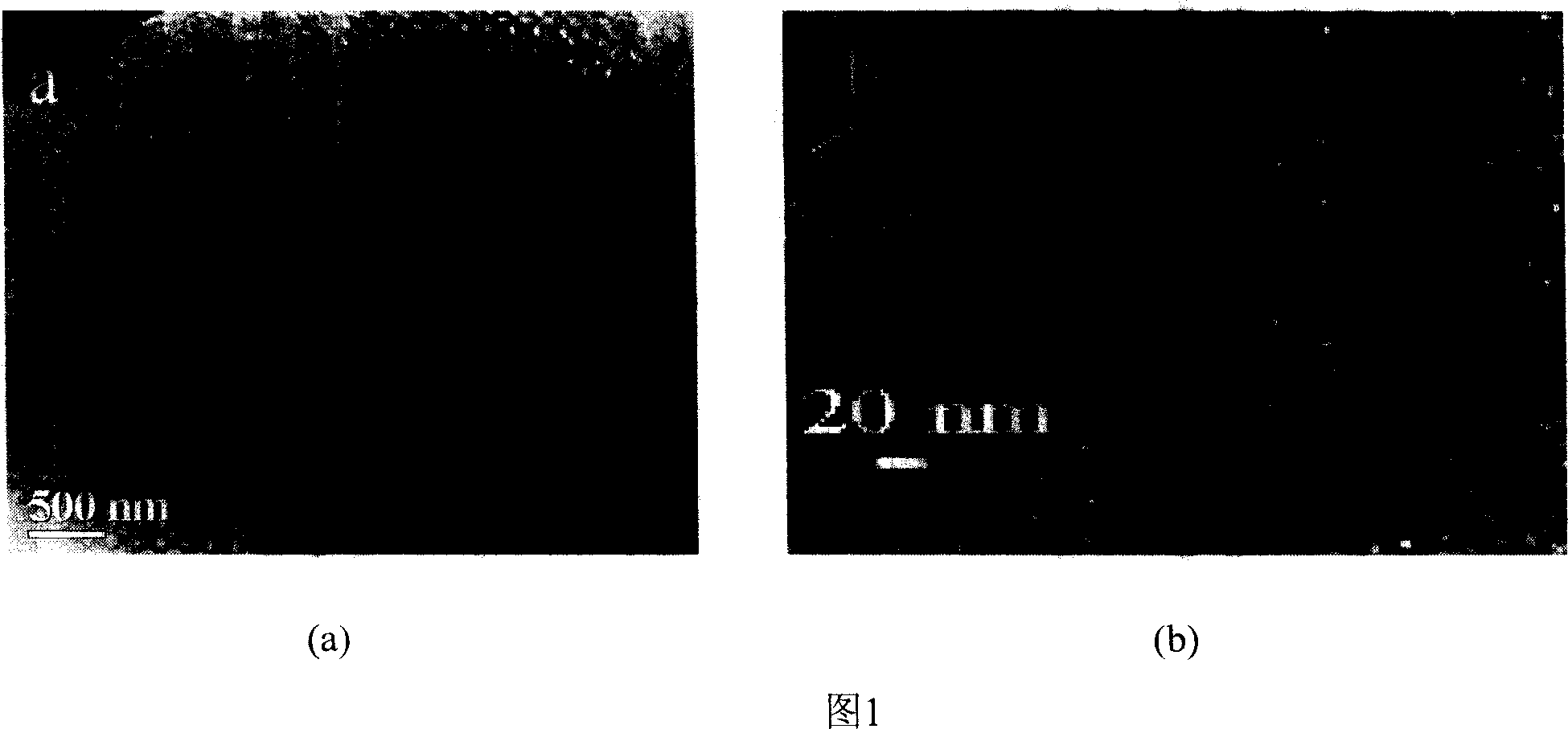
Figure 1 
Figure 2
Abstract
Description
technical field
[0001] The invention belongs to the technical field of advanced nanocomposite materials, and in particular relates to a multi-level ordered mesoporous / metaporous composite carbon material and a preparation method thereof. technical background
[0002] In recent years, mesoporous carbon materials have broad application prospects in catalyst supports, supercapacitor electrodes, and fuel cells due to their superior properties such as the electrical conductivity of carbon materials and the high specific surface area of mesoporous materials. The synthesis of traditional mesoporous carbon materials is usually obtained by nanocasting. This method first synthesizes mesoporous silica materials with a certain structure, and then fills the pores of mesoporous silica materials with organic molecules. As a carbon precursor, the organic matter was then carbonized and the silica template was further removed to obtain a mesoporous carbon material replica with a channel str...
Examples
Embodiment 1
[0022] The silica microsphere dispersion liquid with a solid content of 10wt.% and a particle size of 240nm was left to settle for two weeks, the supernatant was sucked off, then dried naturally and baked at 80°C for 12 hours before use. Take 1.0g heat-treated colloidal crystals of silica microspheres and immerse them in 4.0g ethanol solution containing 0.2g resole phenolic resin and 0.1g F127, volatilize at room temperature for 24h, take out the colloidal crystals and bake them at 100°C 24h, and then burn at 800°C for 5 hours under the protection of nitrogen to obtain carbon-containing colloidal crystals, place the calcined colloidal crystals in 10wt% HF aqueous solution and stir slowly for 24h, and the product is washed repeatedly with distilled water by centrifugation And vacuum drying to obtain ordered mesoporous / macroporous carbon material, the macropore diameter is about 230nm, the mesopore diameter is 10nm, and the mesoporous channel structure is three-dimensional cubic ...
Embodiment 2
[0024] The silica microsphere dispersion liquid with a solid content of 10wt.% and a particle size of 320nm was left to settle for two weeks, the supernatant was sucked off, then dried naturally and baked at 80°C for 12 hours before use. Take 1.0g heat-treated colloidal crystals of silica microspheres and immerse them in 5.0g ethanol solution containing 0.2g resole phenolic resin and 0.2g F127, volatilize at room temperature for 24h, take out the colloidal crystals and bake them at 120°C 8h, and then burned at 900°C for 6 hours under the protection of nitrogen gas to obtain carbon-containing colloidal crystals. The calcined colloidal crystals were placed in 10wt% HF aqueous solution and stirred slowly for 24h. The product was washed repeatedly with distilled water by centrifugation and vacuum drying to obtain an ordered mesoporous / macroporous carbon material. The macropore diameter is about 310nm, the mesopore diameter is 11nm, and the mesoporous channel structure is two-dimen...
Embodiment 3
[0026] The silica microsphere dispersion liquid with a solid content of 8wt.% and a particle size of 450nm was left to settle for two weeks, the supernatant was sucked off, then dried naturally and baked at 100°C for 12 hours before use. Take 1.0g heat-treated colloidal crystals of silica microspheres and immerse them in 5.0g ethanol solution containing 0.3g resole phenolic resin and 0.15g F108, volatilize at room temperature for 24h, take out the colloidal crystals and bake them at 100°C 24h, and then burn at 800°C for 5 hours under the protection of nitrogen to obtain carbon-containing colloidal crystals, place the calcined colloidal crystals in 10wt% HF aqueous solution and stir slowly for 24h, and the product is washed repeatedly with distilled water by centrifugation and vacuum drying to obtain an ordered mesoporous / macroporous carbon material. The macropore diameter is about 435nm, the mesopore diameter is 12nm, and the mesopore channel structure is three-dimensional cub...