
Preparation method for synthesizing polysiloxane neutralizing agent by using alkaline process
A technology of polysiloxane and terminal siloxane, which is applied to the preparation of alkali-synthesized polysiloxane neutralizer and the preparation field of polysiloxane neutralizer, can solve the problem of inability to obtain end-capped products, neutralization Long time, poor compatibility and other problems, to achieve the effects of easy promotion and industrialization, shortened neutralization time, and simple preparation process
Patent Information
- Authority / Receiving Office
- CN · China
- Patent Type
- Applications(China)
- Current Assignee / Owner
- Publication Date
- 2015-03-04
- Estimated Expiration
- Not applicable · inactive patent
Smart Images
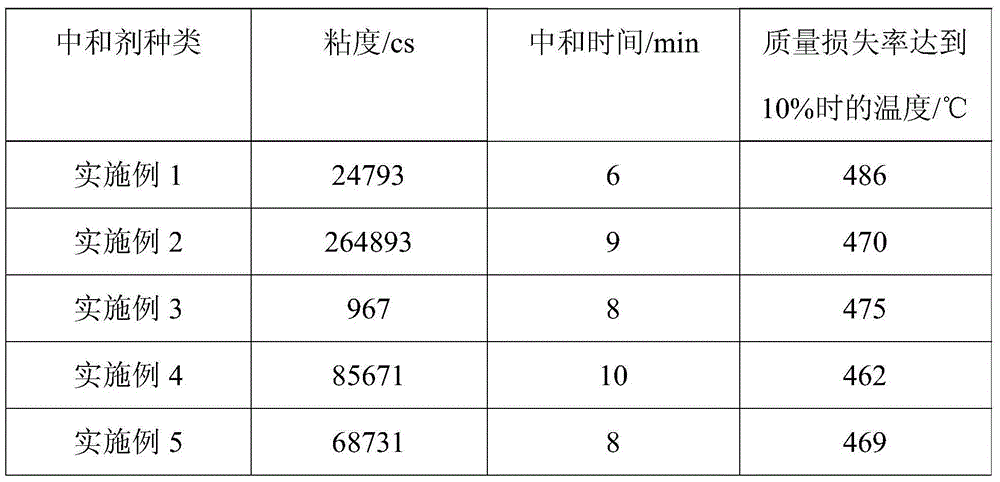
Figure 1 
Figure 2
Abstract
Description
technical field
[0001] The invention relates to the field of organosilicon, in particular to a method for preparing a polysiloxane neutralizing agent, in particular to a method for preparing a polysiloxane neutralizing agent synthesized by an alkali method, and the neutralizing agent can be used to neutralize different viscosities Methylsiloxane. Background technique
[0002] In 1949, Corning Glass Company of the United States invented the method of polymerizing cyclic or short-chain linear polysiloxanes into high molecular polysiloxanes under the catalysis of basic catalysts. This method is widely used in the synthesis of various polysiloxanes. Commonly used basic catalysts include: sodium hydroxide, potassium hydroxide, cesium hydroxide and lithium hydroxide, and temporary catalysts tetramethylammonium hydroxide, tetra-n-butylphosphorous hydroxide and their silicon alkoxides. Temporary catalysts can be deactivated by thermal decomposition after polymerization, while alkal...
Examples
Embodiment 1
[0027] Add 100 parts of phosphoric acid with a mass fraction of 88% and 900 parts of hydroxyl-terminated linear products in the flask, start stirring and heat up at a stirring speed of 220rpm, control the temperature at 110°C to dehydrate until transparent, and dehydrate for 12 minutes to obtain silicon-based phosphoric acid Esters, the viscosity of silicon-based phosphate was measured with a Brookfield viscometer.
[0028] The prepared silicon-based phosphate was neutralized with dimethylsiloxane, and the time required for neutralization was recorded, and 10 mg of dimethylsiloxane was weighed for thermogravimetric testing.
Embodiment 2
[0030] Add 10 parts of phosphoric acid with a mass fraction of 85% and 110 parts of hydroxyl-terminated linear products in the flask, start stirring and heat up at a stirring speed of 200 rpm, control the temperature at 100°C to dehydrate until transparent, and dehydrate for 20 minutes to obtain silyl phosphoric acid Esters, the viscosity of silicon-based phosphate was measured with a Brookfield viscometer.
[0031] The prepared silicon-based phosphate was neutralized with dimethylsiloxane, and the time required for neutralization was recorded, and 10 mg of dimethylsiloxane was weighed for thermogravimetric testing.
Embodiment 3
[0033] Add 100 parts of phosphoric acid with a mass fraction of 98% and 600 parts of hydroxyl-terminated linear products in the flask, start stirring to raise the temperature, the stirring speed is 250rpm, control the temperature at 120°C to dehydrate until transparent, and the dehydration time is 8 minutes to prepare silicon-based phosphoric acid Esters, the viscosity of silicon-based phosphate was measured with a Brookfield viscometer.
[0034] The prepared silicon-based phosphate was neutralized with dimethylsiloxane, and the time required for neutralization was recorded, and 10 mg of dimethylsiloxane was weighed for thermogravimetric testing.