
Preparation and applications of photocatalyst CNU-BA
A CNU-BA, photocatalyst technology, applied in the field of photocatalytic materials, can solve the problems of limited increase in photocatalytic efficiency of modified catalysts, inability to meet industrial requirements, complicated operation, etc.
Patent Information
- Authority / Receiving Office
- CN · China
- Patent Type
- Applications(China)
- Current Assignee / Owner
- Publication Date
- 2018-02-23
- Estimated Expiration
- Not applicable · inactive patent
Smart Images

Figure 1 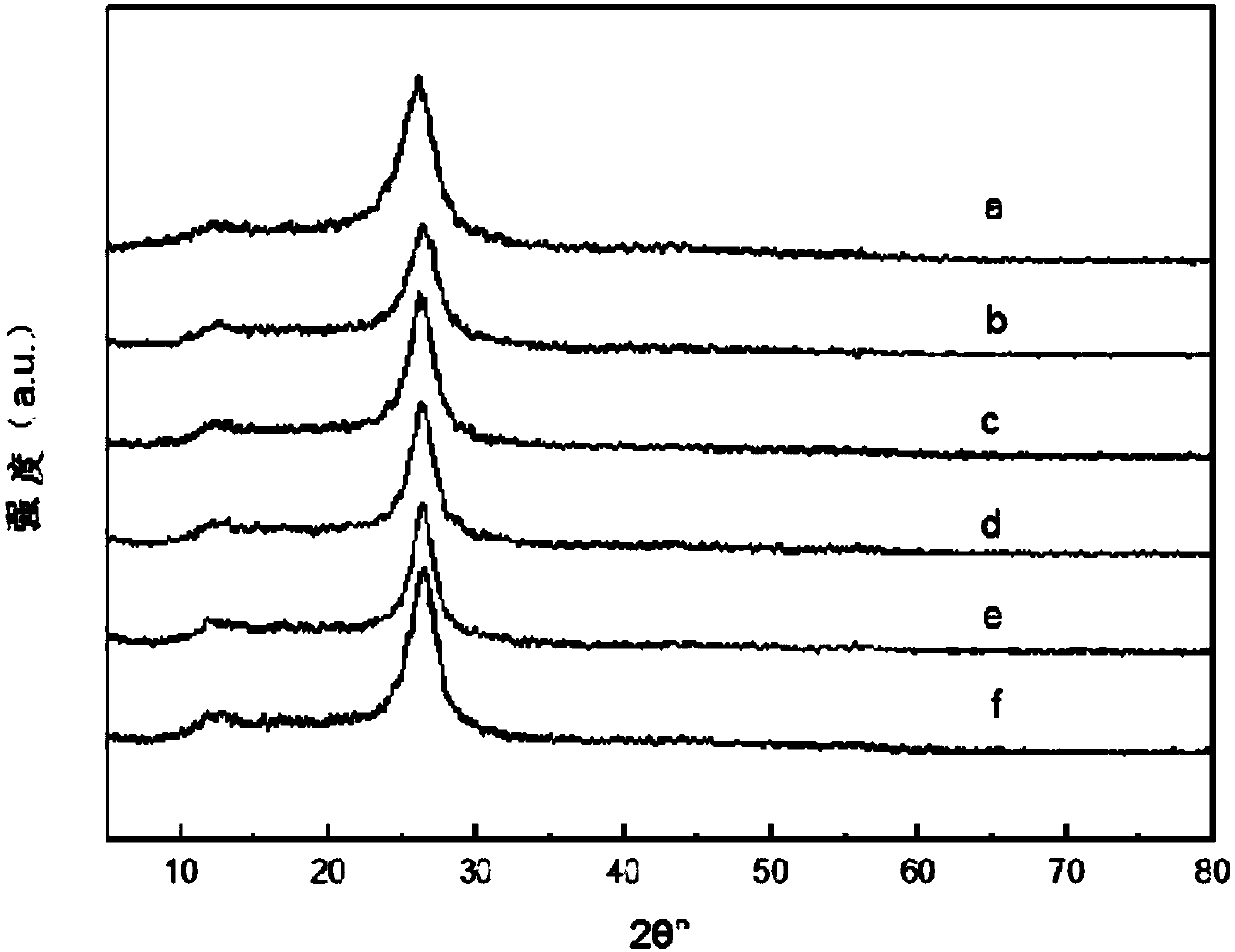
Figure 2 
Figure 3
Abstract
Description
technical field
[0001] The invention belongs to the field of photocatalytic materials, and relates to a composite photocatalyst for treating dye wastewater pollution and a preparation method thereof. Background technique
[0002] g-C 3 N 4 With its outstanding advantages of high photocatalytic activity, good stability, cheap raw materials, and especially no metal, it has become a new type of photocatalytic material. However, single-phase catalysts usually have low quantum efficiency. The photocatalytic performance is not ideal. Ing-C 3 N 4 The high photogenerated electron-hole recombination rate of the material leads to its low catalytic efficiency, which limits its application in photocatalysis.
[0003] To improve g-C 3 N 4 In recent years, many modification methods have been studied. to g-C 3 N 4 The modified non-metallic elements include S, N, C, B, F, P, etc. It is generally believed that these non-metallic elements replace the C, N, and H elements in the 3-s-...
Examples
Embodiment 1
[0060] (1) Accurately weigh 0.01g of barbituric acid with an electronic balance and dissolve it in a beaker containing 10mL of distilled water, then weigh 10g of urea and add it to the above beaker, put a small magnet into the beaker, and place the beaker on a magnetic Stir on a stirrer to speed up the dissolution of the mixture. Then place the beaker in a constant temperature water bath at 100°C to evaporate to dryness, and grind it into powder in an agate mortar to obtain solid I;
[0061] (2) Then the above-mentioned solid I is transferred to a dry and clean porcelain crucible, placed in a muffle furnace, heated to 550°C at a speed of 10°C / min, and ground to powder in an agate mortar after roasting for 2h. Then put it in a sealed bag and seal it for storage. The product number is CNU-BA 0.01 .
Embodiment 2
[0063] The experimental procedure is the same as in Example 1, except that the amount of barbituric acid used is different. In this example, the amount of barbituric acid is 0.03g, and the product number is CNU-BA 0.03 .
Embodiment 3
[0065] The experimental procedure is the same as in Example 1, except that the amount of barbituric acid used is different. In this example, the amount of barbituric acid is 0.05g, and the product number is CNU-BA 0.05 .