
Field Weakening Control Method of Built-in Permanent Magnet Synchronous Motor Based on Torque Feedforward Control Technology
A technology of permanent magnet synchronous motor and feedforward control, applied in the field of control system structure based on torque feedforward technology, to achieve the effect of increasing voltage margin, improving torque output capability, and realizing utilization
Patent Information
- Authority / Receiving Office
- CN · China
- Patent Type
- Patents(China)
- Current Assignee / Owner
- Publication Date
- 2019-11-19
Smart Images
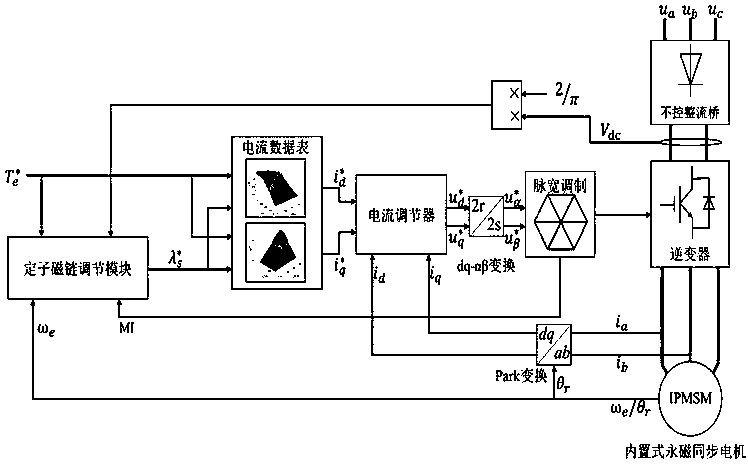
Figure 1 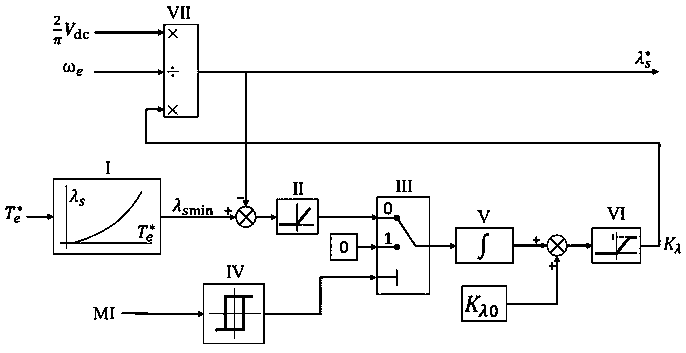
Figure 2 
Figure 3
Abstract
Description
technical field
[0001] The invention relates to a field-weakening control method for a built-in permanent magnet synchronous motor, in particular to a control system structure and algorithm based on torque feedforward technology. Background technique
[0002] Permanent magnet synchronous motor is a kind of motor with high efficiency and high power density, which has very good application prospects in the fields of electric vehicles and train traction. Permanent magnet synchronous motors often use MTPA control technology below the base speed to achieve minimum loss. However, when the rotational speed exceeds the base speed, the permanent magnet synchronous motor must be able to reach a higher speed by using the field weakening control technology. Field weakening control technology generally increases the d-axis current to achieve the purpose of field weakening. However, how to ensure the maximum efficiency and power output of the motor while increasing the d-axis current is ...
Examples
Embodiment Construction
[0025] The present invention will be further described below in conjunction with the accompanying drawings and embodiments.
[0026] A structure of the field weakening control method of the built-in permanent magnet synchronous motor based on the torque feedforward control technology of the present invention is as follows figure 1 shown. The software algorithm part includes stator flux adjustment module, current data table, current regulator, pulse width modulation, Transformation and Park Transformation. The hardware part includes uncontrolled rectifier bridge and inverter.
[0027] The stator flux linkage adjustment module calculates a suitable stator flux linkage given value as an output according to the input torque given value, DC bus voltage, motor speed and modulation coefficient.
[0028] The current data table includes two two-dimensional tables. Each table has two input variables: torque reference and stator flux reference. The outputs of the two tables are the...