
Preparation method of mesotrione
A technology for mesotrione and nitrobenzoic acid is applied in the field of preparation of mesotrione, can solve problems such as potential safety hazards, environmental pollution, low reaction activity, etc., achieves small amount of three wastes, reduced production cost, and low reaction temperature Effect
Patent Information
- Authority / Receiving Office
- CN · China
- Patent Type
- Applications(China)
- Current Assignee / Owner
- Publication Date
- 2018-08-24
Smart Images
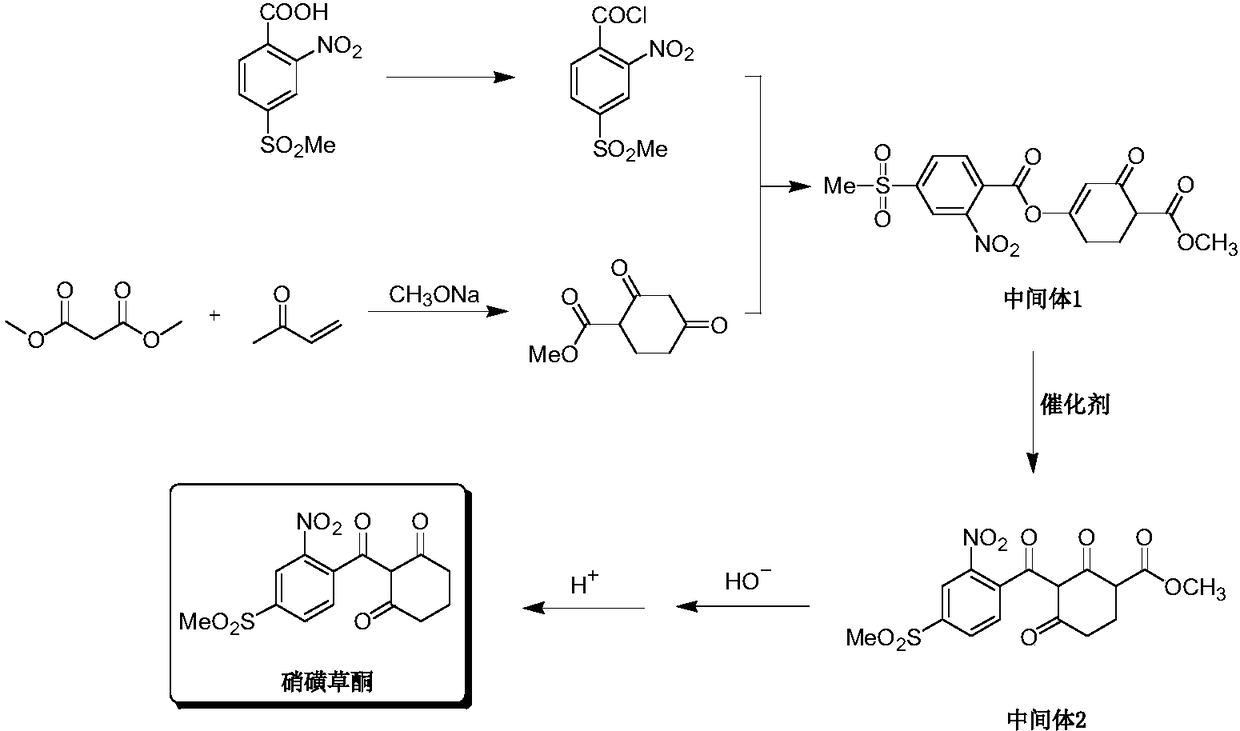
Figure 1 
Figure 2 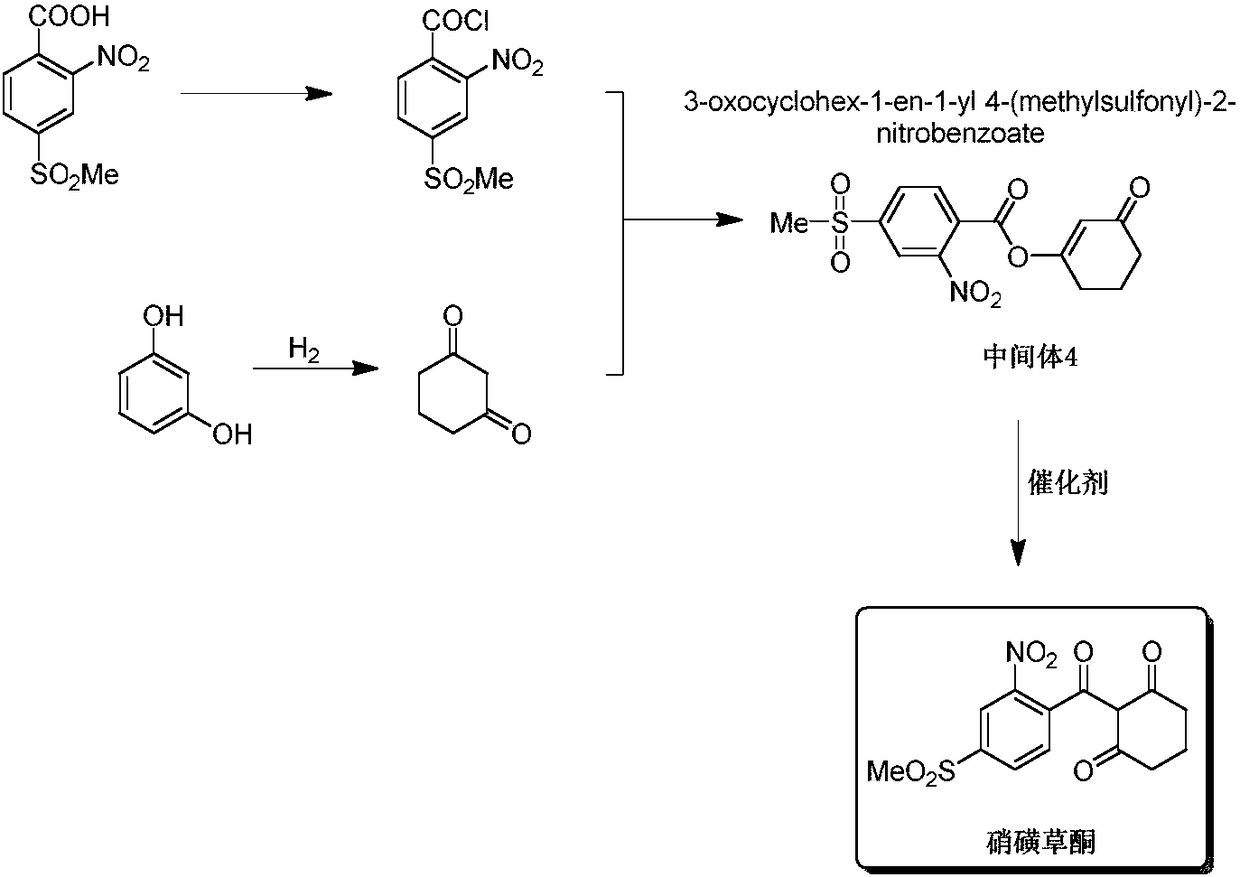
Figure 3
Abstract
Description
technical field
[0001] The invention belongs to the field of herbicide preparation, and in particular relates to a preparation method of mesotrione. Background technique
[0002] p-Hydroxyphenylpyruvate Dioxygenase (HPPD) is a key enzyme in the biosynthetic pathway of plastoquinone and tocopherol necessary for normal plant growth, and can catalyze the biochemical process from tyrosine to plastoquinone in plants , HPPD is currently one of the most important herbicide targets.
[0003] Mesotrione can inhibit HPPD and ultimately affect the biosynthesis of carotenoids. It is a broad-spectrum, systemic, selective, contact herbicide. Mesotrione is mainly absorbed through the leaves and roots, and conducts to the top and base in the xylem and phloem, and is distributed throughout the plant. After the weeds are treated, the leaves turn white, and then the meristems die. The selectivity of mesotrione stems from the difference in its metabolism in crops and weeds (metabolism to 4-h...
Examples
Embodiment 1
[0045] Drop into the dry reaction flask 25g (0.101mol) of p-thiamone-o-nitrobenzoic acid and 75g of ethylene dichloride, stir and heat up to reflux, add 13g (0.108mol) of thionyl chloride dropwise, and return to reflux after dropping. The temperature was reacted for 2 hours, and the solvent was distilled off under reduced pressure to obtain 26.6 g of p-thiamone-o-nitrobenzoyl chloride.
[0046] Add 80g of acetonitrile to the above-obtained p-methylsulfone-o-nitrobenzoyl chloride, add 12g (0.106mol) of 1,3-cyclohexanedione at 0-30°C, and add triethyl ether dropwise at 0-30°C 11g (0.108mol) of amine, dripping in 1-2 hours, and kept at 20-30°C for 2 hours to obtain the intermediate 2-nitro-4-methylsulfonylbenzoic acid-[3'-carbonyl-1'-cyclohexyl enol]-ester.
[0047] Add 9.8 g (0.03 mol) of cesium carbonate and 0.5 g (0.004 mol) of 4-dimethylaminopyridine into the reaction system, keep warm at 20-30° C. for 3 hours, evaporate the solvent under reduced pressure, add 30 g of water,...
Embodiment 2
[0049] Add 25g (0.101mol) of p-thiamone-o-nitrobenzoic acid and 125g of ethylene dichloride into the dry reaction flask, stir and heat up to reflux, add 17.85g (0.15mol) of thionyl chloride dropwise, and dropwise the reflux temperature After reacting for 1 hour, the solvent was distilled off under reduced pressure to obtain 26 g of p-thiamphenyl-o-nitrobenzoyl chloride.
[0050]Add 125 g of dichloroethane to the above-obtained p-methylsulfone-o-nitrobenzoyl chloride, add 12 g (0.106 mol) of 1,3-cyclohexanedione at 20-30 ° C, and dropwise add three Ethylamine 22g (0.2mol), dripped in 2 hours, and kept at 20-30°C for 1 hour to obtain the intermediate 2-nitro-4-methylsulfonylbenzoic acid-[3'-carbonyl-1'-cyclohexene alcohol]-ester.
[0051] Add 17g (0.05mol) of cesium carbonate (0.05mol) and 0.5g (0.003mol) of DBU to the reaction system, keep the temperature at 20-30°C for 2 hours, evaporate the solvent under reduced pressure, add 30g of water, acidify with hydrochloric acid, Ex...
Embodiment 3
[0053] Add 100 g of dichloroethane to the p-thiamone-o-nitrobenzoyl chloride obtained according to the method in Example 1, add 12 g (0.106 mol) of 1,3-cyclohexanedione at 20-30 ° C, and 11g (0.108mol) of triethylamine was added dropwise at ℃, the drop was completed in 1-2 hours, and the temperature was kept at 20-30℃ for 2 hours to obtain the intermediate 2-nitro-4-methylsulfonylbenzoic acid-[3'-carbonyl- 1'-cyclohexenol]-ester.
[0054] Add 15g (0.1mol) of potassium carbonate and 0.15g (0.001mol) of hexamethylenetetramine into the reaction system, keep warm at 20-30°C for 6 hours, add 30g of water, acidify with hydrochloric acid, extract, dry, and reduce pressure The solvent was distilled off to obtain 29.7 g (0.082 mol) of the product mesotrione, with a content of 97% and a yield of 85%.