
Polymer composition containing modified chlorinated polyolefin and its production method
A technology for chlorinating polyolefins and compounds, applied in the direction of polyurea/polyurethane coatings, coatings, etc., can solve the problems of insufficient curability and insufficient manufacturing stability, and achieve the effect of excellent manufacturing stability
Patent Information
- Authority / Receiving Office
- CN · China
- Patent Type
- Patents(China)
- Current Assignee / Owner
- Publication Date
- 2022-01-11
Smart Images

Figure 1 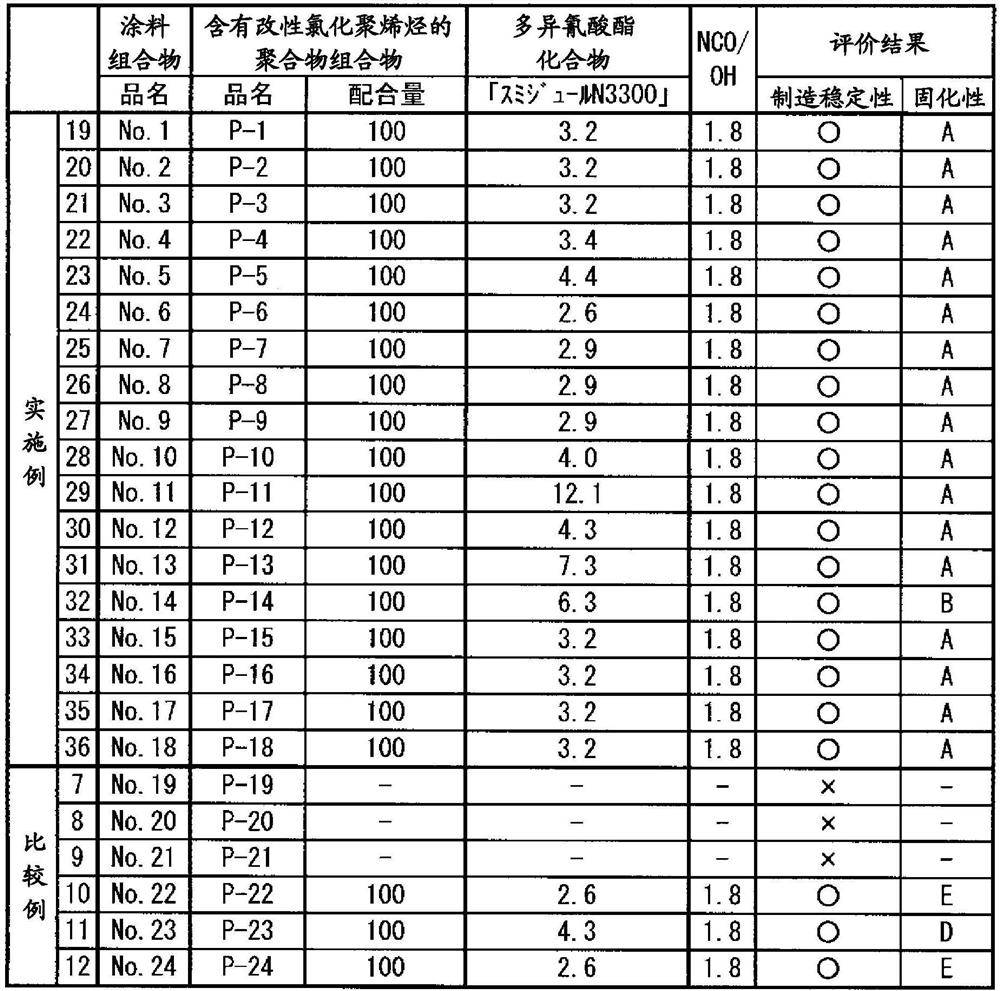
Figure 2 
Figure 3
Abstract
Description
technical field
[0001] The present invention relates to a polymer composition containing a modified chlorinated polyolefin, a method for producing the same, and a coating composition containing the composition. Background technique
[0002] Nowadays, plastic materials are used in various industrial fields. Among them, polyolefin-based resins such as polypropylene resins have many excellent properties and are economical, so they are widely used as base materials for molded articles and films. However, due to the low polarity of polyolefin-based substrates, the adhesion of the coating film formed during coating is poor. Compositions containing modified chlorinated polyolefins such as acrylic-modified chlorinated polyolefins to improve adhesion to materials and compatibility with other resin components used in combination can be used as paints or primers.
[0003] Conventionally, as a method for obtaining such a modified chlorinated polyolefin-containing composition, for examp...
Examples
Embodiment 1
[0091]In a four-necked bottle with a cooling tube, 100 parts of "Superclon 822S" (trade name, produced by Nippon Paper Co., Ltd., maleic anhydride-modified chlorinated polyolefin, 24.5% chlorine content) and 221 parts of toluene were charged. 1. 0.05 parts of di-tert-butylhydroxytoluene (abbreviation: BHT), stirred while blowing air into the liquid phase, and raised the temperature to about 95° C. to prepare a solution. 57.5 parts of 2-allyloxyethanol and 0.1 part of tetrabutylammonium bromide were added thereto, and stirring was continued while making 2-allyloxyethanol and an acid anhydride group react. In the infrared absorption analysis of the solid components in the solution, at about 1770cm -1 The absorbance of about 1460cm -1 In the stage where the absorbance ratio does not change substantially, the temperature is lowered to about 90°C, and the compound (a) containing allyloxy and hydroxyl groups, namely about 55 parts of 2-allyloxyethanol, and having allyloxyl groups i...
Embodiment 2
[0093] In a four-necked bottle with a cooling tube, 100 parts of "Superclon 822S" (trade name, produced by Nippon Paper Co., Ltd., maleic anhydride-modified chlorinated polyolefin, chlorine content 24.5%) and 70 parts of toluene were charged. 1. 0.05 parts of di-tert-butylhydroxytoluene (abbreviation: BHT), stirred while blowing air into the liquid phase, and raised the temperature to about 95° C. to prepare a solution. 23 parts of 2-allyloxyethanol and 0.1 part of tetrabutylammonium bromide were added thereto, and stirring was continued while making 2-allyloxyethanol and an acid anhydride group react. In the infrared absorption analysis of the solid components in the solution, at about 1770cm -1 The absorbance of about 1460cm -1 At the stage where the absorbance ratio does not change substantially, the temperature is lowered to about 90°C, and 150 parts of toluene and 34.5 parts of 2-allyloxyethanol are further added to obtain a compound (a) containing an allyloxy group and ...
Embodiment 3
[0095] In a four-necked bottle with a cooling tube, 100 parts of "Superclon 3228S" (trade name, manufactured by Nippon Paper Co., Ltd., maleic anhydride-modified chlorinated polyolefin, 28% chlorine content) and 210 parts of toluene were charged. , 11 parts of butyl acetate, and 0.05 part of di-tert-butylhydroxytoluene (abbreviation: BHT), stirred while blowing air into the liquid phase, and raised the temperature to about 95° C. to prepare a solution. 57.5 parts of 2-allyloxyethanol and 0.1 part of tetrabutylammonium bromide were added thereto, and stirring was continued while making 2-allyloxyethanol and an acid anhydride group react. In the infrared absorption analysis of the solid components in the solution, at about 1770cm -1 The absorbance of about 1460cm -1 In the stage where the absorbance ratio does not change substantially, the temperature is lowered to about 90°C, and the compound (a) containing allyloxy and hydroxyl groups, namely about 55 parts of 2-allyloxyethan...