
Heat-dissipating member and manufacturing method for same
A component and main surface technology, which is applied in the field of heat dissipation components and its manufacturing, can solve the problems of reduced heat transfer and achieve the effect of improving manufacturing stability
Patent Information
- Authority / Receiving Office
- CN · China
- Patent Type
- Applications(China)
- Current Assignee / Owner
- Publication Date
- 2021-10-01
Smart Images
Figure 1 
Figure 2 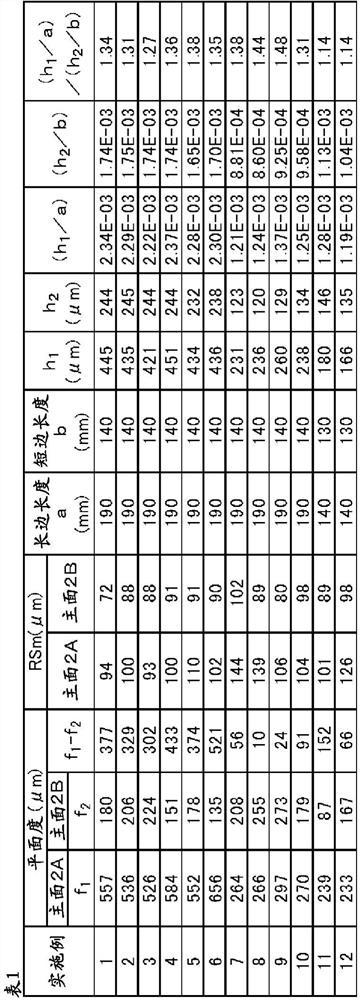
Figure 3
Abstract
Description
technical field
[0001] The present invention relates to a heat dissipation member and a manufacturing method thereof. More specifically, it relates to a plate-shaped heat dissipation member provided with a metal-silicon carbide composite containing aluminum or magnesium, and a method for manufacturing the same. Background technique
[0002] In recent years, heat dissipation members made of metal-silicon carbide composites have gradually been used instead of conventional copper as heat dissipation members for power modules for electric vehicles and electric railways.
[0003] As the metal of the metal-silicon carbide composite, aluminum and its alloys are often used.
[0004] The heat dissipation member is often used in conjunction with other components (for example, heat dissipation fins and heat dissipation units), and the properties of the joint portion are important.
[0005] For example, when joining a heat dissipation member to a heat dissipation fin or a heat dissipa...
Examples
Embodiment 1
[0161] (Formation of silicon carbide porous body)
[0162] First, the following silicon carbide powder A, silicon carbide powder B, and silica sol were mixed for 30 minutes with a stirring mixer to obtain a mixture.
[0163] ・Silicon carbide powder A (manufactured by Pacific Blue Dum Co., Ltd.: NG-150, average particle diameter: 100 μm) 300 g
[0164] ・Silicon carbide powder B (manufactured by Yakushima Denko Co., Ltd.: GC-1000F, average particle diameter: 10 μm) 150 g
[0165] ・Silica sol (manufactured by Nissan Chemical Industry Co., Ltd.: Snowtex) 30 g
[0166] The obtained mixture was put into a mold, and press-molded at a pressure of 10 MPa. Thus, a flat plate-shaped molded body having a size of 185 mm×135 mm×5.5 mm was obtained. The obtained molded body was calcined in the air at a temperature of 900° C. for 2 hours to obtain a silicon carbide porous body with a relative density (bulk density) of 65% by volume.
[0167] The surface of the silicon carbide porous body ...
Embodiment 2~12
[0192] In Examples 2 to 12, in addition to changing the length of the long side and the short side of the heat dissipation member, the processing R in the above (formation of silicon carbide porous body), the processing R in the above (treatment after impregnation), etc., The heat dissipation member was produced by the same process as Example 1. And, it carried out similarly to Example 1, and measured various numerical values.