
A longan flowering regulatory gene dlwrky25 and its regulatory protein and application
A technology of flowering control and longan, which is applied in the fields of application, genetic engineering, plant gene improvement, etc., and can solve the problems that affect the flowering process and are not completely clear
Patent Information
- Authority / Receiving Office
- CN · China
- Patent Type
- Patents(China)
- Current Assignee / Owner
- Publication Date
- 2021-10-01
Smart Images
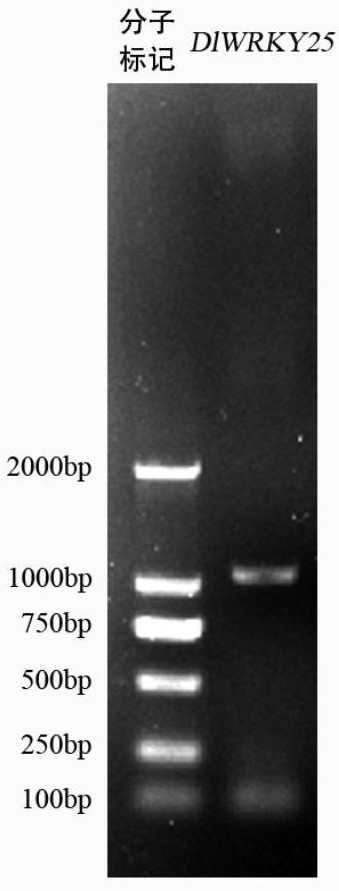
Figure 1 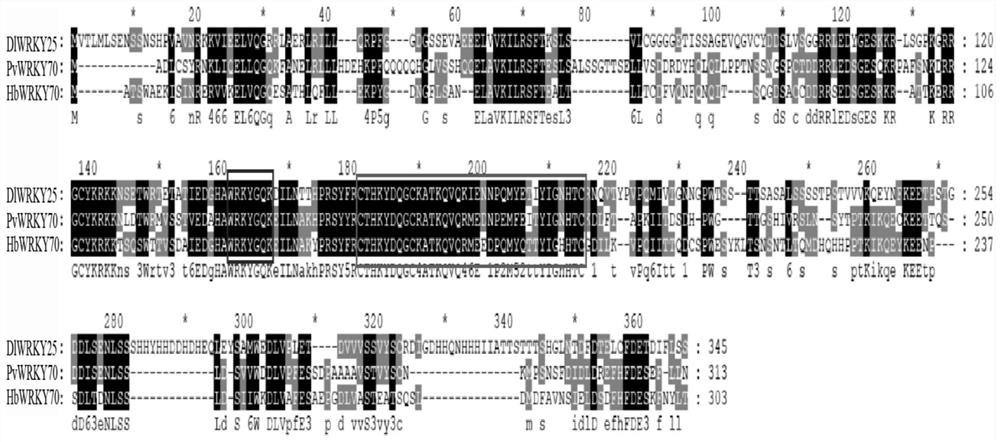
Figure 2 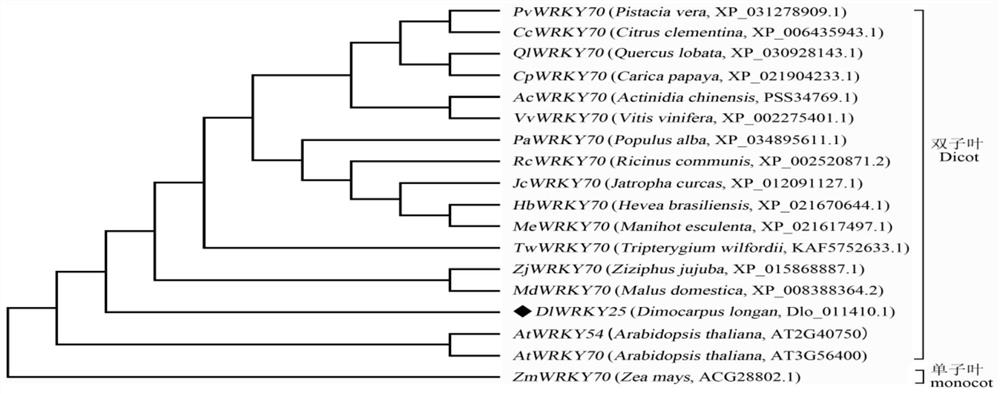
Figure 3
Abstract
Description
technical field
[0001] The invention relates to the field of molecular biology technology, in particular to a longan flowering regulating gene and application thereof. Background technique
[0002] Longan (Dimocarpus longana Lour.) is one of the important economic fruit trees in my country's tropical regions, and has a cultivation history of more than 2,000 years in my country. The flower bud differentiation of longan cultivars is seasonal and requires low temperature induction. In the main production areas of my country, such as the western part of Guangdong and Hainan, because they do not have the low temperature required for longan flowering, it is often necessary to use KClO 3 To urge flowers, but this method has great limitations, such as being restricted by factors such as species and environment. The study on the mechanism of longan flower formation is the fundamental way to solve this problem. According to relevant literature, most of the studies on longan flower fo...
Examples
Embodiment 1
[0027] The cloning of embodiment 1 target gene
[0028] 1 Materials and methods
[0029] 1.1 Source of plant material
[0030] Three groups of 'Sijimi' longan with consistent flowering habit and normal flowering main cultivar 'Shixia' longan in the longan germplasm nursery of South Subtropical Crops Research Institute, Chinese Academy of Tropical Agricultural Sciences.
[0031] 1.2 Purpose and location of sampling
[0032] Sampling sites for flower induction expression analysis: the terminal buds of three flower induction periods, respectively T1 dormant period (the terminal buds have not germinated, the water content is low, and the hardness is high); T2 "red spot" period (the terminal buds begin to germinate and develop Inflorescence, bud axis elongated, axillary buds at the base obviously swollen and turned red, commonly known as "red spot"); T3 first inflorescence stage (terminal bud fully developed into inflorescence, not bloomed).
[0033] Sampling sites for tissue ex...
Embodiment 2
[0043] Example 2 Subcellular Localization Analysis
[0044] Primers were designed according to the cloned DlWRKY25 gene sequence (removal of the terminator) (Table 1), and the full-length ORF of DlWRKY25 was amplified, and the PCR reaction procedure was as above. The PCR product was detected by 1% agarose gel electrophoresis, purified, connected to the pMD18-T vector, and transformed into DH5α. Single colonies were picked, and plasmids were sequenced after PCR detection. Then the target gene sequenced correctly was connected with the expression vector pBWA(V)HS-osgfp. The enzyme-linked plasmid was transformed into Escherichia coli DH5α, and after positive detection, the correct strain was selected for sequencing, and then extracted to obtain the pBWA(V)HS-DlWRKY25-osgfp plasmid. Then, transfer the successfully constructed plasmid into Agrobacterium LB4404 by electroporation, culture at 28°C for 2 days, scrape off the Agrobacterium block and inoculate it in YEB medium, centri...
Embodiment 3
[0045] Example 3 Overexpression vector construction and functional verification of transgenic Arabidopsis
[0046] Using specific PCR primers OEW25-S / OEW25-A (Table 1), longan cDNA was used as a template for PCR amplification. A BamH I restriction site is added to the 5' end of the primer, and a Sac I restriction site is added to the 5' end of the anti-primer. The obtained PCR product was ligated with pMD19-T vector and sequenced. Finally, the plasmids with correct sequencing were extracted, pBI121 and the plasmids with correct sequencing were double-digested with BamHI and Sac I respectively, and a plant expression vector containing the DlWRKY25 target gene was constructed by T4 DNA ligase, and named pBI121-DlWRKY25. The constructed overexpression vector pBI121-DlWRKY25 was transformed into Agrobacterium strain GV3101 by liquid nitrogen freeze-thaw method, referring to the literature (Clough, Steven J, Bent, et al. Floral dip: simplified method for Agrobacterium-mediated tra...