
Tetraphenylethylene-based polypyrazole nitrogen-containing heterocyclic compound as well as preparation method and application thereof
A nitrogen heterocyclic compound and tetraphenylethylene technology, which is applied in the field of supramolecular chemistry, can solve the problems of difficult identification of metal ions, sensitivity to pH value of radius environment, etc., and achieves the effect of strong anti-interference performance and high sensitivity
Patent Information
- Authority / Receiving Office
- CN · China
- Current Assignee / Owner
- Publication Date
- 2021-08-13
Smart Images
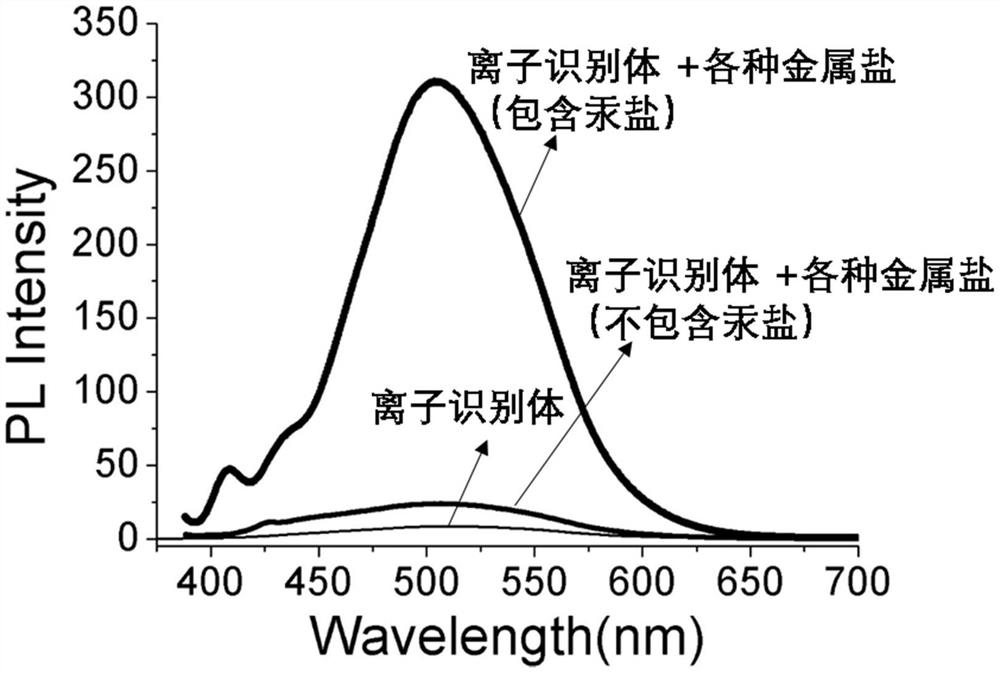
Figure 1 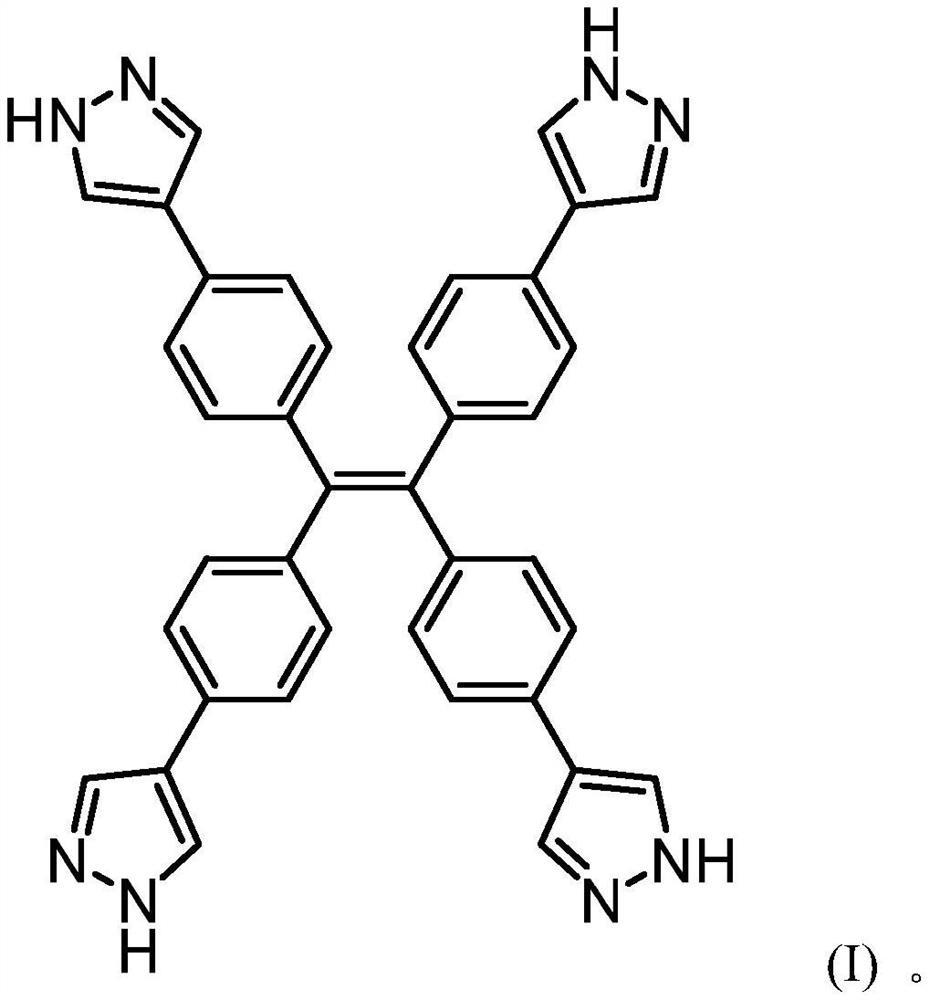
Figure 2 
Figure 3
Abstract
Description
technical field
[0001] The invention relates to the field of supramolecular chemistry, in particular to a tetrastyrylpolypyrazole nitrogen-containing heterocyclic compound, a preparation method and application thereof. Background technique
[0002] Pyrazole compounds are compounds with nitrogen heterocyclic structure, which have excellent biological and physiological activities. In recent years, many pyrazole compound pesticides have been commercialized one after another. The bactericidal performance of pyrazole compounds has also become a research hotspot. In terms of health care and plant protection, many pyrazole compounds have shown wide application and development prospects.
[0003] Metal ions play an important role in life systems and environments. The identification of metal ions has always been a field that supramolecular chemists attach great importance to. The characteristics of position configuration and sensitivity to environmental pH make the identification of...
Examples
Embodiment 1 4
[0032] Synthesis of embodiment 1 tetrastyryl polypyrazole nitrogen-containing heterocyclic compound
[0033] Weigh 1,1,2,2-tetrakis(4-bromophenyl)ethylene (1.23g, 1.91mmol) and tetrakis(triphenylphosphine)palladium (330mg, 0.14mmol) in a 100mL three-necked flask, add 20mL n-Butanol and 10ml of water, install a reflux device, add 4mL of 2M potassium carbonate aqueous solution, add 1-(tetrahydropyran-4-yl)-1H-pyrazole-4-boronic acid under the protection of gas (nitrogen) The nicohol ester (4.00 g, 14.38 mmol) was stirred at 120° C. for 72 hours.
[0034] The solvent was distilled off under reduced pressure, the resulting product was dissolved in dichloromethane, extracted three times with water, the organic layer was taken, and the solvent was removed; the product 1,1,2,2-tetrakis(4-(1-(tetrahydro pyran-4-yl)-1H-pyrazol-4-yl)phenyl)ethylene. The product 1,1,2,2-tetrakis(4-(1-(tetrahydropyran-4-yl)-1H-pyrazol-4-yl)phenyl)ethene was dissolved in methanol 20ml, and dilute Hydroc...
Embodiment 2
[0040] Embodiment 2 The selectivity of the ion recognition body of the present invention to metal mercury ions
[0041] Take 4.8 mg of the compound of formula (I) prepared by the present invention as an ion recognizer, add the ion recognizer into a sample bottle, and prepare a 0.01 mM clear solution with DMA. Prepare Hg(NO 3 ) 2 An aqueous solution of mercury ions, with a concentration of 0.01M, and a mixed aqueous solution of other transition metal ions, respectively Zn(NO 3 ) 2 , Cu(NO 3 ) 2 , Cd(NO 3 ) 2 , Co(NO 3 ) 2 , Ni(NO 3 ) 2 , Al(NO 3 ) 3 , Fe(NO 3 ) 3 , Ag(NO 3 ), Al(NO 3 ) 3 , K 2 CO 3 , the concentration is 0.01M.
[0042]Add this series of metal ion aqueous solutions to the system, only the addition of mercury ions causes the obvious solution color to turn green, and with 378nm as the fluorescence excitation wavelength, the fluorescence intensity at around 520nm is enhanced by about 15 times, see the attached figure 1 . This result shows tha...