
Synthesis method of lenvatinib
A synthesis method and technology of lenvatinib, which are applied in the field of medicinal chemical synthesis, can solve the problems of low intermediate purity, low yield, danger and the like, and achieve the effects of simple reaction steps, simple and easy-to-obtain raw materials, and low production cost.
Patent Information
- Authority / Receiving Office
- CN · China
- Patent Type
- Applications(China)
- Current Assignee / Owner
- Publication Date
- 2021-08-27
- Estimated Expiration
- Not applicable · inactive patent
Smart Images
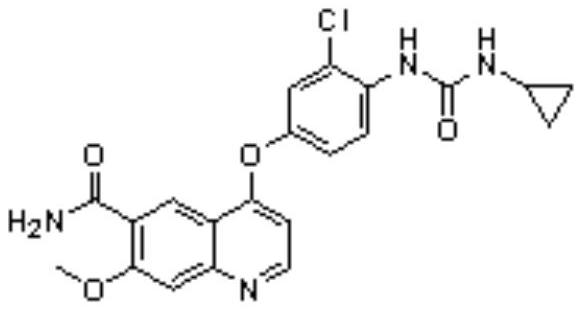
Figure 1 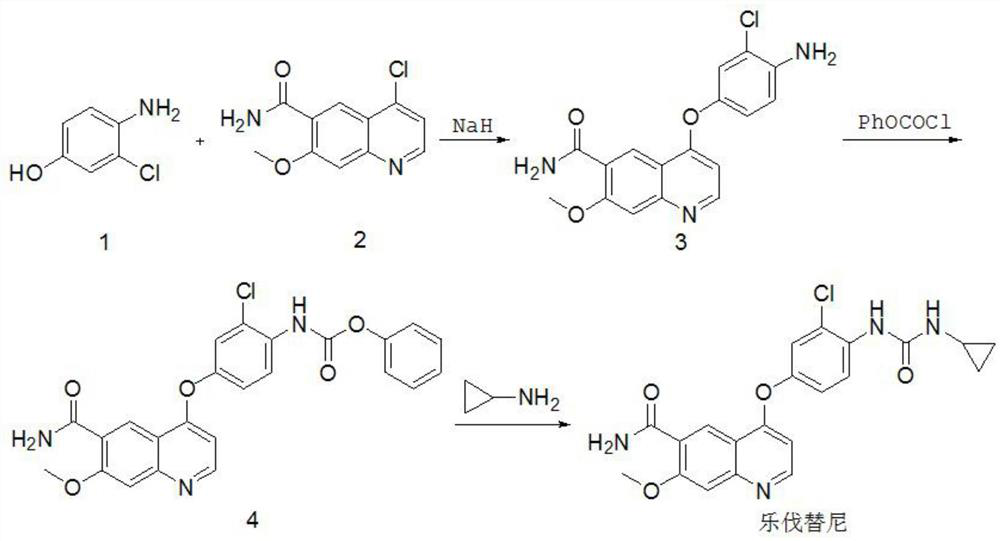
Figure 2 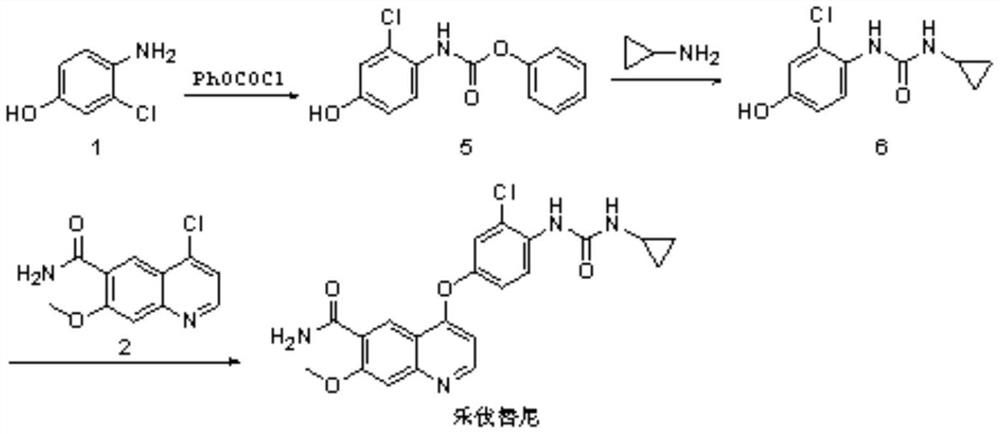
Figure 3
Abstract
Description
technical field
[0001] The invention belongs to the field of pharmaceutical chemical synthesis, and in particular relates to a synthesis method of lenvatinib. Background technique
[0002] Lenvatinib (Lenvatinib, Lenvatinib) is an oral multi-target lysine kinase inhibitor developed by Japan's Eisai (Eisai), the main targets are epidermal growth factor receptor, vascular endothelial growth factor Receptors and other receptor tyrosine kinases, etc., control tumor growth and inhibit tumor angiogenesis by acting on multiple signaling pathways, so as to prevent tumor progression and promote tumor death. It was first approved by the FDA in 2015 for the treatment of thyroid cancer, renal cell carcinoma and hepatocellular carcinoma. Lenvatinib has the characteristics of high efficiency, rapid onset of action and low side effects. On September 4, 2018, lenvatinib was approved for import in China (trade name: Lenvima), which is the second first-line targeted therapy drug for liver ca...
Examples
Embodiment 1
[0051] Dissolve methyl 2-chloro-4-hydroxybenzoate in dimethyl sulfoxide, add potassium carbonate and 4-chloro-7-methoxyquinoline-6-amide at room temperature, stir and heat to reflux for 10 hours . The molar ratio of methyl 2-chloro-4-hydroxybenzoate, 4-chloro-7-methoxyquinoline-6-amide and base is 1:0.5:1.1. After the reaction was completed, naturally cool to room temperature, concentrate under reduced pressure, pour the residue into ice water, filter, wash the filter cake with water, and recrystallize with isopropanol to obtain 4-(3-chloro-4-methoxycarbonylphenoxy) -7-methoxy-6-quinolinecarboxamide, yield 83.3%.
[0052] Dissolve 4-(3-chloro-4-methoxycarbonylphenoxy)-7-methoxy-6-quinolinecarboxamide in methanol, add 1 mol / L sodium hydroxide aqueous solution, and stir at room temperature for 18 hours. The molar ratio of 4-[3-chloro-4-methoxycarbonylphenoxy]-7-methoxy-6-quinolinecarboxamide to base is 1:2.0; 4-[3-chloro-4-methoxy The weight ratio of carbonylphenoxy]-7-methox...
Embodiment 2
[0055] Dissolve methyl 2-chloro-4-hydroxybenzoate in N,N-dimethylformamide, add sodium carbonate and 4-chloro-7-methoxyquinoline-6-amide at room temperature, stir and heat to Reflux for 10 hours. The molar ratio of methyl 2-chloro-4-hydroxybenzoate, 4-chloro-7-methoxyquinoline-6-amide and base is 1:0.9:1.5. After the reaction was completed, naturally cool to room temperature, concentrate under reduced pressure, pour the residue into ice water, filter, wash the filter cake with water, and recrystallize with isopropanol to obtain 4-(3-chloro-4-methoxycarbonylphenoxy) -7-methoxy-6-quinoline carboxamide, yield 83.9%.
[0056] Dissolve 4-(3-chloro-4-methoxycarbonylphenoxy)-7-methoxy-6-quinolinecarboxamide in ethanol, add 1 mol / L potassium hydroxide aqueous solution, and stir at room temperature for 18 hours. The molar ratio of 4-[3-chloro-4-methoxycarbonylphenoxy]-7-methoxy-6-quinolinecarboxamide to base is 1:3.0; 4-[3-chloro-4-methoxy The weight ratio of carbonylphenoxy]-7-meth...
Embodiment 3
[0059] Dissolve methyl 2-chloro-4-hydroxybenzoate in acetonitrile, add potassium hydroxide and 4-chloro-7-methoxyquinoline-6-amide at room temperature, stir and heat to reflux for 10 hours. The molar ratio of 2-chloro-4-hydroxybenzoic acid methyl ester, 4-chloro-7-methoxyquinoline-6-amide and base is 1:1.5:0.9. After the reaction was completed, naturally cool to room temperature, concentrate under reduced pressure, pour the residue into ice water, filter, wash the filter cake with water, and recrystallize with isopropanol to obtain 4-(3-chloro-4-methoxycarbonylphenoxy) -7-methoxy-6-quinoline carboxamide, yield 81.5%.
[0060] Dissolve 4-(3-chloro-4-methoxycarbonylphenoxy)-7-methoxy-6-quinolinecarboxamide in tetrahydrofuran, add 1mol / L sodium hydroxide aqueous solution, and stir at room temperature for 18 hours. The molar ratio of 4-[3-chloro-4-methoxycarbonylphenoxy]-7-methoxy-6-quinolinecarboxamide to base is 1:2.5; 4-[3-chloro-4-methoxy The weight ratio of carbonylphenoxy]...