
Lyocell fiber bamboo pulp and preparation method thereof
A bamboo pulp and fiber technology, applied in the direction of non-fibrous pulp addition, cellulose pulp post-treatment, fiber raw materials, etc., can solve the problems of limited wood resources, high pentosan content, high cost, etc., to improve the uniformity of polymerization degree , reduce the content of pentosan, improve the effect of cooking uniformity
Patent Information
- Authority / Receiving Office
- CN · China
- Patent Type
- Applications(China)
- Current Assignee / Owner
- Publication Date
- 2022-01-04
Smart Images
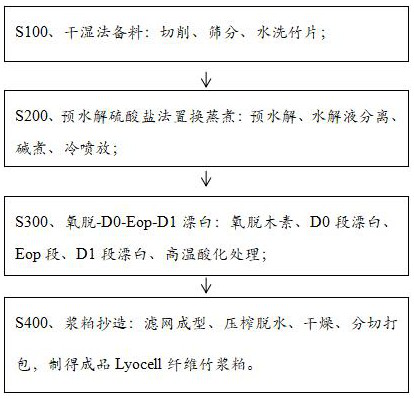
Figure 1
Abstract
Description
technical field
[0001] The invention belongs to the technical field of textiles, in particular to a Lyocell fiber bamboo pulp and a preparation method thereof. Background technique
[0002] Pulp is cellulose separated from impurities such as hemicellulose, lignin, and starch pectin in plant raw materials by physical and chemical methods. Lyocell fiber is a kind of regenerated cellulose fiber made by dry-jet wet spinning with pulp as raw material and non-toxic and tasteless NMM0 as solvent. Lyocell fiber has the advantages of both plant fiber and chemical fiber, and has the advantages of plant fiber. Comfort and strength of synthetic fibers.
[0003] In recent years, Lyocell fiber has developed rapidly, but the production raw material has always relied on sulfite wood pulp. On the one hand, the production waste produced by the sulfite pulping technology is difficult and costly to deal with, which does not meet the national environmental protection requirements, and wood res...
Examples
Embodiment 1
[0037] like figure 1 Shown, present embodiment provides a kind of preparation method of Lyocell fiber bamboo pulp, comprises the following steps:
[0038] S100, wet and dry method of material preparation
[0039] S110, cutting: cutting bamboo to form a mixture of bamboo flakes, bamboo strips, bamboo knots and bamboo ash;
[0040] S120. Screening: There is a big difference in cell structure and morphology between bamboo nodes and internode tissues. Internode tissues are rich in elongated fiber cells, while bamboo nodes are mainly short fibers and miscellaneous cells. Bamboo pulp production technology is to crush the bamboo joints, and then cook together with the internode tissue, resulting in a large dispersion of the bamboo pulp polymerization degree, so this embodiment uses a disc sieve and a swing sieve to sieve the mixture in step S110 , sieve out 20-60mm bamboo slices for later use, and sieve out bamboo sticks, bamboo joints and bamboo ash for other uses. After screening...
Embodiment 2
[0059] A kind of Lyocell fiber bamboo pulp, adopt the preparation method of the Lyocell fiber bamboo pulp of embodiment 1 to make, the whiteness of Lyocell fiber bamboo pulp>87%, pentosan<3.0%, ash<0.08%, iron content <10ppm, degree of polymerization 430-470DP.
[0060] One of the specific embodiments is:
[0061] S100, wet and dry method of material preparation
[0062] S110, cutting: cutting bamboo to form a mixture of bamboo flakes, bamboo strips, bamboo knots and bamboo ash;
[0063] S120, sieving: Utilize disc sieve and swing sieve to sieve the mixture in step S110, sieve out the bamboo chips of 20-60mm for later use, and sieve out bamboo strips, bamboo joints and bamboo ash for other purposes, and the size is qualified after sieving The weight percentage of bamboo chips is 80.1%, and the weight percentage of bamboo joints is 2.0%;
[0064] S120. Washing bamboo slices: Use inclined plate sedimentation tanks to process the washing water for recycling. The pH value of th...