
A bipolar plate for fuel cell with proton exchange membrane and preparation method thereof
A technology of proton exchange membranes and fuel cells, which is applied to fuel cell components, battery electrodes, circuits, etc., can solve the problems of difficult precise control of pore size and pore size distribution, and poor operability, so as to reduce production costs, The effect of increasing integration and simplifying the stack system
Patent Information
- Authority / Receiving Office
- CN · China
- Patent Type
- Applications(China)
- Current Assignee / Owner
- Publication Date
- 2005-03-16
- Estimated Expiration
- Not applicable · inactive patent
Smart Images
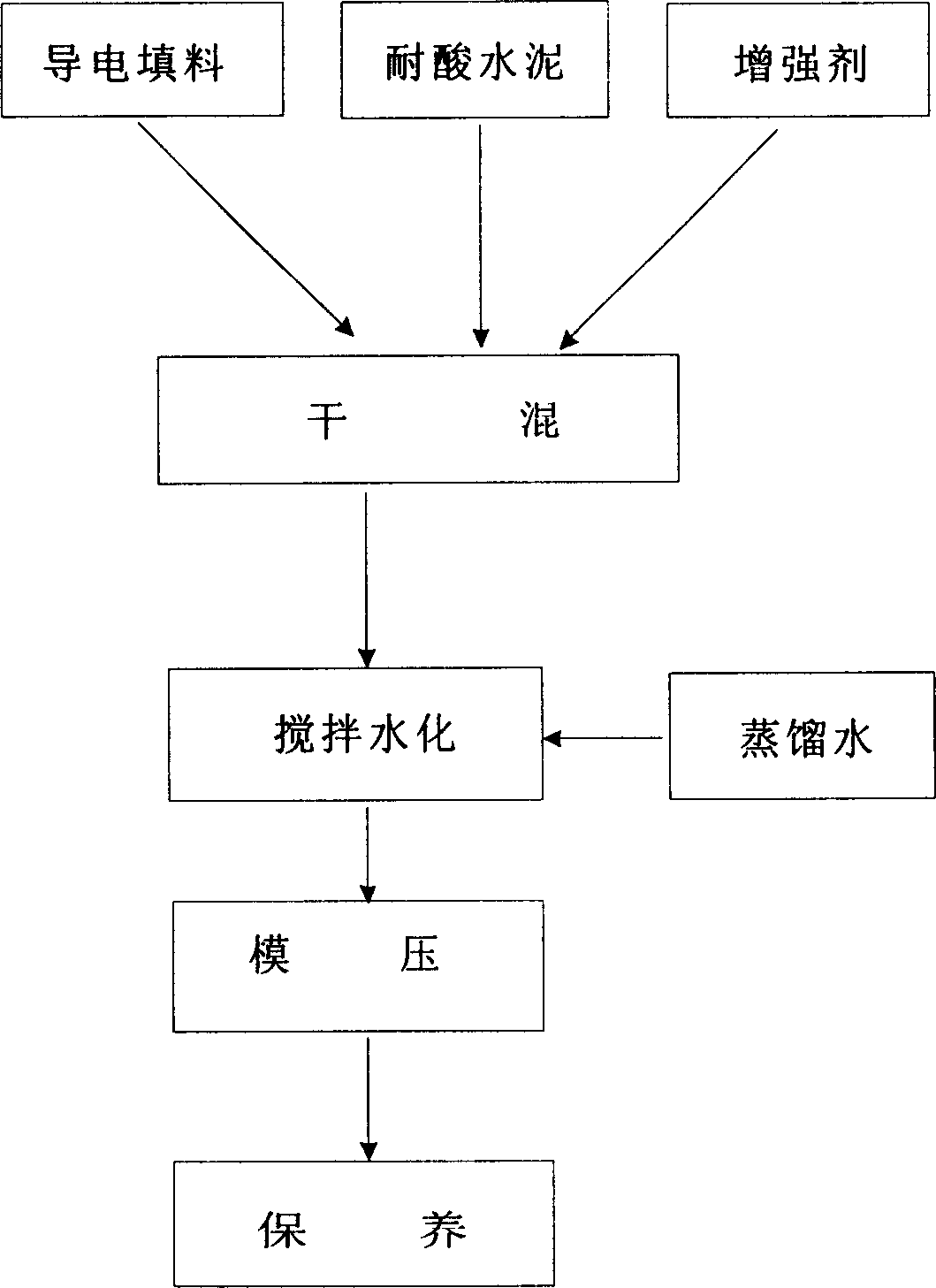
Figure 1
Abstract
Description
technical field
[0001] The invention relates to a bipolar plate with internal humidification function used in a proton exchange membrane fuel cell and a preparation method thereof. Background technique
[0002] Proton exchange membrane fuel cell (PEMFC) is a power technology that can combine hydrogen and oxygen in the air to produce water and release electricity. It has the advantages of high power density, high energy conversion rate, low temperature start-up, and no pollution. Its research has become a hot spot in the field of electrochemistry and energy science, which has attracted the attention of many developed countries and companies, and invested heavily in the development of this technology. As one of the key materials of the fuel cell, the bipolar plate has the following functions and functions: (1) separates the oxidant (oxygen or air) and the reducing agent (hydrogen), and has the function of gas barrier; (2) has the function of collecting current and draining wa...
Examples
Embodiment 1
[0022] Embodiment 1: to Ti 3 SiC 2 Grind and sieve to obtain a powder less than 30um, sieve the sulfoaluminate cement to obtain a powder less than 30um, the silica is nano-scale, dry mix the above mixture in a ball mill for 1-2 hours, add distilled water and stir to let The cement is hydrated for 30 minutes, the weight ratio of cement and water is 1:0.2-0.4, and the sheet is obtained by mold compression molding on a flat vulcanizer. The compression molding conditions are: pressure 15Mpa, compression time 12 hours. Boil in distilled water at 80°C for 2 hours, and maintain for 1 day under 90% relative humidity. Its performance test results are shown in Table 1.
[0023] Ti 3 SiC 2 volume
[0024] Table 1Ti 3 SiC 2 , cement and nano-silica conductive microporous composites performance test results.
Embodiment 2
[0025] Embodiment 2: the preparation method is the same as embodiment 1, the conductive filler Ti 3 SiC 2 Replaced with graphite, the graphite fineness is less than 20um, and its performance test results are shown in Table 2.
[0026] Graphite volume
[0027] Table 2 Performance test results of graphite, cement and nano-silica conductive microporous composites.
Embodiment 3
[0028] Embodiment 3: the preparation method is the same as embodiment 1, the conductive filler Ti 3 SiC 2 Replacement to Graphite and Ti 3 SiC 2 A mixture of graphite fineness less than 20um, Ti 3 SiC 2 The fineness is less than 30um, and the performance test results are shown in Table 3.
[0029] Graphite volume
[0030] Table 3 Graphite, Ti 3 SiC 2 , cement and nano-silica conductive microporous composites performance test results.