
Sampling-efficient mapping of images
a mapping technique and image technology, applied in the field of image data storage and transmission, graphics software, computers, etc., can solve the problems of reducing or otherwise limiting the quality of rendered images, schemes tend to be significantly more complicated to implement in hardware configuration, and no consistent method has been presented for comparing the different features and/or performance of these and other mapping techniques. to achieve the effect of reducing memory/bandwidth requirements
Patent Information
- Authority / Receiving Office
- US · United States
- Patent Type
- Applications(United States)
- Current Assignee / Owner
- Publication Date
- 2002-09-12
- Estimated Expiration
- Not applicable · inactive patent
Smart Images
Figure 1 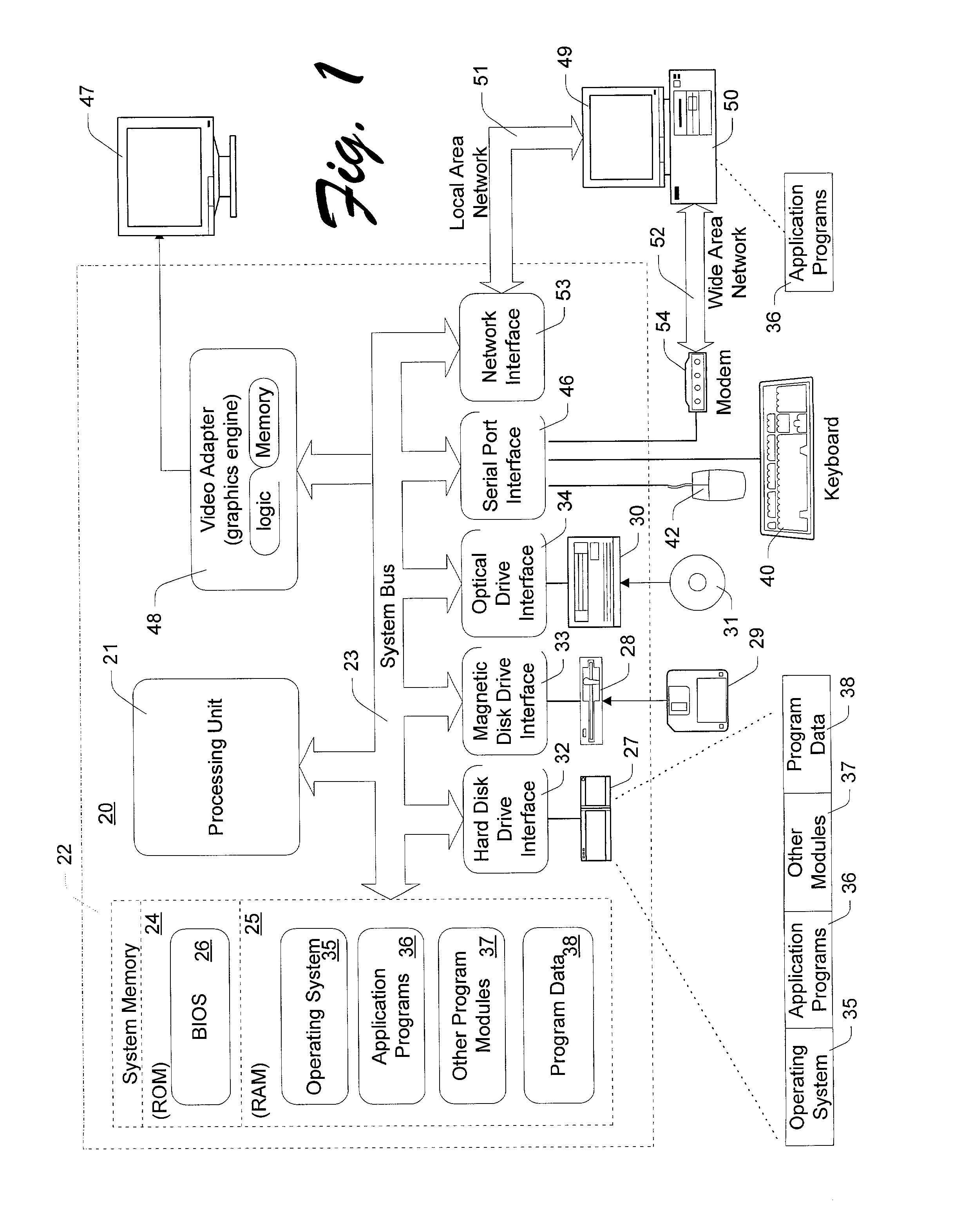
Figure 2 
Figure 3
Abstract
Description
TECHNICAL FIELD
[0001] This invention relates to computers, graphics software, and image data storage and transmission, and more particularly to improved methods and arrangements for use in generating three-dimensional images, such as, e.g., spherical-like images, using novel sampling-efficient mapping techniques.BACKGROUND
[0002] Computer graphic techniques for mapping textures to three-dimensional surfaces have been developed and implemented in software and hardware. These conventional implementations usually map rectangular texture samples to the surface being rendered. Such texture samples or maps tend to present certain limitations that can significantly degrade or otherwise limit the quality of the rendered image.
[0003] Consequently, there is a need for improved computer graphic techniques for mapping textures to three-dimensional surfaces. Preferably, the improved computer graphic techniques will be simpler to implement and suitable for more cost-effective software and / or hardw...
Examples
Embodiment Construction
[0046] Exemplary Operating Environment:
[0047] With reference to FIG. 1, an exemplary system for implementing the operations described herein includes a general-purpose computing device in the form of a conventional personal computer 20, including a processing unit 21, a system memory 22, and a system bus 23. System bus 23 links together various system components including system memory 22 and processing unit 21. System bus 23 may be any of several types of bus structures including a memory bus or memory controller, a peripheral bus, and a local bus using any of a variety of bus architectures. System memory 22 includes read only memory (ROM) 24 and random access memory (RAM) 25. A basic input / output system 26 (BIOS), containing the basic routine that helps to transfer information between elements within the personal computer 20, such as during start-up, is stored in ROM 24.
[0048] As depicted, in this example personal computer 20 further includes a hard disk drive 27 for reading from ...