
Polycrystalline diamond abrasive elements
a technology of diamond abrasives and diamonds, applied in the field of tool inserts, can solve the problems of cutting tool inserts subjected to heavy loads and high temperatures, cutting tools subjected to large contact pressures, and their life, and achieve the effect of improving wear behaviour
Patent Information
- Authority / Receiving Office
- US · United States
- Current Assignee / Owner
- Publication Date
- 2005-06-30
Smart Images
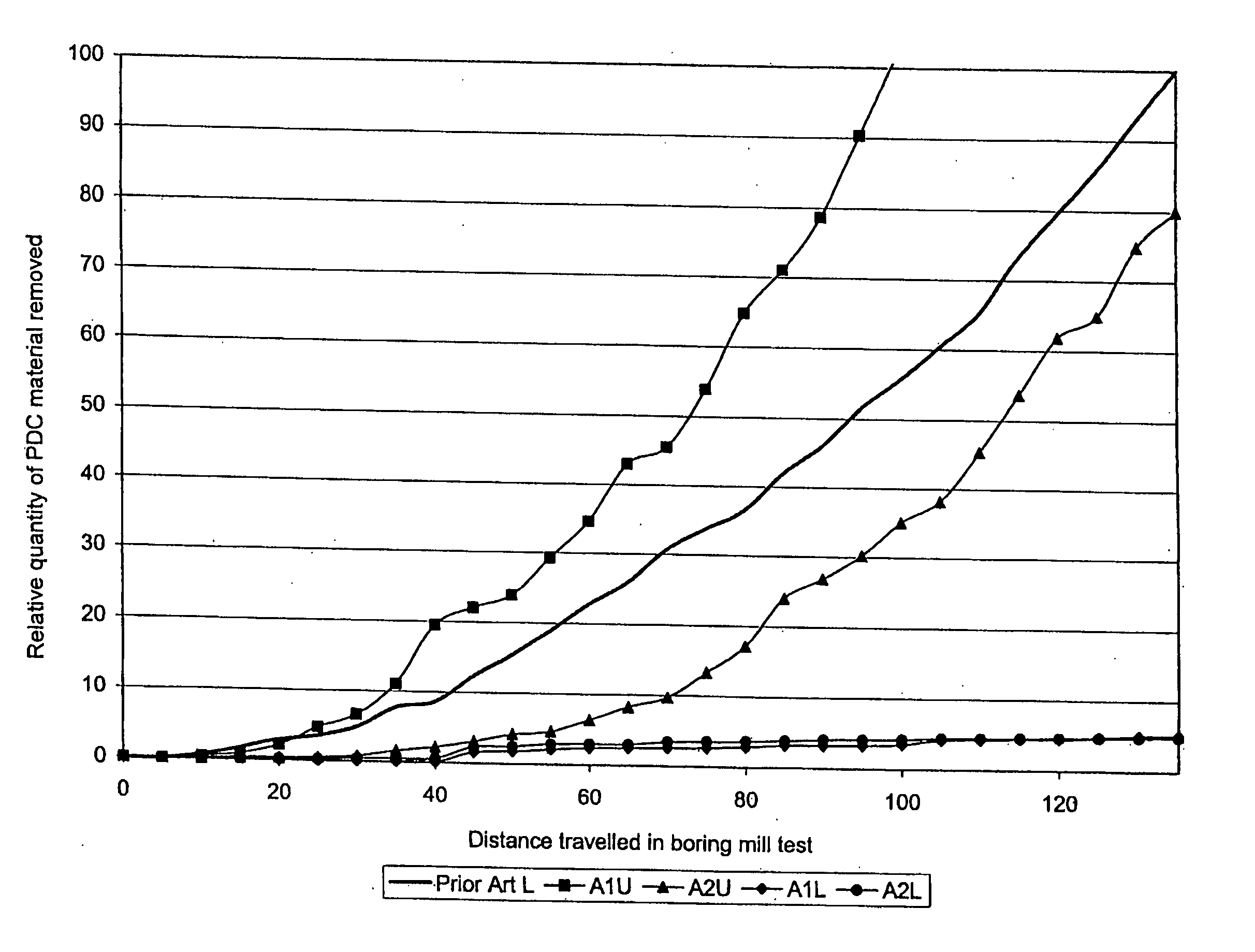
Figure 1 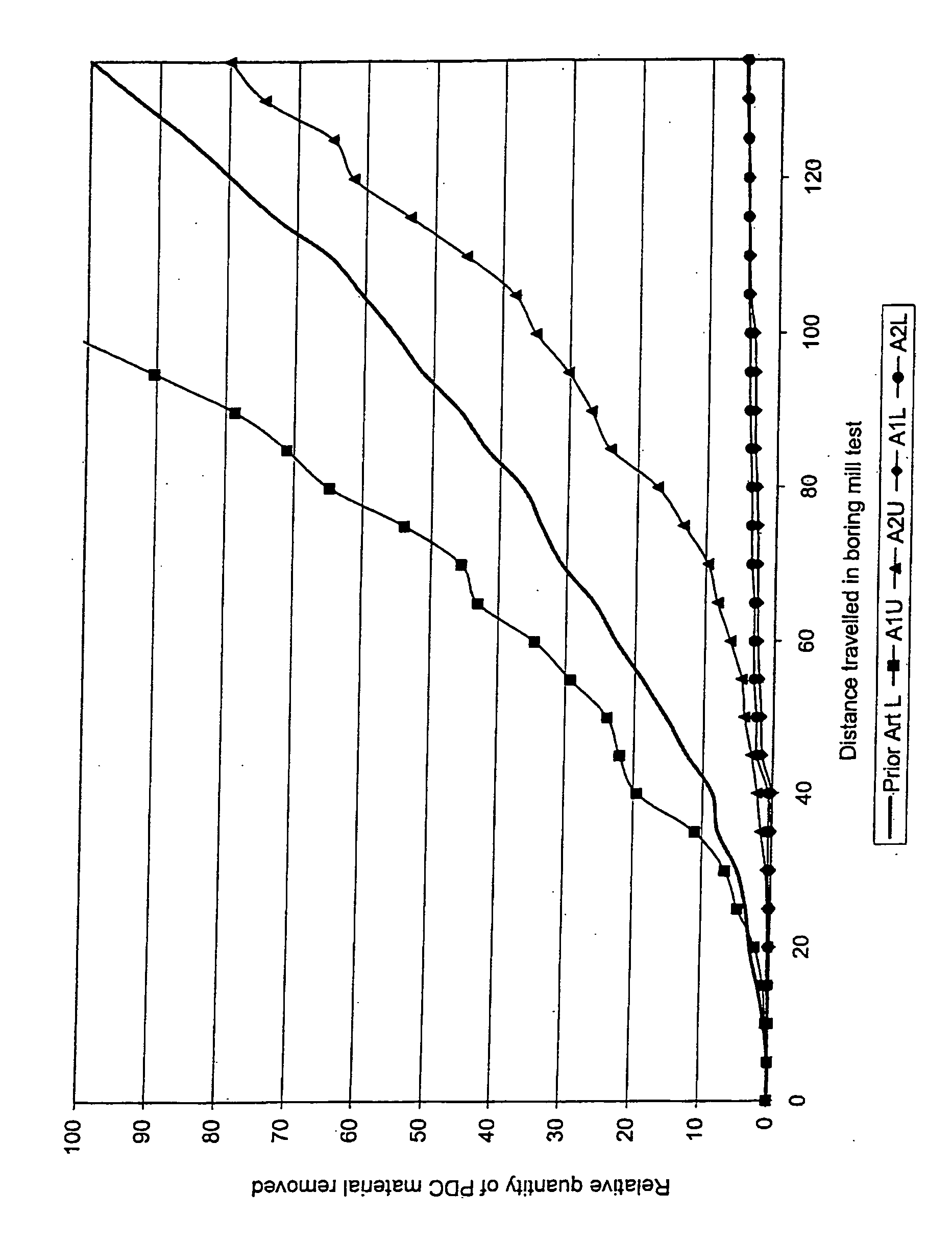
Figure 2
Abstract
Description
BACKGROUND OF THE INVENTION
[0001] This invention relates to tool inserts and more particularly to cutting tool inserts for use in drilling and coring holes in subterranean formations.
[0002] A commonly used cutting tool insert for drill bits is one which comprises a layer of polycrystalline diamond (PCD) bonded to a cemented carbide substrate. The layer of PCD presents a working face and a cutting edge around a portion of the periphery of the working surface.
[0003] Polycrystalline diamond, also known as a diamond abrasive compact, comprises a mass of diamond particles containing a substantial amount of direct diamond-to-diamond bonding. Polycrystalline diamond will generally have a second phase which contains a diamond catalyst / solvent such as cobalt, nickel, iron or an alloy containing one or more such metals.
[0004] In drilling operations, such a cutting tool insert is subjected to heavy loads and high temperatures at various stages of its life. In the early stages of drilling, ...
Examples
Embodiment Construction
[0037] The polycrystalline diamond abrasive elements of the invention have particular application as cutter elements for drill bits. In this application, they have been found to have excellent wear resistance and impact strength without being susceptible to spalling or chipping. These properties allow them to be used effectively in drilling or boring of subterranean formations having high compressive strength.
[0038] A polycrystalline diamond layer is bonded to a substrate. The polycrystalline diamond layer has an upper working surface around which is a peripheral cutting edge. The polycrystalline diamond layer has a region rich in catalysing material and a region lean in catalysing material. The region lean in catalysing material extends from the working surface into the polycrystalline diamond layer. The depth of this region will typically be no more than about 500 microns, and is preferably from about 30 to about 400 microns, most preferably from about 60 to about 350 microns. Ty...