
N-(2-benzyl)-2-phenylbutanamides as androgen receptor modulators
a technology of androgen receptor and n-(2-benzyl)-2-phenylbutanamide, which is applied in the field of n-(2-benzyl)2-phenylbutanamide derivatives, can solve the problems of hot flushes, significant bone loss, fatigue, etc., and achieves the effects of stimulating muscle growth, reducing skin irritation, and reducing the risk of sarcopenia and frailty
Patent Information
- Authority / Receiving Office
- US · United States
- Current Assignee / Owner
- Publication Date
- 2005-12-15
- Estimated Expiration
- Not applicable · inactive patent
Smart Images
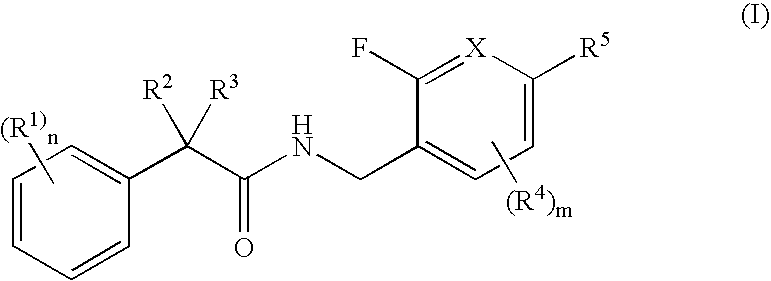
Figure 1 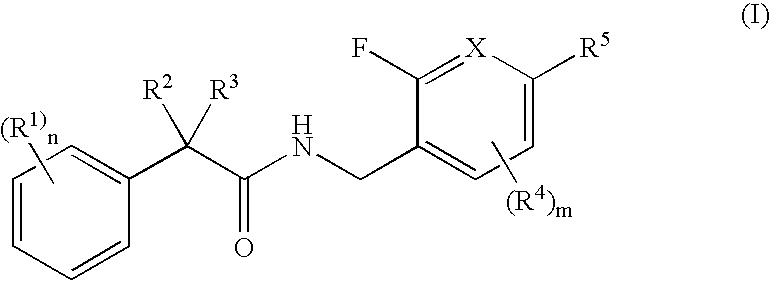
Figure 2 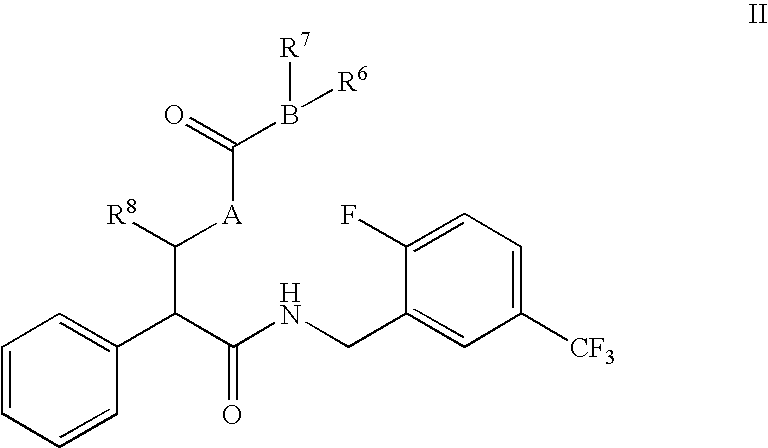
Figure 3
Abstract
Description
FIELD OF THE INVENTION
[0001] The present invention relates to N-(2-benzyl)-2-phenylbutanamide derivatives, their synthesis, and their use as androgen receptor modulators. More particularly, the compounds of the present invention are tissue-selective androgen receptor modulators (SARMs) and are thereby useful for the treatment of conditions caused by androgen deficiency or which can be ameliorated by androgen administration, such as osteoporosis, periodontal disease, bone fracture, frailty, and sarcopenia. Additionally, the SARMs of the present invention can be used to treat mental disorders associated with low testosterone, such as depression, sexual dysfunction, and cognitive decline. SARMs, being antagonists in specific tissues, are also useful in conditions where elevated androgen tone or activity causes symptoms, such as benign prostate hyperplasia and sleep apnea. BACKGROUND OF THE INVENTION
[0002] The androgen receptor (AR) belongs to the superfamily of steroid / thyroid hormon...
Examples
example 1-1
[0450] Examples 1-1 and 1-2 were synthesized in accordance with Scheme 1.
(S)—N-(2-fluoro-5-(trifluoromethyl)benzyl)-2-phenylbutanamide (1-1)
[0451]
[0452] A solution of (S)-2-phenylbutanoic acid (1-d, 50 mg, 0.30 mmol, Sigma-Aldrich, Milwaukee, Wis.) and diisopropylethylamine (98 uL, 0.60 mmol) in N,N-dimethylformamide (1 mL) was treated at room temperature with benzotriazol-1-yloxytripyrrolidinophosphonium hexafluorophosphate (PyBop, 158 mg, 0.30 mmol). After 15 min, (2-fluoro-5-(trifluoromethyl)phenyl)methanamine (1-g, 60 mg, 0.30 mmol, Synthesis, Inc., Wyndham, N.H.) was added. The reaction mixture was stirred for 3 h, partitioned between dichloromethane and 0.5N—NaOH. The aqueous layer was removed and the organic layer was washed with 0.5N—HCl. The aqueous layer was removed by filtering through a plastic frit. The organic layer was concentrated in vacuo to give the desired product (1-1); HRMS (M+1) 340.12941H NMR (500 MHz, CDCl3) 7.49 (bs, 1H), 7.41 (d, 1H, J=6.5 Hz), 7.34-7.26...
example 1-2
N-(2-fluoro-5-methylbenzyl)-2-phenylbutanamide (1-2)
[0453]
[0454] A solution of (2-fluoro-5-methylphenyl)methanamine (1-f, 50 mg, 0.26 mmol, Oakwood Products, Inc., West Columbia, S.C.) and diisopropylethylamine (88 uL, 0.52 mmol) in dichloromethane (1 mL) was treated at room temperature with 2-phenylbutanoyl chloride (1-a, 47 mg, 0.26 mmol). The reaction mixture was stirred for 30 min, partitioned between dichloromethane and 0.1N—NaOH. The aqueous layer was removed and the organic layer was washed with 0.1N—HCl. The aqueous layer was removed by filtering through a plastic frit. The organic layer was evaporated in vacuo to give the desired product (1-2); HRMS (M+1) 286.1586.
[0455] Additionally, Examples 1-3 through 1-28 in Table 1 below were prepared by the general protocols described in Scheme 1. Specific details of the synthesis of particular compounds are presented below.
[0456] Examples 1-6 through 1-9 were obtained by direct introduction of ethyl, vinyl or cyclopropyl group to...
example 1-3
[0464] Compound 1-3 was synthesized as shown in Scheme 3 and described below.
Step A (S)—N-((2-amino-5-(trifluoromethyl)pyridin-3-yl)methyl)-2-phenylbutanamide (3-2)
[0465]
[0466] A solution of 5-(trifluoromethyl)pyridin-2-amine (3-a with R4═CF3, 1.6 g, 9.87 mmol) (Maybridge Chemical company, Cornwall, England) in N,N-dimethylformamide (30 mL) was treated at room temperature with silver sulfate (3.1 g, 9.87 mmol) and iodine (2.5 g, 9.87 mol). The reaction mixture was stirred for 14 h and filtered. The filtrated solution was concentrated in vacuo. The residue was chromatographed (SiO2, 25% ethyl acetate in hexanes) to give 5-(trifluoromethyl)-3-iodopyridin-2-amine (3-b, with R4═CF3). The iodide (3-b, with R4═CF3, 1.0 g, 3.47 mmol) and cuprous cyanide (CuCN, 78 g, 8.68 mmol) was dissolved in N,N-dimethylformamide (6 mL) and heated under the microwave at 100 C for 30 min, cooled to ambient temperature, and diluted with ethyl acetate. The precipitates were removed by filtration. The fil...