
Acid functional polyamideimides
a technology of polyamideimide and acid functional, applied in the field of polyamideimide (pai) base coating composition, can solve the problems of economic inability to use amideimide coatings and limit their use, and achieve the effects of reducing the cost of use, and reducing the cost of solvent systems
Patent Information
- Authority / Receiving Office
- US · United States
- Current Assignee / Owner
- Publication Date
- 2007-06-21
- Estimated Expiration
- Not applicable · inactive patent
Smart Images
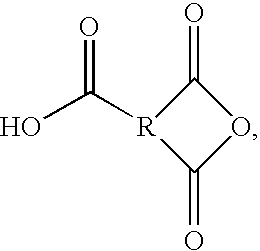
Figure 1 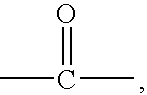
Figure 2 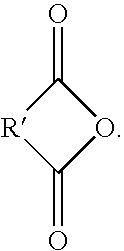
Figure 3
Abstract
Description
CROSS REFERENCE TO RELATED APPLICATIONS
[0001] None STATEMENT REGARDING FEDERALLY SPONSORED RESEARCH OR DEVELOPMENT
[0002] Not applicable BACKGROUND OF THE INVENTION
[0003] This invention relates to polyamideimide (PAI) base coating compositions; and more particularly, to such coating compositions having excess carboxyl functionality.
[0004] Resinous coating compositions in the form of varnishes and enamels, and in which, for ease of application, the polymer is dissolved in compatible solvents, are well known. Polyamideimide compositions are described, for example, in U.S. Pat. No. 4,259,221.
[0005] Among the most useful coating compositions are those based on polyamideimides. Polyamideimide coating compositions form flexible and durable films, and are particularly useful as wire enamels, varnishes, adhesives for laminates, non-stick coatings, paints and the like. These compositions are particularly noted for their long term high temperature capability (≈220° C. (430° F.)). In addit...
Examples
example 1
[0123] To 160.0 g glacial acetic acid, add 38.4 g (2 equivalents) of trimellitic anhydride and 10.3 g (1 equivalent) of diethylenetriamine. Stir the resulting mixture under a nitrogen blanket and heat the batch to a reflux temperature of 110-120° C. (230-248° F.). Hold for one (1) hour. Cool the batch to room temperature and allow the product to precipitate out of the solution. Filter off the product, wash it with ethanol, and dry the product in an oven. The final product was a tan powder. The material was characterized by NMR and MS to confirm the structure of a bisimide adduct with the secondary amine unreacted.
example 2
[0124] To 160.0 g of glacial acetic acid, add 38.4 g (2 equivalents) of trimellitic anhydride and 13.1 g (1 equivalent) of dipropylenetriamine. Stir the mixture under a nitrogen blanket. Heat the batch to a reflux temperature of 110-120° C. (230-248° F.) and hold for one (1) hour. Cool the batch to room temperature and allow the product to precipitate out of the solution. Filter off the product, wash it with ethanol, and dry the product in an oven. The final product was a white powder. The material was characterized by NMR and MS to confirm the structure of a bisimide adduct with the secondary amine unreacted.
example 3
[0125] To 1000.0 g of glacial acetic acid, add 384.2 g (2 equivalents) of trimellitic anhydride and 297.3 g (1 equivalent) of 4,4′-diaminodiphenylamine sulfate. Stir the mixture under a nitrogen blanket. Heat the batch to a reflux temperature of 110-120° C. (230-248° F.) and hold for three (3) hours. Cool the batch to room temperature and allow the product to precipitate out of the solution. Filter off the product, wash it with methanol, and dry the product in an oven. The final product was a dark blue powder. The material was characterized by NMR and MS to confirm the structure of a bisimide adduct with the secondary amine unreacted.