
Protease-resistant modified seb and vaccine containing the same
Patent Information
- Authority / Receiving Office
- US · United States
- Current Assignee / Owner
- Publication Date
- 2010-07-01
- Estimated Expiration
- Not applicable · inactive patent
Smart Images
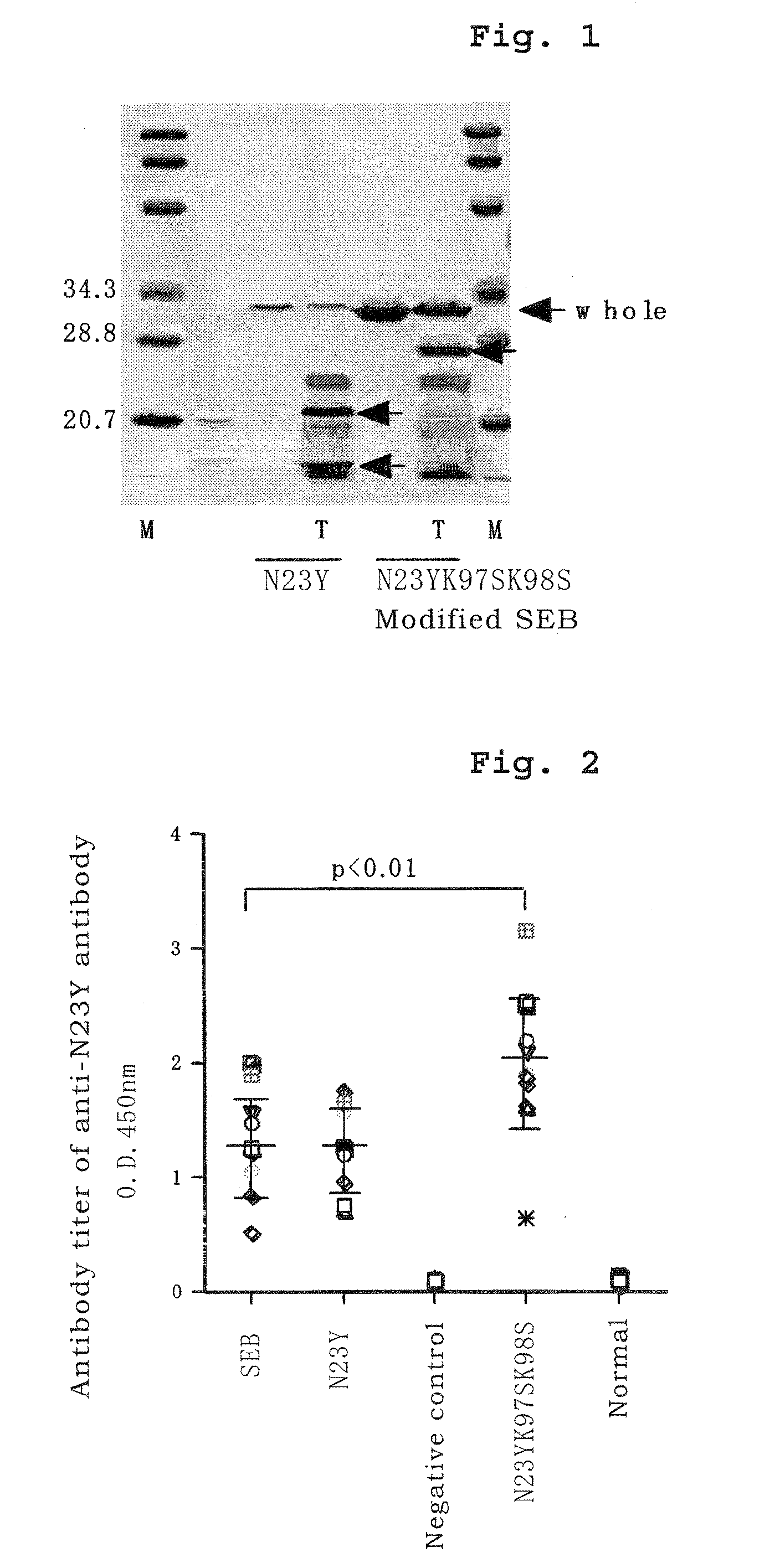
Figure 1 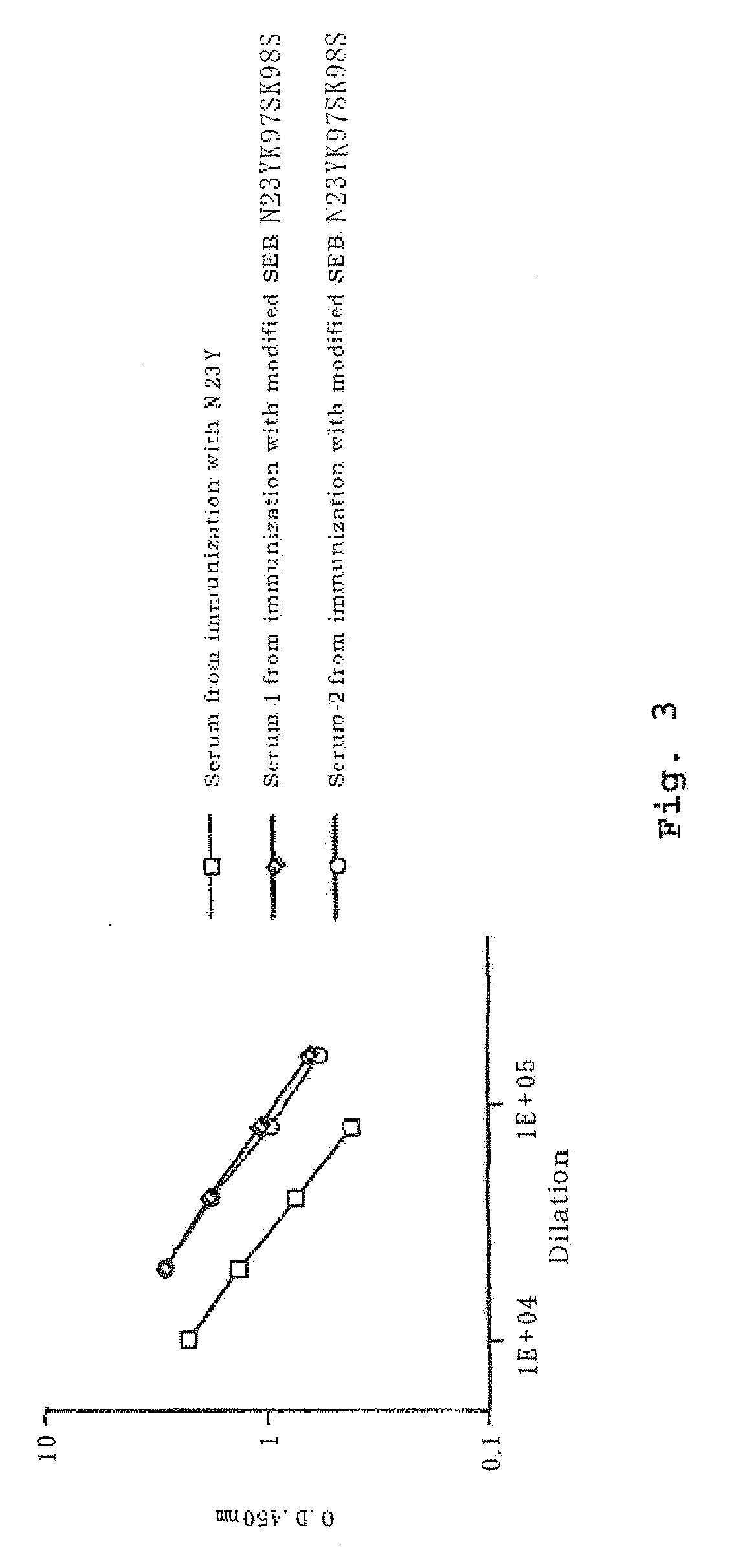
Figure 2 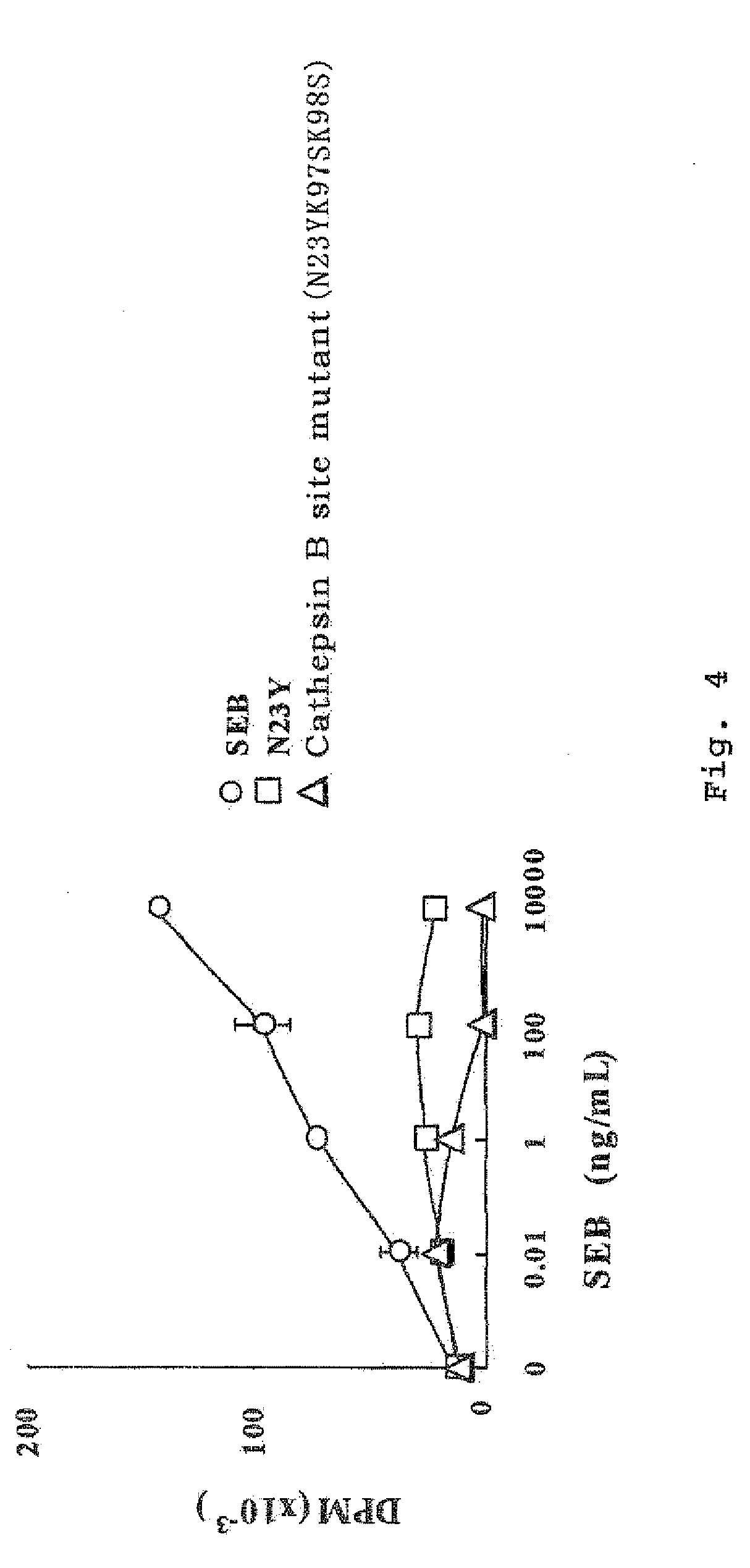
Figure 3
Abstract
Description
CROSS-REFERENCE TO RELATED APPLICATIONS
[0001] The present application is a continuation of application Ser. No. 10 / 570,499, filed Dec. 11, 2006, which is a 371 national stage application of PCT / JP04 / 12545, filed Aug. 31, 2004. The entire content of both applications are incorporated herein by reference.TECHNICAL FIELD
[0002] The present invention relates to modified forms of Staphylococcal enterotoxin B (hereinafter also referred to as “SEB”), known as one of superantigens, or a derivative thereof and a vaccine comprising as an active ingredient the modified SEB or a derivative thereof and use of the vaccine. More particularly, the present invention relates to a modified SEB or a derivative thereof which has resistance to a protease and consequently has a reduced toxicity, and a vaccine comprising as an active ingredient said modified SEB or a derivative thereof and use of the vaccine.BACKGROUND ART
[0003] SEB is one of enterotoxins (causative toxins of toxin-type food poisoning) produce...
Examples
examples
[0041]The present invention is explained in more detail by means of the following Preparation and Examples but should not be construed to be limited thereto.
preparation 1
Preparation and Expression of Recombinant Modified SEB
[0042]A DNA library of Staphylococcus aureus enterotoxin A+B+C was purchased from CLONOTEC and plaque hybridization was performed. Antisense synthetic DNAs or PCR fragments were used as a probe. For facilitating the subsequent cloning, SalI cleavage sites were introduced at both ends of the primers.
[0043]Plaques bound with the above primers were selected and subject to PCR with sense primers. DNAs were extracted from the bands obtained and cloned into PCR-II vector (Invitrogen). Table 1 shows the primers used for hybridization as described above.
TABLE 1Antisense:5′-AAG TCG ACA ATA TTA GAA AAG GCA GGT ACT-3′(SEQ ID NO: 3) Sal ISense:5′-ATG TCG ACT TAA TTG AAT ATT TAA GAT TAT-3′(SEQ ID NO: 4) Sal I
[0044]Then, a nucleotide sequence of the DNA was determined with an automated sequencer. The obtained SEB gene was found to contain a promoter region (SEB-Pro). Thus, in order to obtain an SEB gene ...
example 1
Lethal Toxicity Test with Mice
[0054]As reported by Miethke T. et al., it is known that although no lethal toxicity would normally be brought about with natural SEB in mice, administration of 20 μg / kg D-galactosamine followed by intravenous or intraperitoneal administration of 20 μg / mouse SEB would lead to death in mice (J. Exp. Med., Vol. 175, p. 91-98 (1992)). In this Example, whether the modified SEB may indeed be improved in lethality in mice was investigated by administering SEB or the modified SEB to mice which previously received D-galactosamine.
[0055]First, in order to assess susceptibility to endotoxin, 20 mg / mouse of D-galactosamine was administered to BALE / c mice and then LPS (lipopolysaccharide) from E. coli B4 was administered intravenously to investigate lethality after 24 hours. As a result, it was found that an LPS dose of 1 ng / mice or less lead to no death of animal (Table 4).
TABLE 4DoseNumber of Death / Total number1μg / head7 / 9100ng / head8 / 910ng / head5 / 91ng / head0 / 90.1ng / ...