
Aspartic acid ester-functional polysiloxanes, their preparation and use thereof
Patent Information
- Authority / Receiving Office
- US · United States
- Current Assignee / Owner
- Publication Date
- 2021-11-25
Smart Images
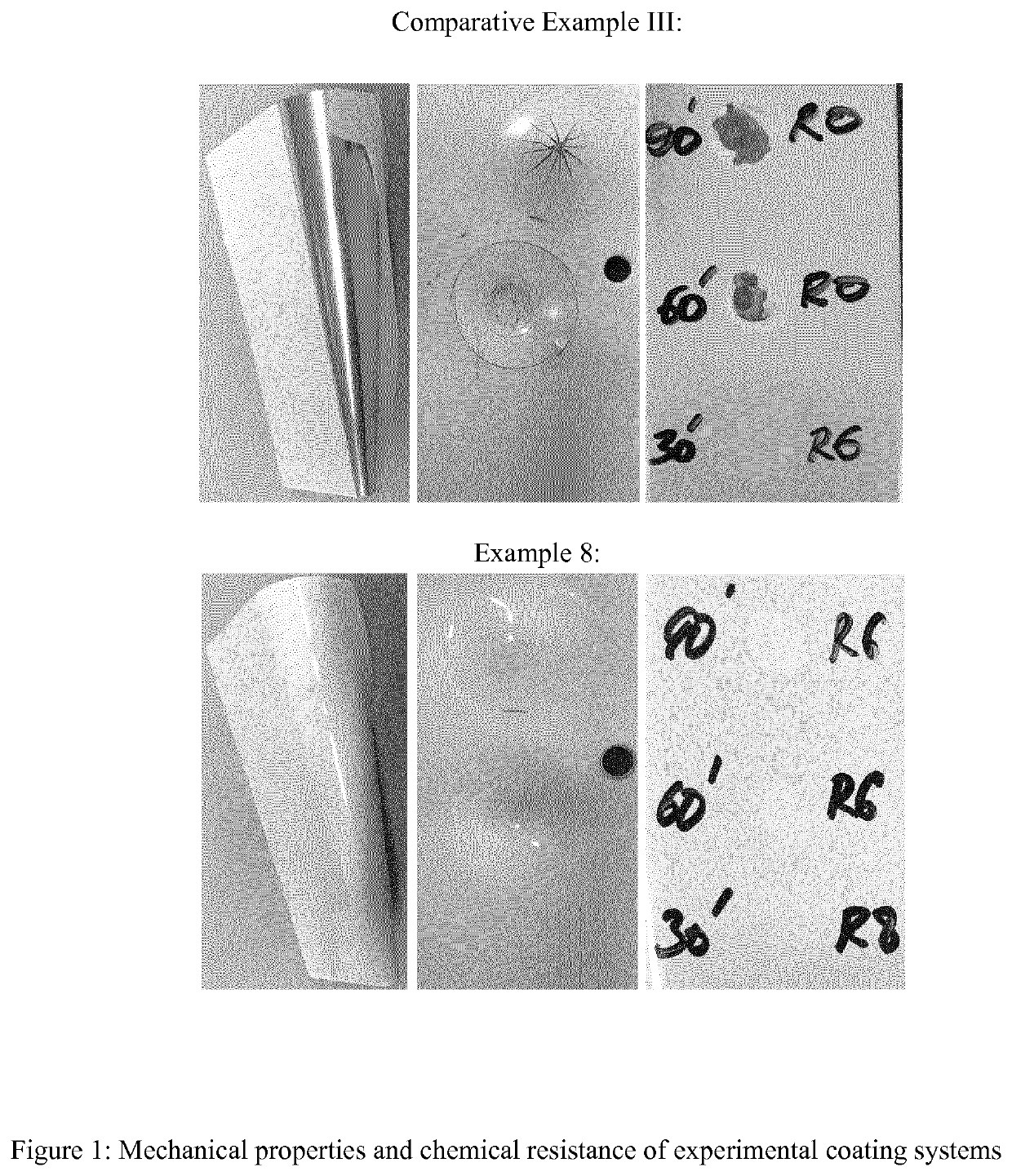
Figure 1 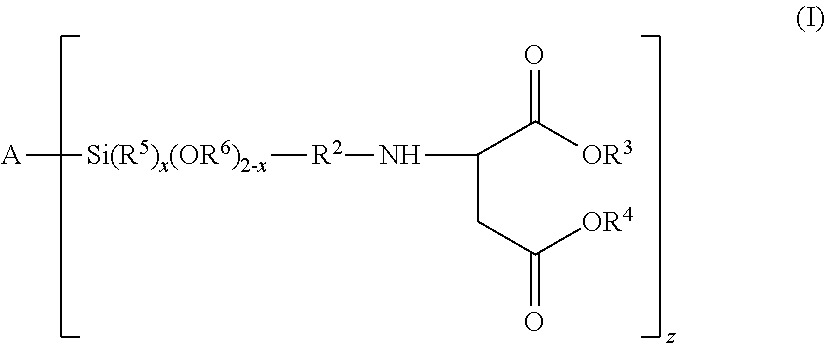
Figure 2 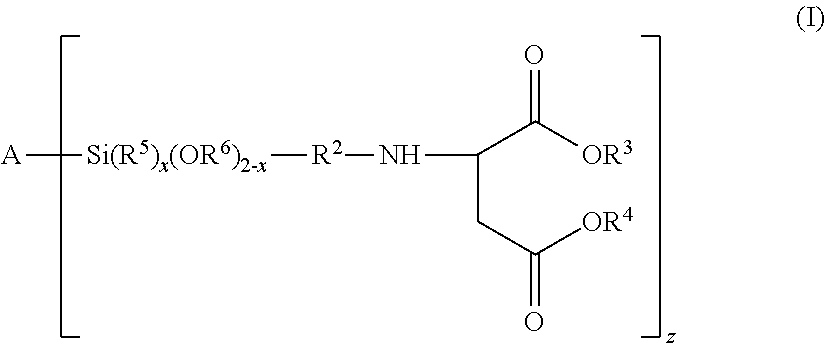
Figure 3
Abstract
Description
FIELD OF INVENTION
[0001] The present invention relates to aspartic acid ester-functional polysiloxanes, their use in the manufacture of curable compositions using polyisocyanate crosslinkers, in particular, in the manufacture of coating compositions, cured compositions obtained from said curable compositions and articles comprising the cured compositions.BACKGROUND OF THE INVENTION
[0002] Polymer coating systems containing reactive polyurethane and polyurea polymers in which the backbones contain urethane and / or urea groups are very well known in the art as a tough and durable compositions utilized in a wide variety of commercial applications in the construction, marine, industrial and automotive field. Notwithstanding the high performance characteristics of the polyurethane or polyurea based coating compositions such systems very often require additional adjustment of bending strength, elongation, impact flexibility and chemical resistance. Polysiloxanes are well known in the art as s...
Examples
embodiment 1
[0166]A compound of the formula (I):
[0167]wherein
[0168]A is oxygen (—O—) or a polyorganosiloxanyl residue comprising at least one siloxy unit selected from the group consisting of R13SiO2, R12SiO2 / 2, R1SiO3 / 2 and SiO4 / 2, wherein R1 is an organic group and the polyorganosiloxanyl residue is bonded to Si via an oxygen atom, with the provisos that (i) if A is oxygen (—O—), then z is 2, and (ii) if A is a polyorganosiloxanyl residue, then the polyorganosiloxanyl residue contains at least two siloxy groups which can bond to the silicon atom;
[0169]each R2 is independently selected from the group consisting of a straight chain alkylene group having from 1 to 10 carbon atoms, branched chain alkylene group having from 3 to 10 carbon atoms, a cycloalkylene group having from 3 to 10 carbon atom, an arylene group having from 6 to 12 carbon atoms, an aralkylene group having from 7 to 10 carbon atoms and an arenylene group having from 7 to 10 carbon atom, preferably methylene, propylene, 2-methyl...
example 1
of Aspartic Acid Ester-Functional Polysiloxane (AEAFP-1)
[0259]4-Amino-3,3-dimethylbutyltrimethoxysilane (256 grams, 1.15 mole) was charged in a 1000-ml four neck flask, equipped with a stirrer, condenser, thermometer and a dropping funnel. Hydroxy-terminated polydimethylsiloxane (260 grams with an OH content of 4.4 mmole / gram or 1.15 mole of OH) was added to the aminosilane from the dropping funnel over 30 minutes, starting at room temperature. During the feeding the temperature increased up to 31° C. After the feeding, the mixture was heated up to 70° C. and held for 2 hours at 70° C. After that, the formed methanol was stripped out at 150° C., 20 mbar. Yield: 450 grams of a low viscous amino-functional siloxane with an amine content of 2.4 mmole N / gram, determined by titration with 1 molar hydrochloric acid. The following structure of the product (AFP-1) was confirmed by the 1H and 29Si NMR analyses.
[0260]wherein n1 is about 4 to about 8.
[0261]Amino-functional polysiloxane (AFP-1)...
example 2
of Aspartic Acid Ester-Functional Polysiloxane (AEAFP-2)
[0262]3-Aminopropyltriethoxysilane (221 grams, 1 mole, obtained from Momentive under the trade designation Silquest* A-1100 silane) was charged into a 1000 ml four neck flask, equipped with stirrer, condenser, thermometer and dropping funnel. Over the dropping funnel 260 grams of a hydroxy-terminated polydimethysiloxane with an OH content of 4.4 mmole / gram or 1.15 mole OH were added to the above aminosilane over 30 minutes, starting at room temperature. During the feeding the temperature increased up to 31° C. After the feeding, the mixture was heated up to 70° C. and held for 2 hours at 70° C. After that, the formed ethanol was stripped out at 150° C., 20 mbar. Yield: 450 grams of a low viscous amino-functional polysiloxane (AFP-2) with an amine content of 2.5 mmole N / gram, determined by titration with 1 molar hydrochloric acid. The following structure of the product (AFP-2) was confirmed by the 1H and 29Si NMR analyses.
wherei...