
Novel synthetic glycolipid and use thereof
Patent Information
- Authority / Receiving Office
- US · United States
- Current Assignee / Owner
- Publication Date
- 2013-01-03
- Estimated Expiration
- Not applicable · inactive patent
Smart Images
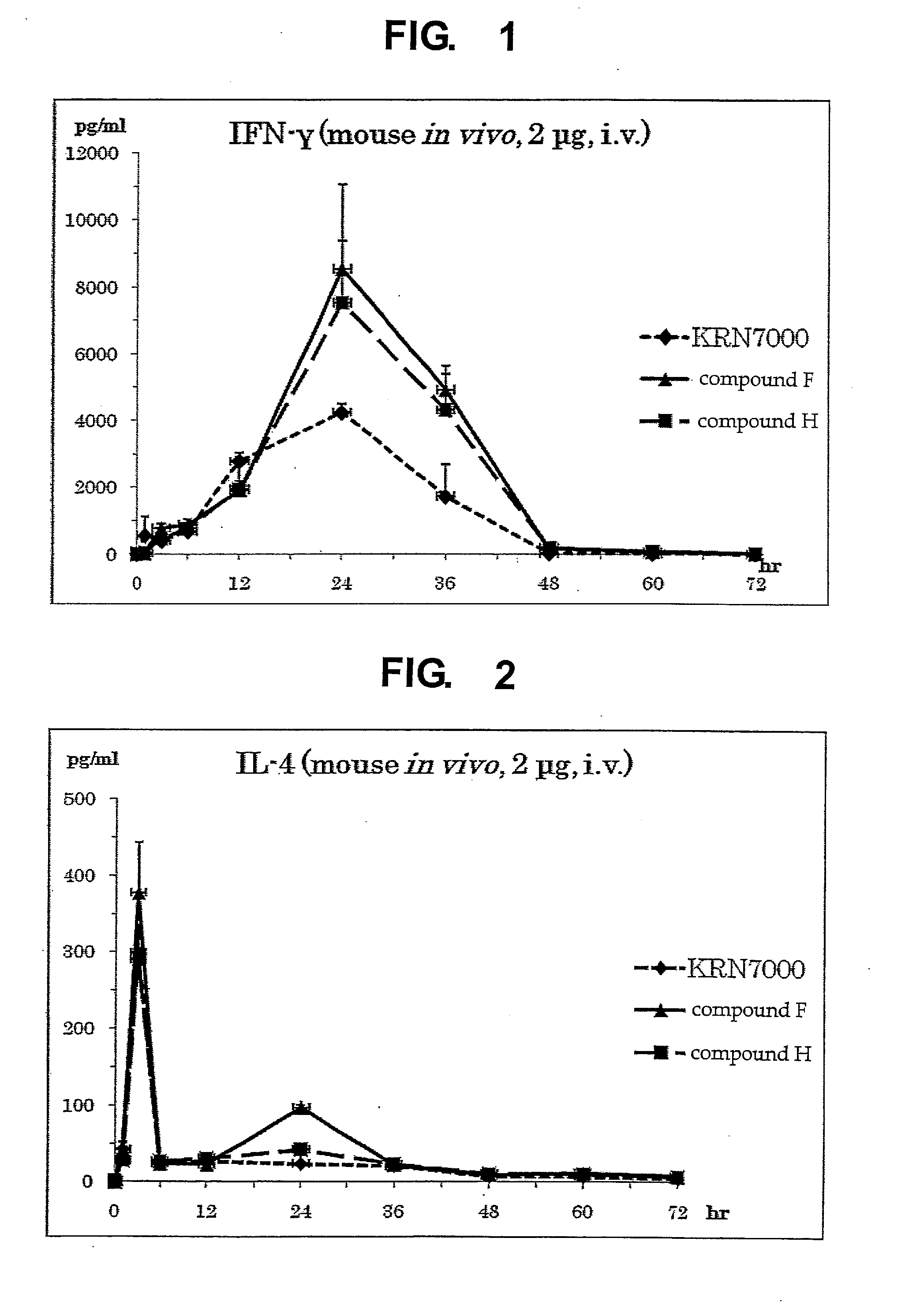
Figure 1 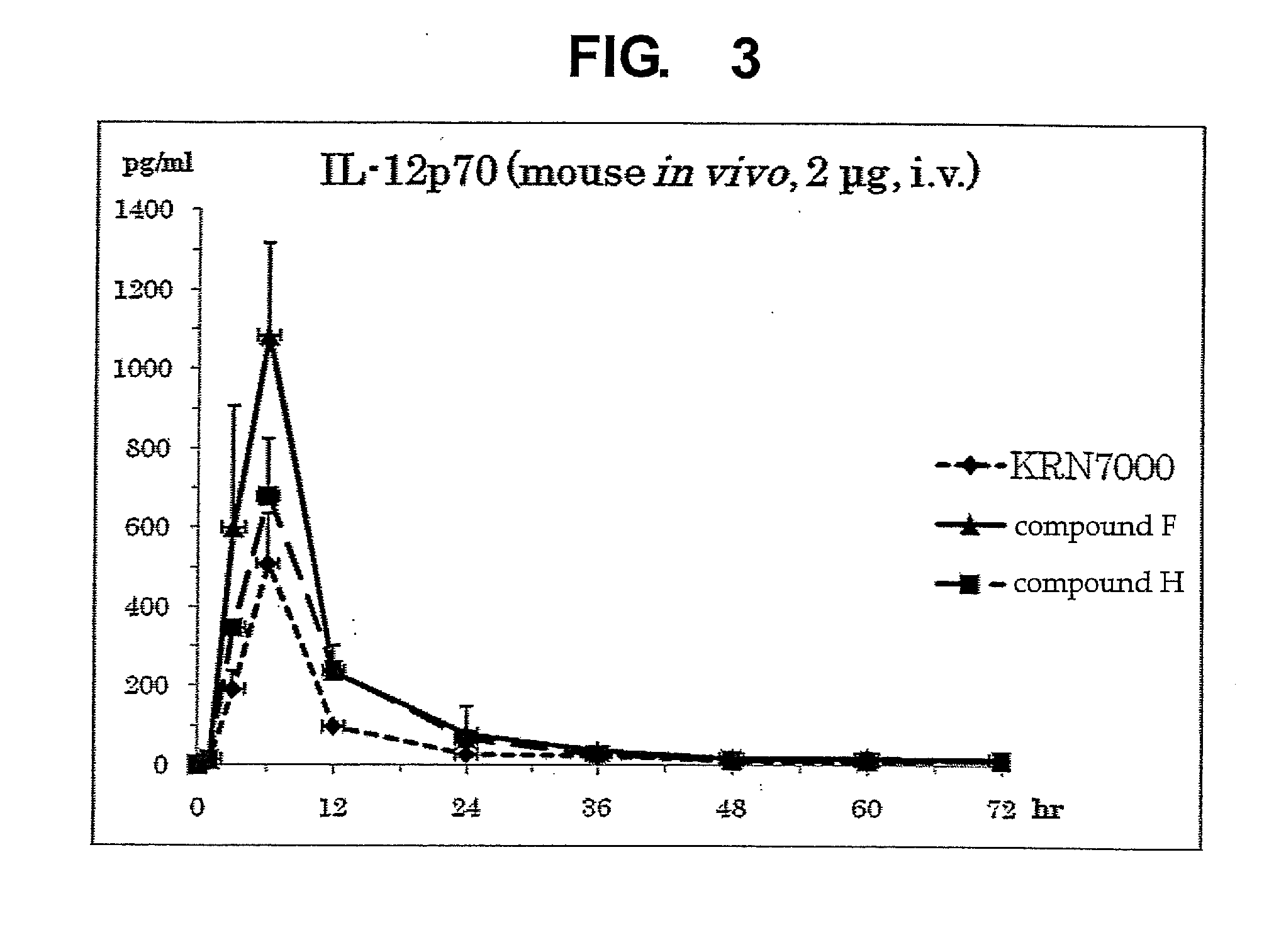
Figure 2 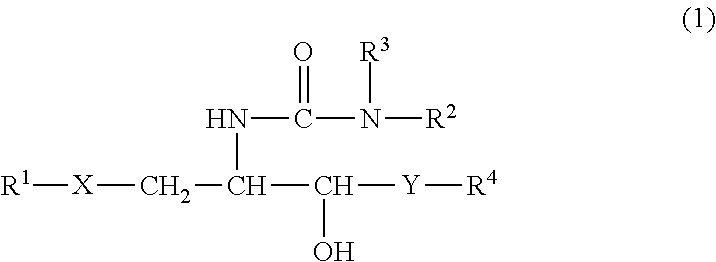
Figure 3
Abstract
Description
TECHNICAL FIELD
[0001] The present invention relates to a novel glycolipid and use thereof, more specifically, a novel glycolipid having a urea bond, a production method thereof and a pharmaceutical use thereof.BACKGROUND ART
[0002] Immune system has a skillful surveillance function to distinguish abnormal cells from autochtonous normal cells in the body and eliminate only the abnormal cells. When the surveillance function collapses, abnormal cells produced by mutation and the like cannot be eliminated, and the presence and growth thereof in the body are allowed. The grown abnormal cell mass is a tumor, or cancer.
[0003] The cancer treatment is mainly removal of cancer by surgical operation, or use of anti-cancer agents. However, these treatment methods often place physical burden due to extirpative surgery and side effects of anti-cancer agents, or mental burden due to operative scar on patients.
[0004] With such background, treatments by immunotherapy are drawing attention. In the immunot...
Examples
example 1
Synthesis of Compound F
[0126]The synthesis processes are as described in the following scheme.
Synthesis of Compound B
[0127]A suspension of commercially available compound A (310 mg, 0.810 mmol) in anhydrous benzene (5 mL) was heated to 60° C. to allow dissolution. To the obtained solution was added oxalyl chloride (1.0 mL, 12 mmol) at 60° C. The reaction mixture was stirred at 60° C. for 2 hr and concentrated under reduced pressure to give an acid chloride.
[0128]The obtained acid chloride was dissolved in a mixed solvent of tetrahydrofuran (5 ml) and N,N-dimethylformamide (2 mL), and cooled to 0° C. A solution of sodium azide (107 mg, 1.65 mmol) in water (1 mL) was slowly added at 0° C., and the mixture was stirred at 0° C. for 2 hr. The reaction mixture was diluted with benzene and washed successively with water and saturated brine, and the organic layer was dried over anhydrous sodium sulfate. After filtration, the filtrate was stirred at 70° C. for 2 hr, concentrated under reduc...
example 2
Synthesis of Compound G
[0149]
[0150]Compound G was synthesized in the same manner as in Example 1.
[0151][α]D26=+55.7 (c=0.30, pyridine).
[0152]IR (KBr): νmax=3320 (br s, OH, NH), 1630 (br s, C═O), 1570 (br s), 1070 (br s, C—O), 1030 (br s, C—O) cm−1.
[0153]1H-NMR (500 MHz, pyridine-d5): δ=6.81 (1H, t, J=5.5 Hz), 6.79 (1H, d, J=9.5 Hz), 6.66-5.70 (6H, m), 5.54 (1H, d, J=4.0 Hz), 5.10-5.05 (1H, m), 4.61 (1H, dd, J=9.5, 3.5 Hz), 4.59 (1H, dd, J=11, 4.5 Hz), 4.48 (1H, d, J=3.0 Hz), 4.47-4.42 (2H, m), 4.41-4.33 (2H, m), 4.37 (1H, dd, J=11, 6.0 Hz), 4.28-4.23 (2H, m), 3.48 (1H, ddt, J=13, 7.5, 5.5 Hz), 3.40 (1H, ddt, J=13, 7.5, 5.5 Hz), 2.28-2.21 (1H, m), 1.92-1.78 (2H, m), 1.66-1.56 (1H, m), 1.55 (2H, quint., J=7.5 Hz), 1.43-1.15 (48H, m), 0.84 (6H, t, J=7.0 Hz) ppm.
[0154]13C-NMR (126 MHz, pyridine-d5): δ=159.5, 101.6, 77.4, 73.0, 72.8, 71.6, 70.9, 70.2, 69.7, 62.7, 52.0, 40.6, 34.7, 32.1, 31.0, 30.4, 30.1, 30.01, 29.98, 29.92, 29.91, 29.7, 29.6, 27.4, 26.5, 22.9, 14.3 ppm.
[0155]HR-ESIMS: C...
example 3
Synthesis of Compound H
[0156]
[0157]Compound H was synthesized in the same manner as in Example 1.
[0158][α]D25=+50.2 (c=0.29, pyridine).
[0159]IR (KBr): νmax=3340 (br s, OH, NH), 1640 (br s, C═O), 1570 (br s), 1070 (br s, C—O), 1035 (br s, C—O) cm−1.
[0160]1H-NMR (500 MHz, pyridine-d5): δ=7.04 (1H, br s), 6.77 (1H, t, J=5.5 Hz), 6.68 (1H, d, J=9.0 Hz), 6.63 (1H, br s), 6.29 (2H, br s), 6.01 (1H, d, J=5.5 Hz), 5.51 (1H, d, J=4.0 Hz), 5.09 (1H, dq, J=8.5, 4.0 Hz), 4.60 (1H, dd, J=11, 5.5 Hz), 4.57 (1H, dd, J=10, 4.0 Hz), 4.42-4.36 (2H, m), 4.33-4.21 (4H, m), 3.95 (1H, dd, J=10, 5.5 Hz), 3.90 (1H, dd, J=10, 7.0 Hz), 3.48 (1H, ddt, J=13, 7.0, 5.5 Hz), 3.40 (1H, ddt, J=13, 7.0, 5.5 Hz), 3.32 (3H, s), 2.29-2.21 (1H, m), 1.92-1.78 (2H, m), 1.67-1.58 (1H, m), 1.56 (2H, quint., J=7.0 Hz), 1.44-1.17 (64H, m), 0.84 (6H, t, J=7.0 Hz) ppm.
[0161]13C-NMR (126 MHz, pyridine-d5): δ=159.3, 101.5, 77.3, 72.9, 72.8, 71.3, 70.7, 70.6, 70.0, 69.6, 58.8, 51.8, 40.6, 34.8, 32.1, 31.0, 30.3, 30.1, 30.01, 30.00...