
Curing catalyst for epoxy resin composition, epoxy resin composition comprising same, and apparatus manufactured by using same
Patent Information
- Authority / Receiving Office
- US · United States
- Current Assignee / Owner
- Publication Date
- 2016-11-10
Smart Images
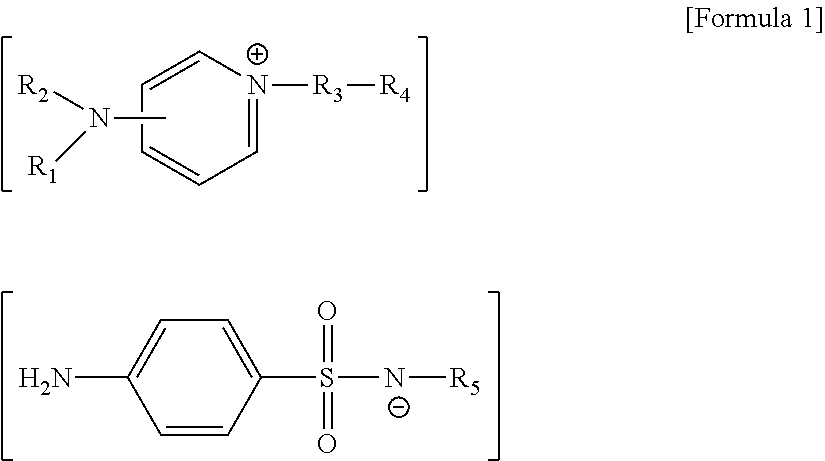
Figure 1 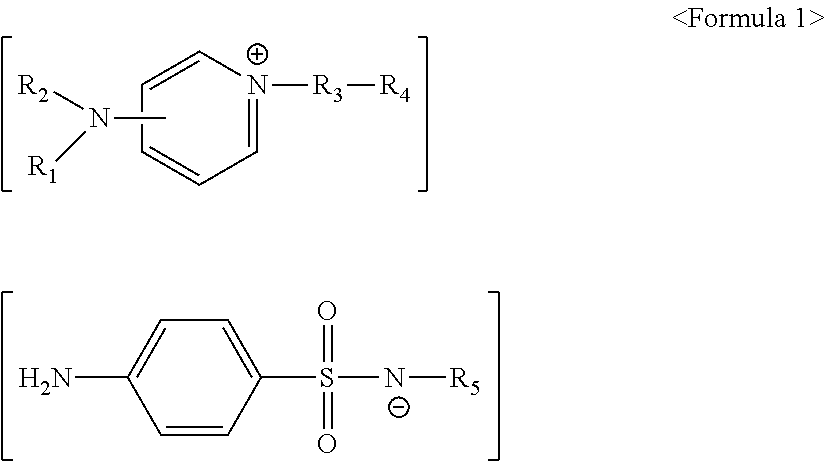
Figure 2 
Figure 3
Abstract
Description
TECHNICAL FIELD
[0001] The present invention relates to a curing catalyst for epoxy resin compositions, an epoxy resin composition including the same, and an apparatus manufactured using the same.BACKGROUND ART
[0002] Epoxy resins have low reaction shrinkage, excellent electrical, mechanical properties, and high processability and chemical resistance, and are used as a matrix and coating for electric, electronic, construction, and composite materials. For example, epoxy resins are used for encapsulation of semiconductor devices, adhesive films, insulating resin sheets such as prepregs, circuit boards, solder resists, underfills, die bonding agents, and component replenishing resins.
[0003] Generally, such an epoxy resin is used after being mixed with a curing agent to be a thermosetting material rather than being used alone. Here, since properties of the epoxy resin depend on a three-dimensional structure created after curing, selection of the curing agent is important. Although many curi...
Examples
example 1
[0076]1.2 g of 4-(dimethylamino)pyridine and 1.9 g of 2-(chloromethyl)naphthalene were dissolved in 30 ml of toluene, followed by reacting at 60° C. for 5 hours and then filtering and drying a produced precipitate, thereby obtaining 2.2 g of a solid. 2.2 g of the obtained solid and 2.5 g of sodium sulfadiazine were dissolved in 50 ml of a methylene chloride / H2O 1:1 solution, followed by reacting at room temperature for 24 hours. Next, the methylene chloride layer was subjected to distillation under reduced pressure (evaporating), thereby obtaining 3.0 g of a solid represented by Formula 10.
[0077]1H NMR (400 MHz, DMSO) 8.42 (d, J=2.2 Hz, 2H), 7.78 (dd, J=7.2, 2.4 Hz, 2H), 7.70-7.10 (m, 7H), 7.58 (d, J=9.0 Hz, 2H), 6.64 (d, J=2.2 Hz, 2H), 6.60 (t, J=4.8 Hz, 1 H), 6.49 (d, J=9.0 Hz, 2H), 5.65 (br, 2H), 5.53 (s, 2H), 2.45 (s, 6H) ppm; LC-MS m / z=512 (M+); Anal. Calcd for C28H28N6O2S: C, 65.60; H, 5.51; N, 16.39. Found: C, 65.49; H, 5.69; N, 16.41.
example 2
[0078]1.2 g of 4-(dimethylamino)pyridine and 1.9 g of 2-(chloromethyl)naphthalene were dissolved in 30 ml of toluene, followed by reacting at 60° C. for 5 hours and then filtering and drying a produced precipitate, thereby obtaining 2.2 g of a solid. 2.2 g of the obtained solid and 2.6 g of sodium sulfamerazine were dissolved in 50 ml of a methylene chloride / H2O 1:1 solution, followed by reacting at room temperature for 24 hours. Next, the methylene chloride layer was subjected to distillation under reduced pressure (evaporating), thereby obtaining 3.0 g of a solid represented by Formula 11.
[0079]1H NMR (400 MHz, DMSO) 8.42 (d, J=2.2 Hz, 2H), 7.78 (dd, J=7.5 Hz, 1H), 7.70-7.10 (m, 7H), 7.56 (d, J=8.4 Hz, 2H), 6.64 (d, J=2.2 Hz, 2H), 6.53 (m, 1H), 6.51 (d, J=8.4 Hz, 2H), 5.60 (br, 2H), 5.53 (s, 2H), 2.45 (s, 6H), 2.19 (s, 3H) ppm; LC-MS m / z=526 (M+); Anal. Calcd for C29H30N6O2S: C, 66.14; H, 5.74; N, 15.96. Found: C, 66.32; H, 5.64; N, 16.09.
example 3
[0080]1.2 g of 4-(dimethylamino)pyridine and 1.9 g of 2-(chloromethyl)naphthalene were dissolved in 30 ml of toluene, followed by reacting at 60° C. for 5 hours. Next, a precipitate was filtered, followed by drying, thereby obtaining 2.2 g of a solid. 2.2 g of the obtained solid and 2.7 g of sodium sulfamethazine were dissolved in 50 ml of a methylene chloride / H2O 1:1 solution, followed by reacting at room temperature for 24 hours. Next, the methylene chloride layer was subjected to distillation under reduced pressure (evaporating), thereby obtaining 3.0 g of a solid represented by Formula 12.
[0081]1H NMR (400 MHz, DMSO) 8.42 (d, J=2.2 Hz, 2H), 7.70-7.10 (m, 7H), 7.58 (d, J=8.8 Hz, 2H), 6.64 (d, J=2.2 Hz, 2H), 6.51 (m, 1H), 6.49 (d, J=8.8 Hz, 2H), 5.69 (br, 2H), 5.53 (s, 2H), 2.45 (s, 6H), 2.15 (s, 6H) ppm; LC-MS m / z=512 (M+); Anal. Calcd for C30H32N6O2S: C, 66.64; H, 5.97; N, 15.54. Found: C, 66.43; H, 5.74; N, 15.49.