
Recombinant collagen iv surrogates and uses thereof
Patent Information
- Authority / Receiving Office
- US · United States
- Current Assignee / Owner
- Publication Date
- 2018-03-01
- Estimated Expiration
- Not applicable · inactive patent
Smart Images
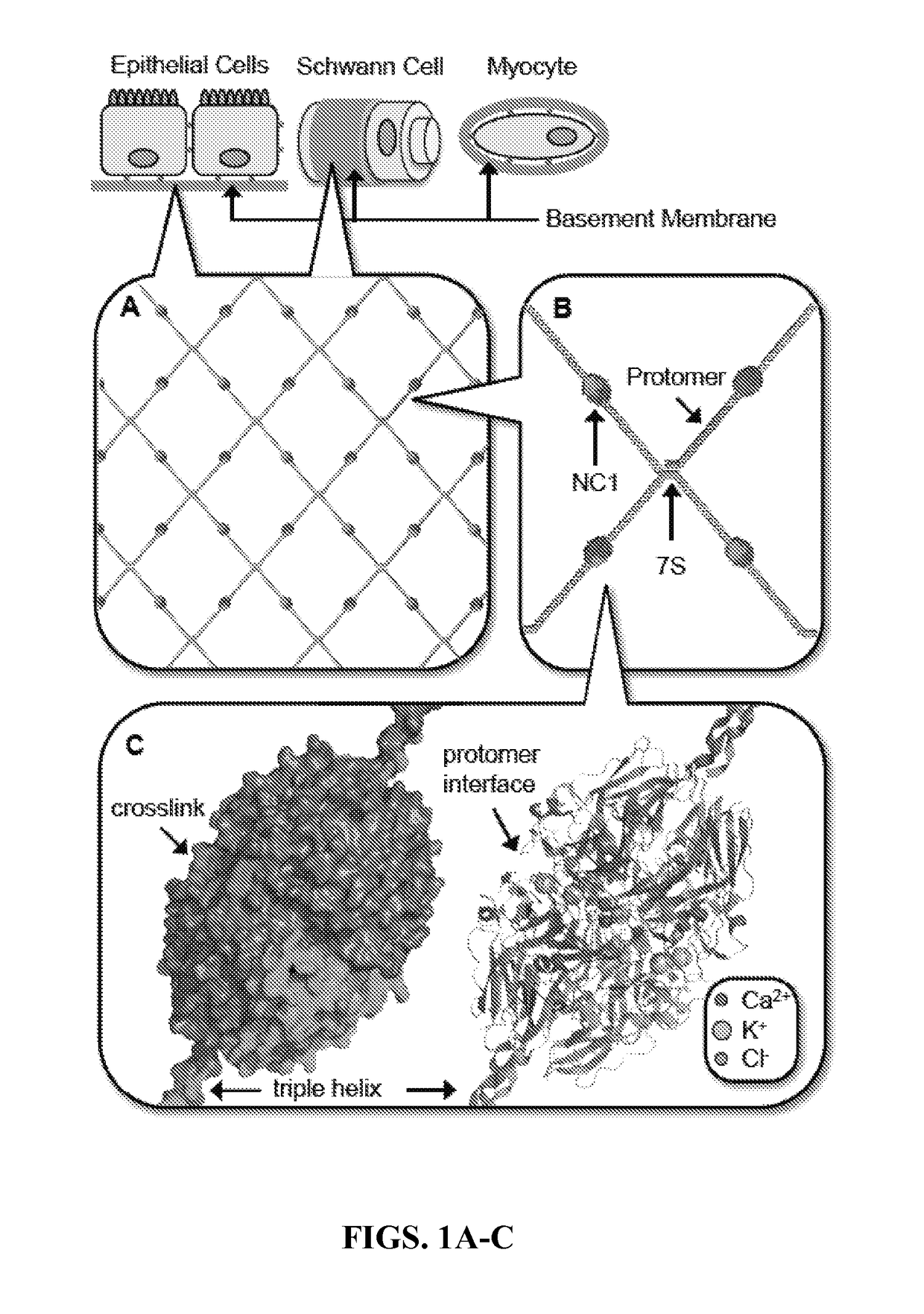
Figure 1 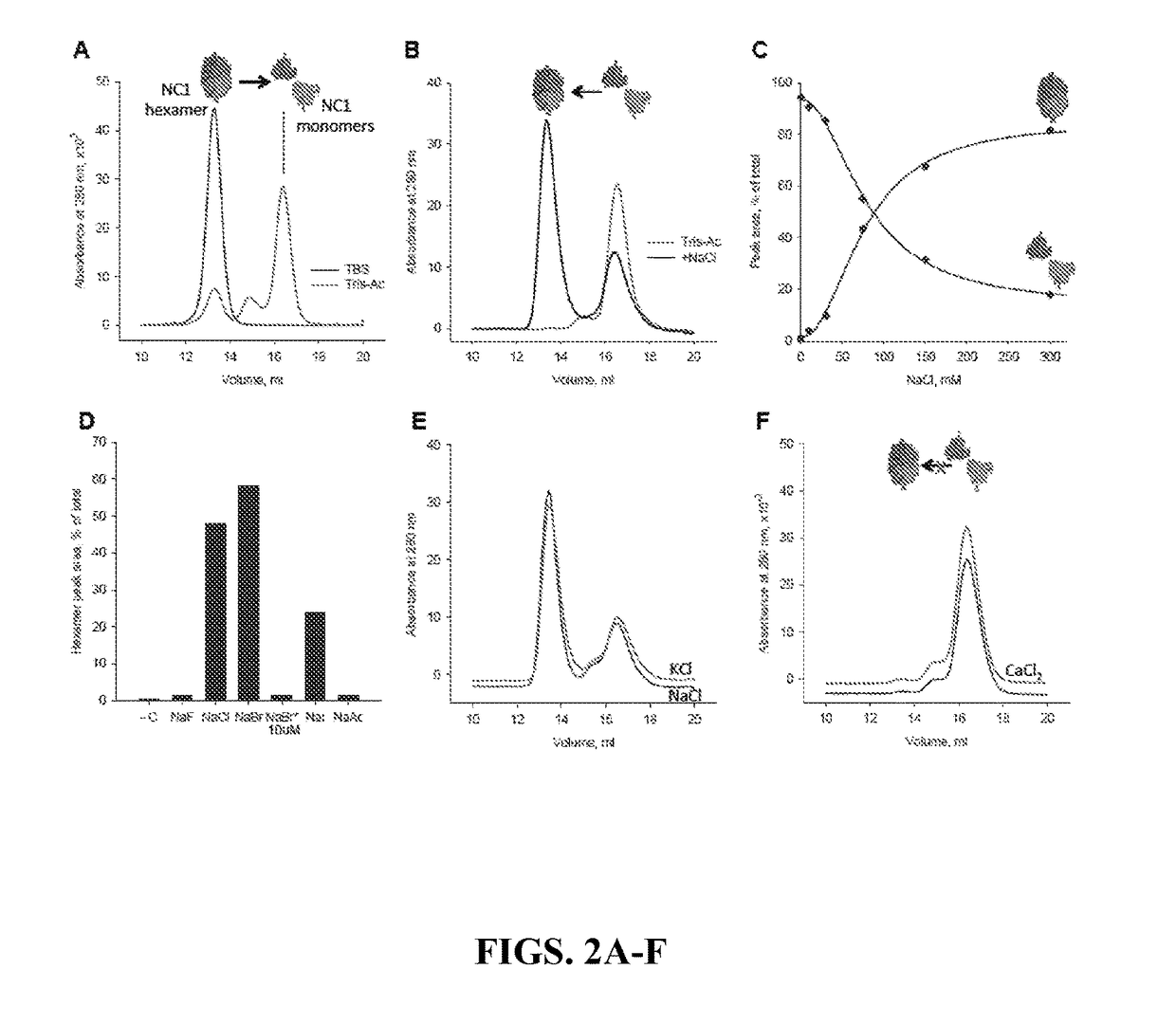
Figure 2 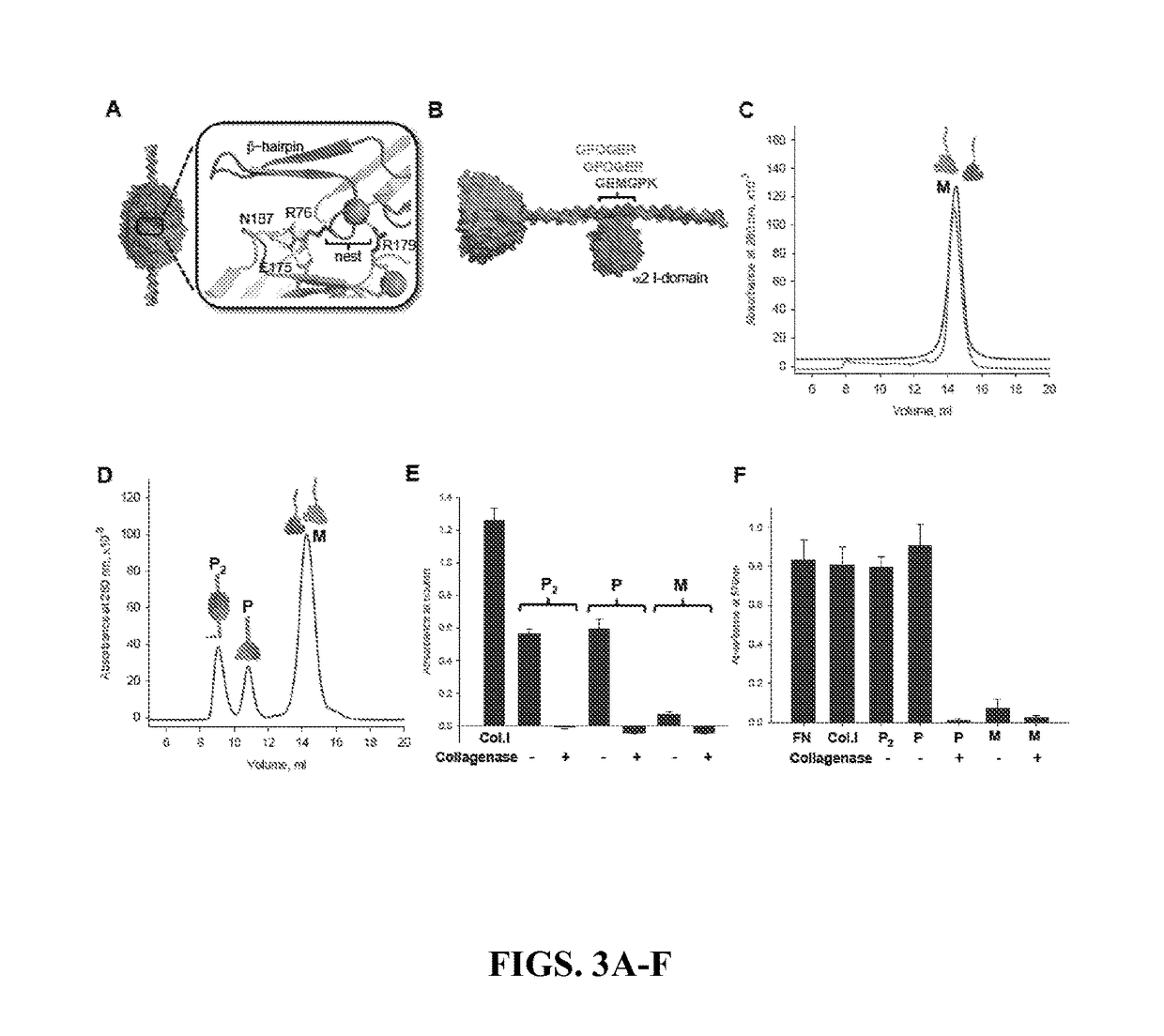
Figure 3
Abstract
Description
[0001] This application claims benefit of priority to U.S. Provisional Application Ser. No. 62 / 030,170, filed Jul. 29, 2014, the entire contents of which are hereby incorporated by reference.STATEMENT REGARDING FEDERALLY-FUNDED SUPPORT
[0002] This invention was made with government support under grant numbers RO1 DK18381, DK18381-38S1 and 2PO1 DK065123 awarded by the National Institutes of Health. The government has certain rights in the invention.BACKGROUND OF THE INVENTION1. Field of the Invention
[0003] The present invention relates generally to the fields of biology and medicine. In particular, the invention relates to collagen IV surrogates and uses thereof.2. Description of Related Art
[0004] Collagen IV scaffolds are critical components of basement membranes (BM), a specialized form of extracellular matrix that underlies all epithelia in metazoa from sponge to human. Collagen IV molecules are assembled into networks that support the assemblage of BM components (Hudson et al., 2003)....
Examples
example 1
& Methods
[0213]Materials.
[0214]Cell culture reagents were purchased from CellGro (Mediatech, Manassas, Va.), while all other chemicals and reagents were purchased from Sigma-Aldrich (Saint Louis, Mo.).
[0215]Methods. Preparation of Collagen IV NC1 and PXDN:
[0216]NC1 hexamers were isolated from tissues as described previously (Boutaud et al., 2000). Briefly, matrices were washed successively with buffered 1% sodium deoxycholate, then buffered 1 M NaCl, and finally low salt buffer prior to digestion with bacterial collagenase. Hexamers were purified from the digest using DE-52 cellulose and SEC chromatography (GE Life Sciences; Piscataway, N.J.). Alternatively, collagen IV was expressed in PFHR9 cell cultures in the presence of either 50 μM phloroglucinol or 1 mM KI to inhibit sulfilimine crosslink formation (Bhave et al., 2012), and hexamers isolated similarly to tissue-derived matrices. Recombinant PXDN was produced and purified as previously described (Bhave et al., 2012).
[0217]Diss...
example 2
[0231]Introduction.
[0232]The extracellular microenvironment plays a pivotal role in tissue genesis, architecture and function. A core feature of these microenvironments is the basement membrane (BM), a specialized form of extracellular matrix that underlies epithelial (Daley and Yamada, 2013; Hagios et al., 1998; Hynes, 2009; Lu et al., 2012; Yurchenco, 2011) and endothelial cells (Rhodes and Simons, 2007), and ensheaths muscle (Campbell and Stull, 2003; Sanes, 2003), fat (Sillat et al., 2012), Schwann (Court et al., 2006) and decidua cells (Farrar and Carson, 1992; Wewer et al., 1985) (FIGS. 1A-C). BMs are fundamental components of the cellular toolkit that function as supramolecular scaffolds in sculpting diverse tissue architectures and functions. Known BM functions include compartmentalizing and providing structural integrity of tissues, guiding cell migration and adhesion delineating apical-basal polarity modulating cell differentiation during development, orchestrating cell be...
example —
Example—Discussion
[0263]Proper network assembly is pivotal for imparting scaffold functionality to collagen IV, evidenced by the developmental defects and lethality that result from network perturbation (Nagai et al., 2000; Matsuoka et al., 2004; Bhave et al., 2012; Pokidysheva et al., 2013; McCall et al., 2014). The process of assembly spans both sides of the plasma membrane, requiring NC1 domains to steer intracellular protomer assembly while Cl− and Br− are required for extracellular network assembly and crosslinking, respectively. The work presented herein illumines important steps in scaffold assembly and represents vulnerabilities that may be exploited in disease.
[0264]NC1 Activity in Protomer Assembly and Molecular Pathology.
[0265]NC1 domains self-associate through a pattern recognition process governing chain selectivity (Boutaud et al., 2000; Sundaramoorthy et al., 2002; Khoshnoodi et al., 2006b). These data shows that this interaction is critical for chain registration as ...