
Use of nanosecond scale, time-resolved, imaging to differentiate contemporaneous fluorescence responses from multiple substances
Patent Information
- Authority / Receiving Office
- US · United States
- Current Assignee / Owner
- Publication Date
- 2009-06-16
- Estimated Expiration
- Not applicable · inactive patent
Smart Images
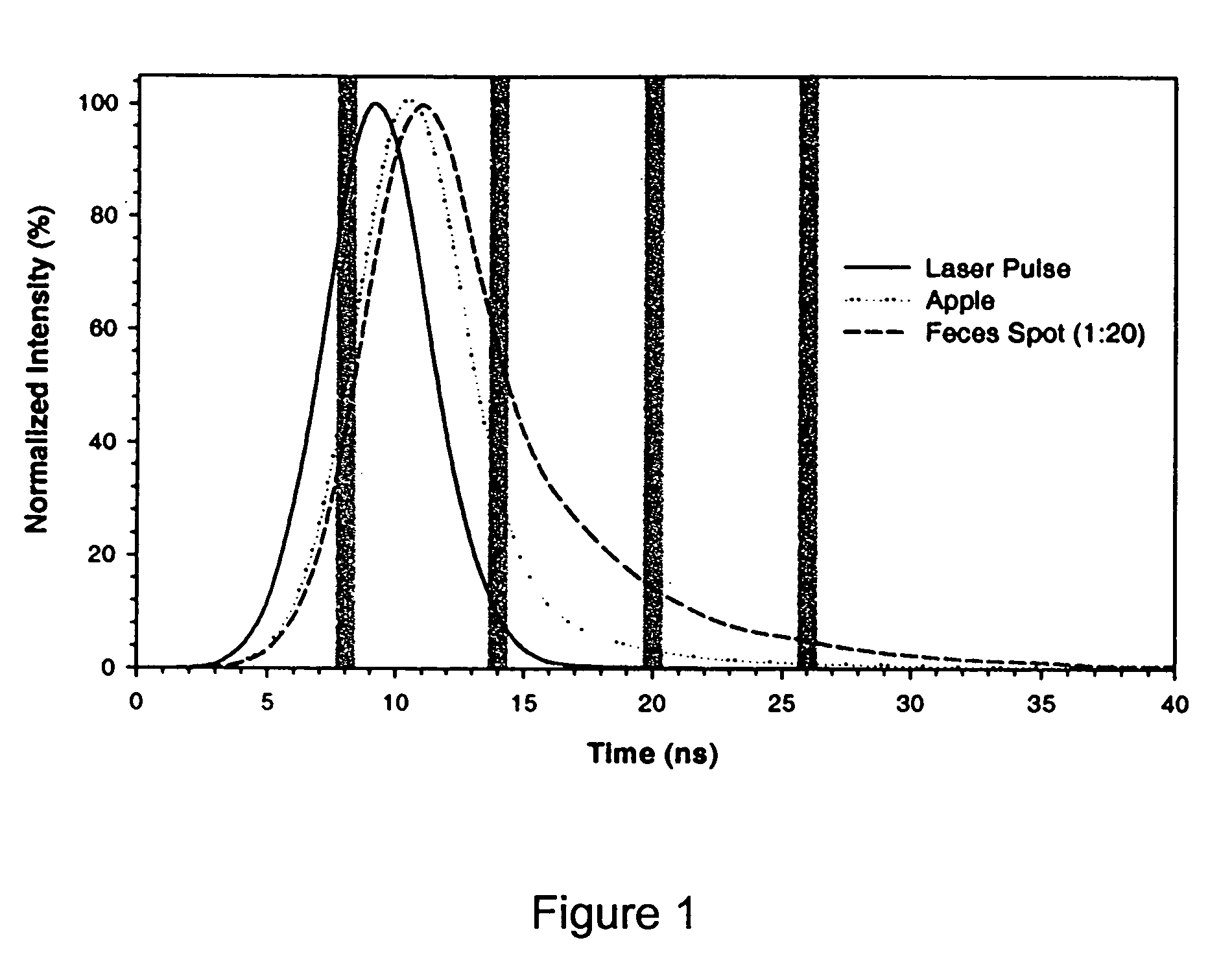
Figure 1 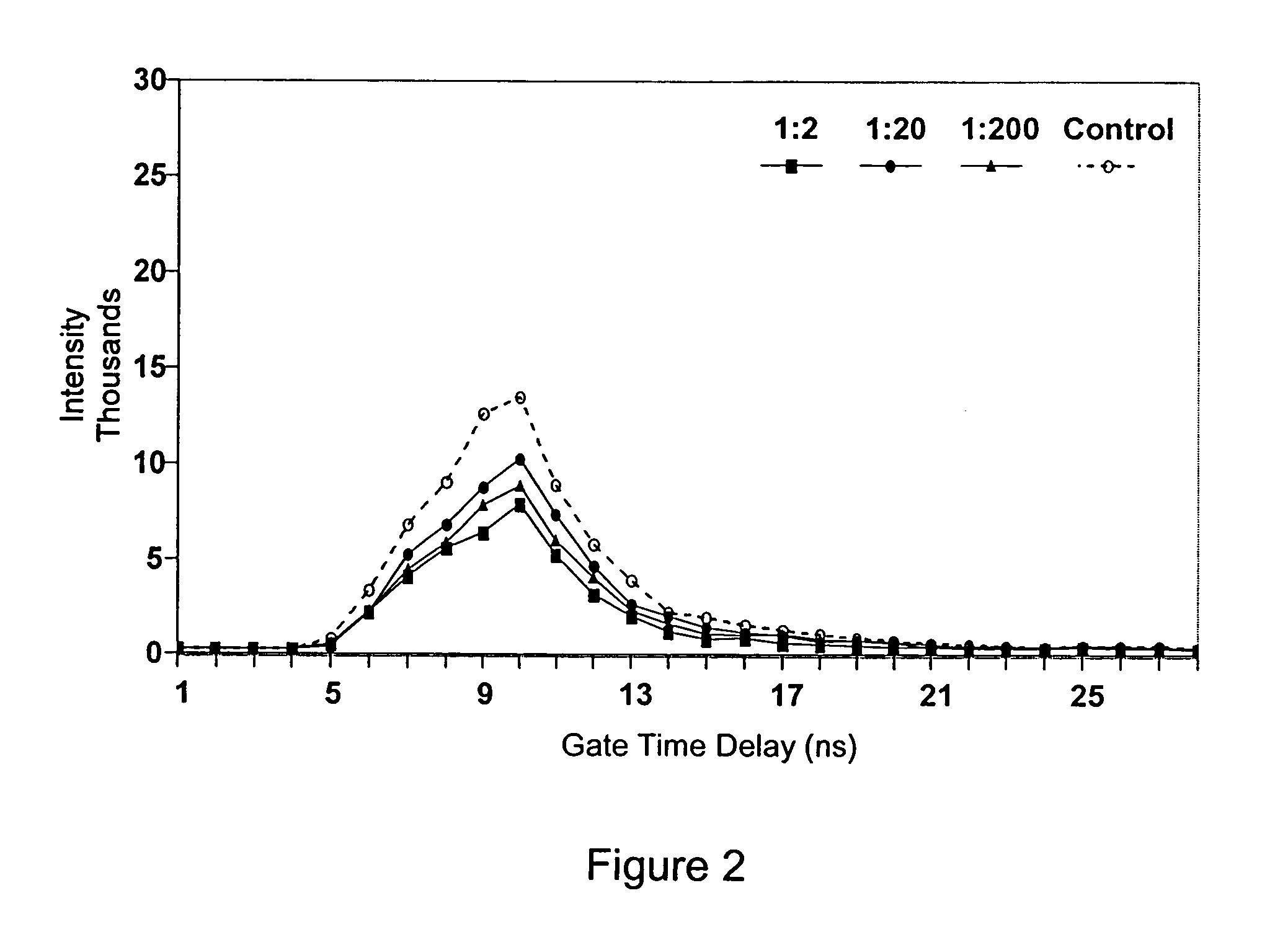
Figure 2
Abstract
Description
[0001] This application hereby claims the benefit of U.S. provisional patent application 60 / 640,340, filed Dec. 30, 2004, the content of which are incorporated by reference herein.BACKGROUND OF THE INVENTION
[0002] 1. Field of the Invention
[0003] The invention relates to an improved method and apparatus for detecting fecal contamination on the surface of produce using visible light fluorescent spectroscopy.
[0004] 2. Description of the Prior Art
[0005] Microbial pathogens in food cause an estimated 6.5 million to 33 million cases of human illness and up to 9,000 deaths annually, according to the Council for Agricultural Science and Technology. Furthermore, the USDA Economic Research Service has recently reported that the annual cost of the food borne illnesses caused by six common bacterial pathogens, Campylobacter spp., Clostridium perfringens, Escherichia coli 0157:H7, Listeria monocytogenes, Salmonella spp., and Staphylococcus aureus, ranges from 2.9 billion to 6.7 billion dollars (Food ...
Examples
example 1
1. Introduction
[0032]This example describes the method of using a laser-induced fluorescence imaging system for detecting fecal contamination on apples. We have previously shown that the maximal fluorescence yield from feces is obtained using an excitation wavelength around 417 nm.16 In this study, the UV pulsed-laser was replaced by a pulsed-laser with an output wavelength of 417 nm. In addition, we hypothesized that consideration of time-dependent differences in fluorescence responses of areas with or without feces treatment might allow for improved detection of contaminated apples. To test this possibility, an intensified camera with a gate-width of two ns was used to image artificially contaminated apples sequentially by time.
2. Materials and Methods
[0033]Serial dilutions of dairy feces were applied to Red Delicious and Golden Delicious apples. Contamination sites were detected by taking advantage of differences between fluorescence responses of apple surfaces and of feces on ap...