
Multicast routing optimization method based on quantum evolution
An optimization method, a technology of quantum evolution, which is applied to genetic models, devices that provide special services in branches, details of data exchange, etc., can solve the problems of complex solution process, premature, unsuitable for optimizing large-scale networks, etc., and achieves good simulation performance. Effect
- Summary
- Abstract
- Description
- Claims
- Application Information
AI Technical Summary
Problems solved by technology
Method used
Image

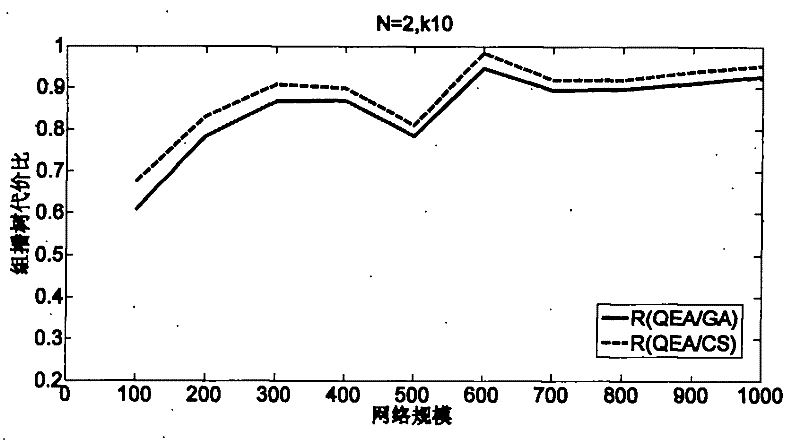
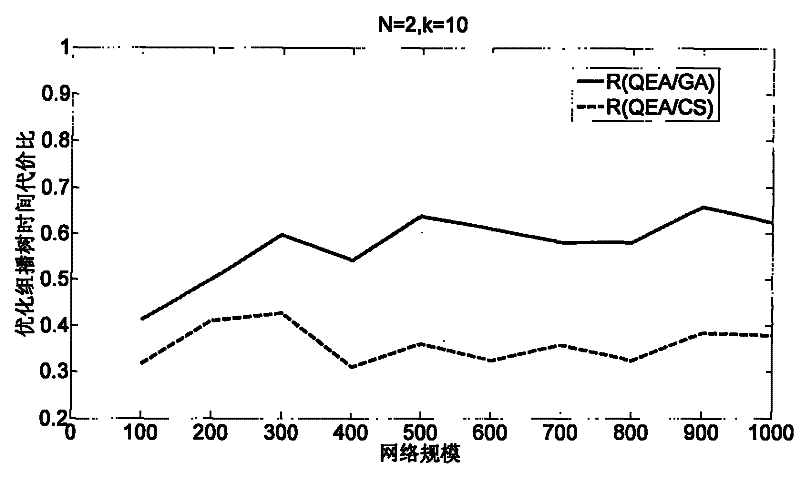
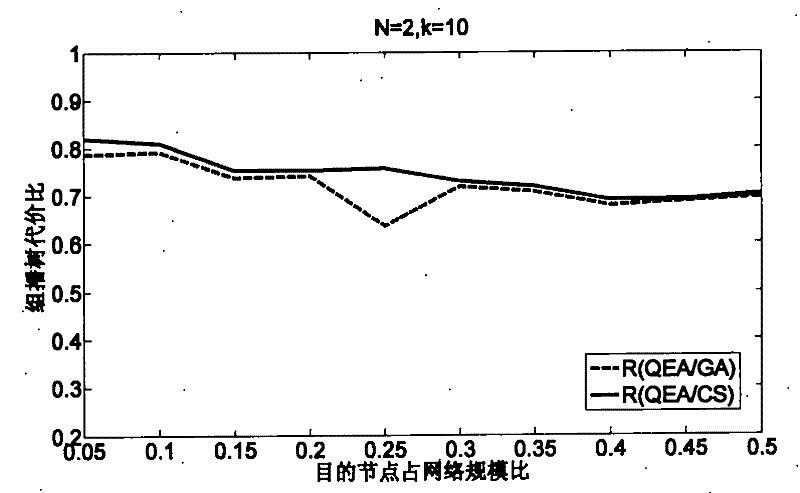
Examples
Embodiment Construction
[0034] refer to figure 1 , the specific implementation process of the present invention is as follows:
[0035] Step 1, initialize and generate a random network and set the source node and destination node, given the operating parameters and the maximum allowable delay. The operating parameters include the initial population size M, N qubits representing the set of alternative paths for each destination node and the rotation angle δ of the quantum revolving door.
[0036] Step 2, find all the paths from the destination node to the source node that satisfy the delay condition, and arrange the set of alternative paths in ascending order of cost.
[0037] refer to figure 2 , find all the paths from a destination node to the source node satisfying the delay condition as follows:
[0038] 2a. The node currently to be visited is pushed into the stack storing the path, and its state is set as visited;
[0039] 2b. If the current access node is the source node, save the path to t...
PUM
 Login to View More
 Abstract
Description
Claims
Application Information
 Login to View More