Method for realizing vehicle-mounted mobile self-organized network routing

A self-organizing network and vehicle-mounted mobile technology, applied in the network field, can solve the problems of realizing complex and effectively representing the optimal path, and achieve the effect of reducing functional requirements and improving applicability

CN101720059AInactive Publication Date: 2010-06-02ZHEJIANG UNIV CITY COLLEGE
0 Cites 61 Cited by

Patent Information

Authority / Receiving Office
CN · China
Patent Type
Applications(China)
Current Assignee / Owner
Publication Date
2010-06-02
Estimated Expiration
Not applicable · inactive patent

Smart Images

  • Figure 1
    Figure 1
  • Figure 2
    Figure 2
  • Figure 3
    Figure 3
Patent Text Reader

Abstract

The invention relates to a method for realizing vehicle-mounted mobile self-organized network routing, which is characterized by comprising the following steps that: (1) a static node is arranged at each intersection; (2) when forwarding a data packet, a source node can forward the data packet to the static node relatively close to a target static node at one end of a road section where the source node is positioned; (3) when forwarding the data packet, the static node firstly judges whether the static node closer to the target static node is in a neighbouring list or not, if so, the static node directly forwards the data packet to the corresponding static node, otherwise, the static node selects a neighbouring road section according to a road section selection algorithm, and then appoints another static node on the selected road section as the static node of a road section receiving terminal, wherein the neighbouring road section is not the road section which just receives the data packet; and the road section direction of the neighbouring road section is close to the target static node; and (4) when receiving the same data packet transmitted from the same source node from different road sections, a routing static node selects an optimal route which is high in the success rate for receiving the data packet and relatively short in delay time, and forbids the receiving routes which are not optimal at the same time.
Need to check novelty before this filing date? Find Prior Art

Description

technical field

[0001] The invention belongs to the field of network technology, and in particular relates to a method for realizing routing of a vehicle-mounted mobile ad hoc network (VANET). Background technique

[0002] Vehicle Ad Hoc Network (VANET for short) refers to a network composed of each vehicle on the road and some static nodes on the roadbed as a communication carrier. These communication carriers can communicate directly within a certain distance, which is called communication within a hop range. They can also forward the information to the destination communication carrier in a multi-hop manner through the forwarding of other communication carriers after the direct communication distance is exceeded.

[0003] At present, the vehicle-mounted mobile ad hoc network mainly has the following applications: ① In terms of vehicle driving safety, for example, when a traffic accident occurs, the vehicle at the scene of the accident can broadcast the accident informatio...

Examples

Embodiment Construction

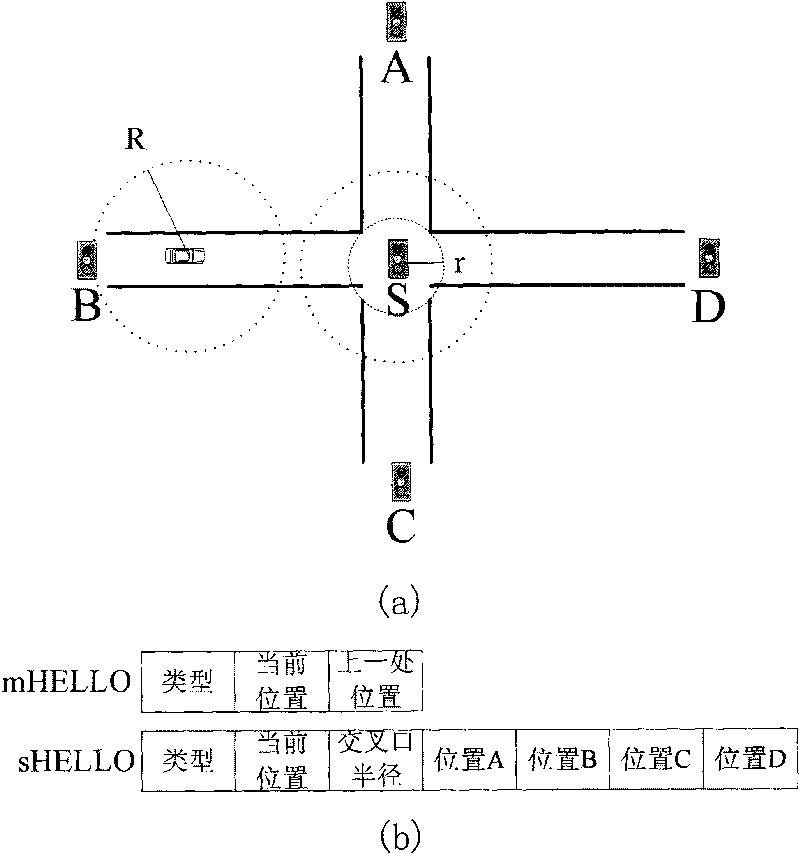
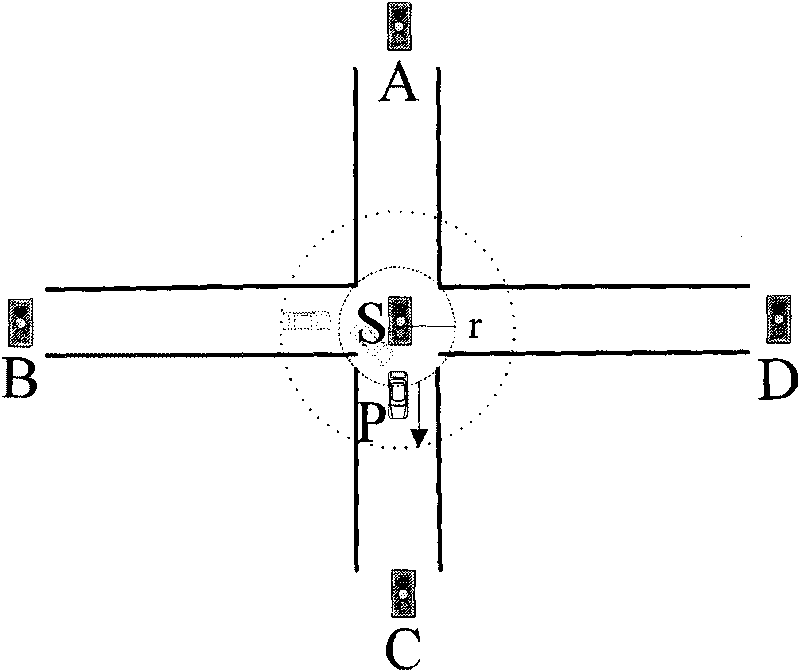
[0037] The present invention regards each vehicle running on the road as a mobile node, and the mobile node is configured with a radio frequency transceiver module, and the signal transmission range is a circular area with a radius of R (usually several hundred meters); The node is the source node, and the mobile node that finally receives the data packet is the destination node. Static nodes (configured with radio frequency transceiver modules, and the signal transmission range is a circular area with a radius of R) are set at each intersection, usually integrated with traffic lights, The static node in the approaching direction of the source node is the initial static node, the static node in the approaching direction of the destination node is the destination static node, and the static node forwarding the data packet is the routing static node; the static node stores its own location during initialization The geographical location of the static node at the other end of each...