
Method for treating chromium-containing wastewater by using barite adsorbent
The technology of barite and adsorbent is applied in the field of treating chromium-containing wastewater by barite adsorbent, which can solve the problems of high power consumption, lack of promotion, and low practical effect, and achieves simple preparation process, convenient popularization, application and operation. handy effect
- Summary
- Abstract
- Description
- Claims
- Application Information
AI Technical Summary
Problems solved by technology
Method used
Image

Examples
preparation example Construction
[0025] Preparation of the adsorbent:
[0026] The preparation method of barite adsorbent is characterized in that it comprises the following steps:
[0027] 1. Put the barite mineral material in an electric blast drying oven and roast at 100-110°C for 3-4 hours, cool to room temperature, grind and sieve through 80-100 mesh to obtain barite powder;
[0028] 2. Mix the above-mentioned barite powder with 0.10-0.20mol / L ferric chloride solution according to the weight ratio of barite powder: ferric chloride solution = 2-3:100, oscillate at a constant temperature of 300 times / min for 20-24 hours and pump Filter, and wash the filter cake with distilled water 2 to 3 times;
[0029] 3. Dry the above-mentioned washed and filtered filter cake in a blast drying oven at a temperature of 140-150°C for 1-2 hours;
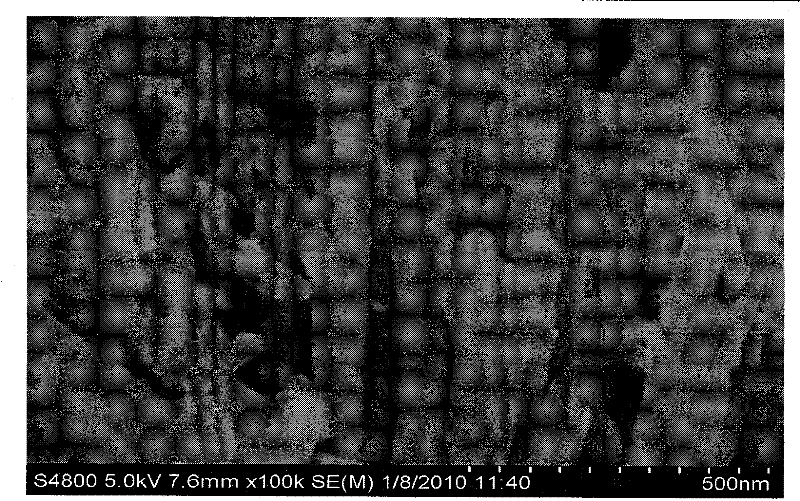
[0030] 4. Crush and grind the dried filter cake above, and sieve it with 80-100 meshes to get the barite adsorbent. figure 1 .
Embodiment 1
[0031] Embodiment 1: Screening of different adsorbents
[0032] Take 0.2g different adsorbents such as barite, natural zeolite, sepiolite, bentonite, kaolin, diatomaceous earth, vermiculite powder, and 100ml concentration of potassium chromate solution of 50mg / L (simulating chromium in electroplating wastewater ion concentration) mixed, shaken in a water bath constant temperature oscillator at 20°C for 1 hour, after the reaction, the solution was centrifuged, and the supernatant was put into a small test tube, and analyzed and detected by a Shimadzu AA-6200 atomic spectrophotometer.
[0033] Table 2 Screening of the best adsorbent
[0034] Adsorbent removal rate (%)
[0035] Barite 99.00
[0036] Natural zeolite 83.59
[0037] Meerschaum 85.93
[0038] Bentonite 81.45
[0039] Kaolin 76.06
[0040] Diatomaceous earth 65.91
[0041] Vermiculite powder 71.46
[0042] Experimental results: barite is used to adsorb and treat heavy metal chromium in wastewater, which is bet...
Embodiment 2
[0043] Embodiment 2 Different initial concentration is to the influence test of adsorption:
[0044] Take 0.5g of barite adsorbent and mix it with 100ml of potassium chromate solution (simulating the concentration of chromium ion in electroplating wastewater) with a concentration of 30, 50, 100, 150, 200, 250, 300, 500mg / L respectively, and mix them at 20°C at room temperature , PH value of 3 to 4 conditions in a water bath constant temperature oscillator for 1 hour, after the reaction, the solution is centrifuged, the supernatant is taken into a small test tube, and analyzed by Shimadzu AA-6200 atomic spectrophotometer to detect Cr6+ ions concentration.
[0045] Table 3 Adsorption experiments at different initial concentrations (adsorption of Cr6+)
[0046] Cr6+ initial concentration Cr6+ removal rate
[0047] (mg / L)
[0048] 30 100.00%
[0049] 50 99.02%
[0050] 100 99.02%
[0051] 150 98.29%
[0052] 200 98.25%
[0053] 250 98.13%
[0054] 300 97.63%
[0055] 500...
PUM
| Property | Measurement | Unit |
|---|---|---|
| clearance rate | aaaaa | aaaaa |
Abstract
Description
Claims
Application Information
 Login to View More