This helps you quickly interpret patents by identifying the three key elements:
Problems solved by technology
Method used
Benefits of technology
Problems solved by technology
In addition, in the method used in Patent Document 2, especially due to the poor flatness of the interface between the light output layer and the transparent electrode, there will be problems when the transparent electrode is formed into a film, so it is necessary to use a method with higher production reliability and high light output efficiency. method of organic electroluminescent device
Method used
the structure of the environmentally friendly knitted fabric provided by the present invention; figure 2 Flow chart of the yarn wrapping machine for environmentally friendly knitted fabrics and storage devices; image 3 Is the parameter map of the yarn covering machine
View more
Image
Smart Image Click on the blue labels to locate them in the text.
Viewing Examples
Smart Image
Click on the blue label to locate the original text in one second.
Reading with bidirectional positioning of images and text.
[0121] Figure 4 This is a cross-sectional view in the thickness direction of the organic electroluminescence element (hereinafter referred to as an organic EL element) according to the first embodiment, and a part of the cross-section is enlarged and shown.
[0122] The organic EL element 1 is composed of a light-transmitting substrate 2 , a light output layer 3 , a transparent electrode 4 , an organic light-emitting layer 5 , and a counter electrode 6 laminated in this order.
[0123] (light-transmitting substrate)
[0124] The translucent substrate 2 is a smooth plate-shaped member for supporting the light output layer 3 , the transparent electrode 4 , the organic light emitting layer 5 and the counter electrode 6 . The organic EL element 1 is a so-called bottom emission type element in which the light output direction of radiant light generated by the organic light-emitting layer 5 is toward the translucent substrate 2 side....
no. 2 approach >
[0174] Next, a second embodiment of the present invention will be described based on the drawings.
[0176] Figure 7 It is a cross-sectional view in the thickness direction of the organic EL element 40 according to the second embodiment, and a part of the cross-section is shown enlarged.
[0177] In the organic EL element 40 according to the second embodiment, the electron transport region 41, the organic light emitting layer 5 and the transparent electrode are provided between the organic luminescent layer 5 and the counter electrode 6 in the organic EL element 1 according to the first embodiment. 4 has the same configuration as the organic EL element 1 except that a hole transport region 42 is provided between them. That is, the organic EL element 40 is composed of a translucent substrate 2, a light output layer 3, a transparent electrode 4, a hole transport region 42, an organic light emitting layer 5, an electron transport ...
no. 3 approach
[0209] 〔Organic EL element〕
[0210] Figure 10 It is a cross-sectional view in the thickness direction of the organic EL element 50 according to the third embodiment, and a part of the cross-section is enlarged and shown.
[0211] In the organic EL element 50 according to the third embodiment, in addition to the organic EL element 40 according to the second embodiment, there is an intermediate unit 5A between the electron transport region 41 and the transparent electrode 4, and a plurality of Other than the organic light-emitting layers 51 , 55 , and 56 , it has the same configuration as the organic EL element 40 . That is, the organic EL element 50 is composed of the light-transmitting substrate 2, the light output layer 3, the transparent electrode 4, the hole transport region 42, the first organic light-emitting layer 51, the intermediate unit 5A, the second organic light-emitting layer 55, the third organic light-emitting The layer 56, the electron transport region 41, ...
the structure of the environmentally friendly knitted fabric provided by the present invention; figure 2 Flow chart of the yarn wrapping machine for environmentally friendly knitted fabrics and storage devices; image 3 Is the parameter map of the yarn covering machine
Login to View More
PUM
Login to View More
Abstract
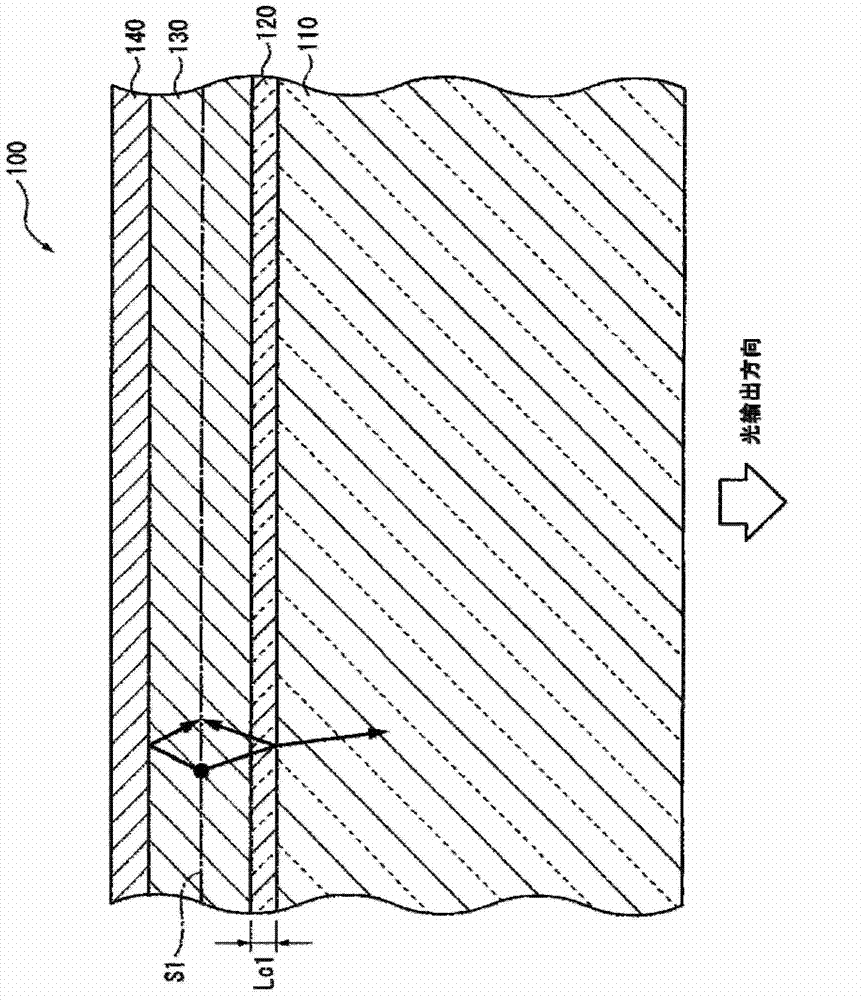
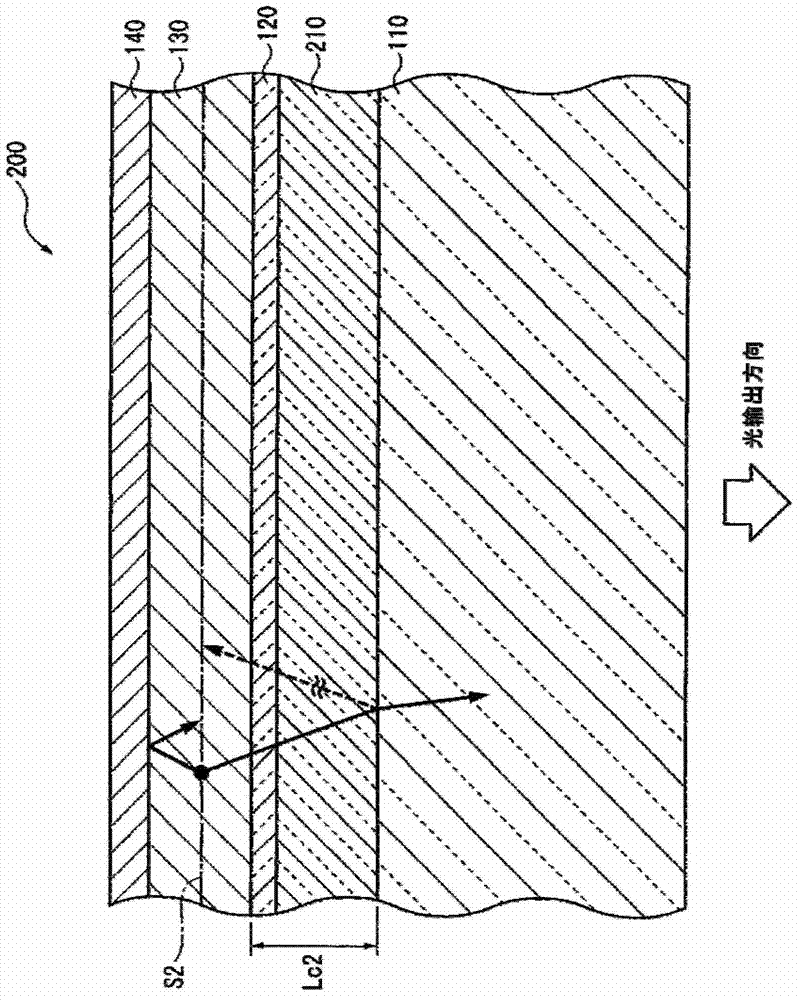
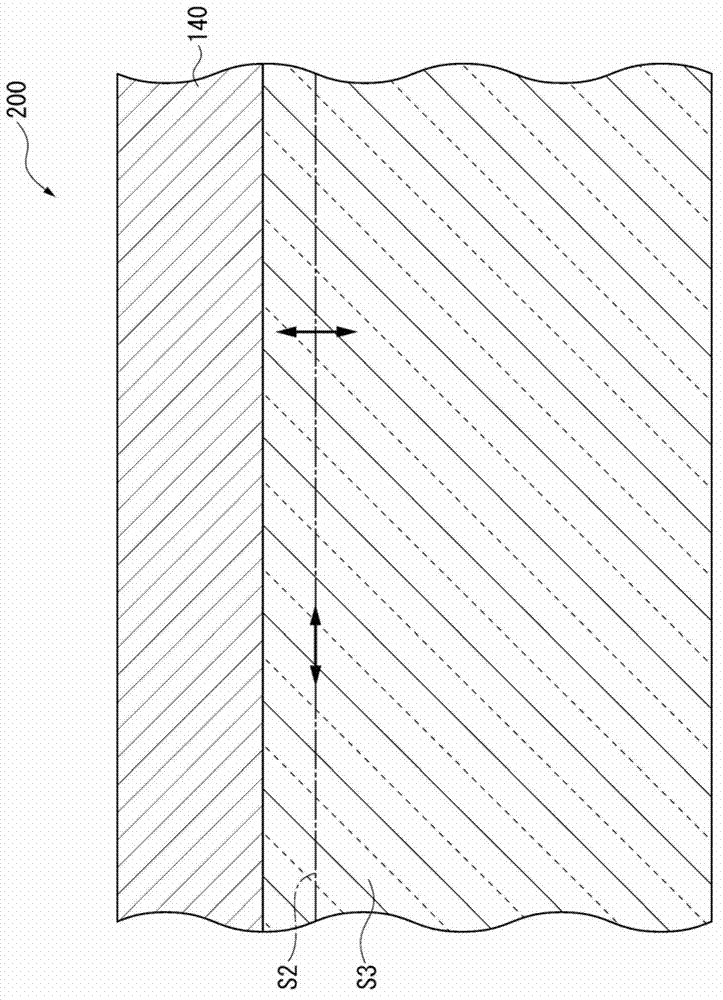
Disclosed is an organic EL element (1)-which is provided with a counter electrode (6), an organic light-emitting layer (5), and a transparent electrode (4) on a translucent substrate (2)-wherein: a light extraction layer (3), of which a high refractive index layer (31) adjacent to the transparent electrode (4) and a low refractive index layer (32) adjacent to the translucent substrate (2) are stacked, has a plurality of irregular-section units (31A) configured from convex sections (311) and concave sections (312) at the interface of the high refractive index layer (31) and the low refractive index layer (32); in at least one of the plurality of irregular-section units (31A), the distance (d1) from the interface between the high refractive index layer (31) and the low refractive index layer (32) to the interface between the transparent electrode (4) and the high refractive index layer (31) is at least the optical coherence length; and the height (d2) of the convex sections (311), the width (d3) of the convex sections (311), and the spacing (d4) between each convex sections (311) and the adjacent convex sections (311) with concave sections (312) therebetween is at least 1 [mu]m.
Description
technical field [0001] The invention relates to an organic electroluminescence element and a lighting device. Background technique [0002] An organic electroluminescence element is known, which is provided with an organic thin film layer including a light-emitting layer between an anode and a cathode. Combination, and the recombination generates exciton (exciton) energy to obtain light emission. [0003] Among organic electroluminescence elements, light-emitting elements that exhibit advantages as self-luminous elements, luminous efficiency, image quality, power consumption, and thin design are expected. [0004] In the optical design of the organic electroluminescent element, in order to improve the luminous efficiency, the optical interference distance is adjusted. By adjusting the film thickness of the organic layer such as the hole transport layer, the luminous efficiency can be effectively improved and the luminous spectrum can be tuned, which is an indispensable met...
Claims
the structure of the environmentally friendly knitted fabric provided by the present invention; figure 2 Flow chart of the yarn wrapping machine for environmentally friendly knitted fabrics and storage devices; image 3 Is the parameter map of the yarn covering machine
Login to View More
Application Information
Patent Timeline
Application Date:The date an application was filed.
Publication Date:The date a patent or application was officially published.
First Publication Date:The earliest publication date of a patent with the same application number.
Issue Date:Publication date of the patent grant document.
PCT Entry Date:The Entry date of PCT National Phase.
Estimated Expiry Date:The statutory expiry date of a patent right according to the Patent Law, and it is the longest term of protection that the patent right can achieve without the termination of the patent right due to other reasons(Term extension factor has been taken into account ).
Invalid Date:Actual expiry date is based on effective date or publication date of legal transaction data of invalid patent.


 Login to View More
  Login to View More