
A method and device for configuring ipv6 transition technology on cpe
A transition technology, a technology for configuring parameters, applied in the field of communication networks, can solve problems such as unavailability of services, and achieve the effect of small amount of transformation, saving bandwidth resources, and easy implementation
- Summary
- Abstract
- Description
- Claims
- Application Information
AI Technical Summary
Problems solved by technology
Method used
Image

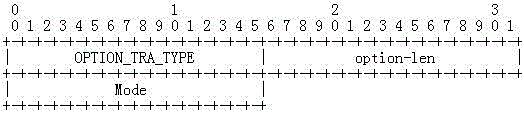
Examples
Embodiment 1
[0036] This embodiment describes the process of configuring IPv6 transition technology configuration parameters for a CPE by using a DHCPv6 protocol message.
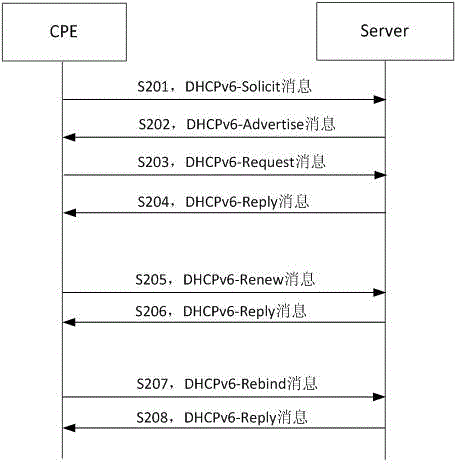
[0037] The following combination figure 2 , detailing the process of configuring IPv6 transition technical parameters for CPE during the process of IPv6 address and network parameter allocation, as shown in the figure, the process includes the following steps:
[0038] In step 201, the CPE broadcasts and sends a DHCPv6-Solicit message (DHCPv6 configuration parameter request message) to request a server in the network to assign an IPv6 address and network configuration parameters to it.
[0039] In step 202, the server sends a DHCPv6-Advertise message (DHCPv6 Advertisement message) to the CPE according to the DHCPv6-Solicit message, to notify the CPE of its allocated IPv6 address and network configuration parameters.
[0040] Specifically, after receiving the DHCPv6-Solicit message sent by the CPE, the server selects a...
Embodiment 2
[0063] This embodiment describes the process of specifying the IPv6 transition technology configuration parameters of the CPE through the DHCPv6 stateless configuration.
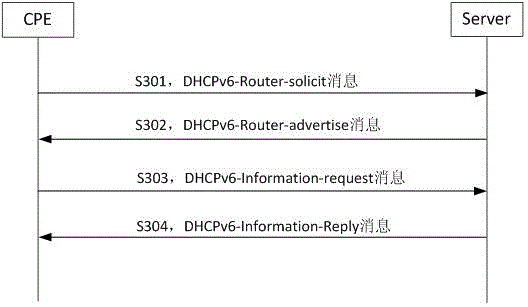
[0064] A DHCPv6 server can assign other network configuration parameters to clients that already have an IPv6 address. This process is called DHCPv6 stateless configuration, such as image 3 As shown, the process includes the following steps:
[0065] Step 301, when the CPE device is initialized, the CPE sends a DHCPv6-Router-solicit message (DHCPv6 router solicitation message) to the server to request to allocate an IPv6 address to it.
[0066] Step 302, the server sends a DHCPv6-Router-advertise message (DHCPv6 router advertisement message) to the CPE according to the DHCPv6-Router-solicit message.
[0067] When the managed address configuration flag M in the DHCPv6-Router-advertise message is 0, and the other configuration flags O are 1, it means that the server notifies the CPE to obtain an IPv6 address...
PUM
 Login to View More
 Abstract
Description
Claims
Application Information
 Login to View More