Method for controlling traffic signals under bi-direction and two-lane road maintenance construction situation

A road maintenance and traffic signal technology, applied in the field of road construction traffic organization and signal control optimization, can solve problems such as difficult to continue for a long time, labor-intensive, etc., and achieve the effect of ensuring traffic, low control cost, and easy implementation.

CN104299431AInactive Publication Date: 2015-01-21SOUTHEAST UNIV +1
7 Cites 10 Cited by

Patent Information

Authority / Receiving Office
CN · China
Patent Type
Applications(China)
Current Assignee / Owner
Publication Date
2015-01-21
Estimated Expiration
Not applicable · inactive patent

Smart Images

  • Figure 1
    Figure 1
  • Figure 2
    Figure 2
  • Figure 3
    Figure 3
Patent Text Reader

Abstract

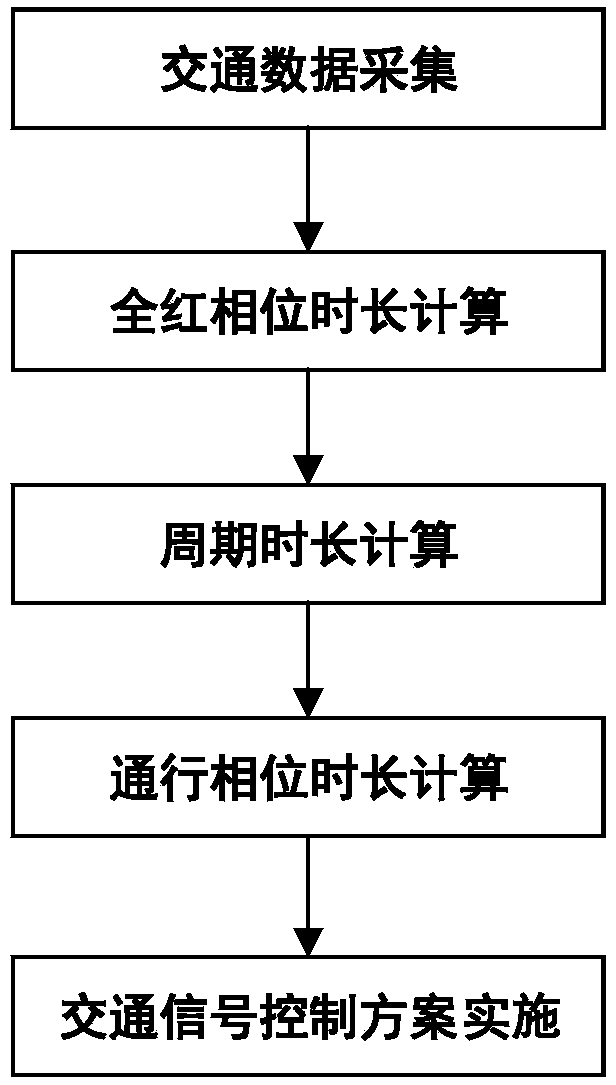
The invention discloses a method for controlling traffic signals under the bi-direction and two-lane road maintenance construction situation. The method comprises the steps of traffic data collecting, whole-red phase duration calculating, period duration calculating, passing phase duration calculating and traffic signal controlling scheme implementing. According to the method, the traffic circulation character under the bi-direction and two-lane road maintenance construction situation is fully taken into consideration, and a signal control scheme is designed according to the bi-direction and two-lane road maintenance construction needs. A most common four-phase signal control scheme is adopted to give wayleave to bi-direction vehicles in sequence according to the signal control method of a city intersection. The method is very suitable for long-time bi-direction and two-lane road maintenance construction, convenient to calculate and actually operate, high in practicality and capable of improving the overall running efficiency of a traffic system under the bi-direction and two-lane road maintenance construction situation, and has very important practical significance.
Need to check novelty before this filing date? Find Prior Art

Description

technical field

[0001] The invention relates to road construction traffic organization and signal control optimization technology, in particular to a traffic signal control method in a two-way two-lane road maintenance construction area. Background technique

[0002] At this stage, our country is in the period of comprehensive construction of transportation infrastructure, and the planning, new construction, reconstruction and expansion projects of various grades of roads are being carried out all over the country. Taking expressways as an example, in 2013, the national expressway construction completed an investment of 729.776 billion yuan. It can be seen that my country's current investment in road construction is still very large. In the future, as the pace of road construction slows down and the road network gradually takes shape, engineering projects related to roads and bridges will shift from focusing on construction at present to centering on maintenance. The data ...

Examples

Embodiment Construction

[0023] The present invention will be further described below in conjunction with the accompanying drawings.

[0024] Such as figure 1 Shown is an overall flowchart of a traffic signal control method under the condition of two-way two-lane road maintenance construction. Combine below figure 1 The method of the present invention is further described.

[0025] A traffic signal control method in the case of two-way two-lane road maintenance construction, characterized in that the method adopts a four-phase signal control scheme, and sequentially gives traffic flow rights in two directions, and the four phases are in order of phase sequence: closed lane The current phase of traffic flow in the opposite lane, all red phase 1, the traffic flow phase of the opposite lane, all red phase 2; this method includes five steps in sequence: step 1, traffic data collection step, step 2, all red phase Step 3 of duration calculation, step 4 of cycle duration calculation, step 4 of calculation...