Multi-stroke realizing circuit and multi-stroke control method for circuit breakers

A circuit breaker, multi-stroke technology, applied in the direction of protection switch operation/release mechanism, etc., can solve the problem of circuit breaker closing/opening coil burning, etc., to achieve the effect of improving the closing success rate, avoiding losses, and ensuring greater safety

CN105261530AActive Publication Date: 2016-01-20STATE GRID HENAN LINGBAO POWER SUPPLY CO
7 Cites 2 Cited by

Patent Information

Authority / Receiving Office
CN · China
Current Assignee / Owner
Publication Date
2016-01-20

Smart Images

  • Figure 1
    Figure 1
  • Figure 2
    Figure 2
  • Figure 3
    Figure 3
Patent Text Reader

Abstract

The invention discloses a multi-stroke realizing circuit and a multi-stroke control method for circuit breakers. The multi-stroke realizing circuit comprises a microprocessor, a positive control bus +KM, a negative control bus -KM, a first current self-holding relay HBJ1, a circuit breaker auxiliary normally closed contact DL, a closing coil HQ, a closing relay HJ and a manual closing operation switch KK, and further comprises a switching relay QH, a second current self-holding relay HBJ2 and a transient wave relay MP. First, the microprocessor controls the switching device and further controls on-off of the closing coil so as to make the circuit breaker auxiliary normally closed contact do stroke movement repeatedly when the circuit breaker auxiliary normally closed contact fails to be closed in the first stroke of the closing coil, thus avoiding the situation in which a circuit breaker is burned out when the circuit breaker receives a closing instruction but fails to be closed; and then, the microprocessor makes the closing coil of the circuit breaker do stroke movement repeatedly, which can improve the success rate of circuit breaker closing under the condition that the circuit breaker is in the state of sub-health and cannot be closed by a single action.
Need to check novelty before this filing date? Find Prior Art

Description

technical field

[0001] The invention relates to the protection field of distribution substation devices, in particular to a multi-stroke realization circuit and control method of a circuit breaker. Background technique

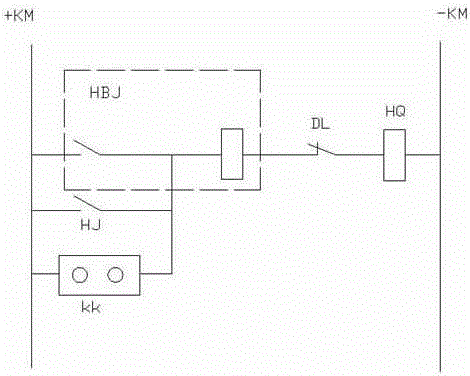
[0002] In order to prevent damage to the contacts of the opening and closing relays during the process of breaking the operating current, the traditional opening and closing control circuits are equipped with current self-holding coils (relays). Since the principles of the opening and closing control circuits are the same, we use Take the closing circuit as an example to explain the principle; figure 1 The closing circuit shown includes microprocessor, positive control bus +KM, negative control bus -KM, current self-holding coil HBJ, circuit breaker auxiliary normally closed contact DL, closing relay HJ, manual closing operation switch KK and closing Brake coil HQ, the output terminal of the microprocessor is connected with the closing relay HJ, which is us...

Examples

Embodiment Construction

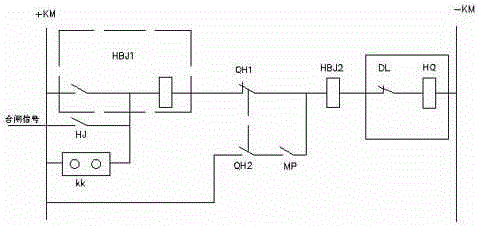
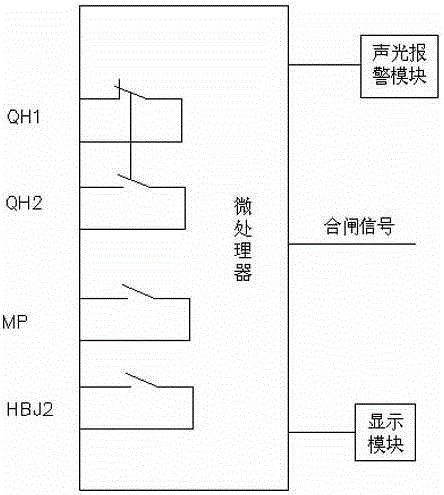
[0023] like Figure 2 to Figure 4 As shown, a multi-stroke realization circuit of a circuit breaker according to the present invention includes a microprocessor, a positive control bus +KM, a negative control bus -KM, a first current self-holding relay HBJ1, and a circuit breaker auxiliary normally closed contact DL , closing coil HQ, closing relay HJ and manual closing operation switch KK, also includes switching relay QH, second current holding relay HBJ2 and transient wave relay MP; Described microprocessor can adopt general microprocessor, DSP , microcontroller or microcontroller.

[0024] The normally open contact of the first current self-holding relay HBJ1, the first end of the closing relay HJ and the manual closing operation switch KK are all connected to the positive control bus +KM, the normally open contact of the first current self-holding relay HBJ1, The second ends of the closing relay HJ and the manual closing operation switch KK are connected to the first end...