A kind of method of acetonitrile method separation petroleum cracking carbon five distillates
What is AI technical title?
AI technical title is built by Patsnap AI team. It summarizes the technical point description of the patent document.
A C5 fraction and petroleum cracking technology, applied in the field of cyclopentene and cyclopentane, piperylene, isoprene, cyclopentadiene, can solve the problem of no separation of cyclopentene and cyclopentane, acetonitrile Solvent light hydrocarbon pollution, polluted solvent, etc.
Active Publication Date: 2019-01-18
PETROCHINA CO LTD
View PDF11 Cites 0 Cited by
Summary
Abstract
Description
Claims
Application Information
AI Technical Summary
This helps you quickly interpret patents by identifying the three key elements:
Problems solved by technology
Method used
Benefits of technology
Problems solved by technology
[0003] The shortcoming that prior art exists is that in extracting and rectifying process, cyclopentadiene very easily polymerizes, pollutes solvent, reduces the selectivity of acetonitrile solvent; , the acetonitrile solvent is easily polluted by light hydrocarbons in the process of recovering acetonitrile, and the quality of isoprene products will be affected during the recycling of acetonitrile solvent; the purity of piperylene can only reach about 65%, and the purity is low; cyclopentene and cyclopentene Pentane was not subjected to further separation
Method used
the structure of the environmentally friendly knitted fabric provided by the present invention; figure 2 Flow chart of the yarn wrapping machine for environmentally friendly knitted fabrics and storage devices; image 3 Is the parameter map of the yarn covering machine
View more
Image
Smart Image Click on the blue labels to locate them in the text.
Viewing Examples
Smart Image
Click on the blue label to locate the original text in one second.
Reading with bidirectional positioning of images and text.
Smart Image
Examples
Experimental program
Comparison scheme
Effect test
Embodiment 1
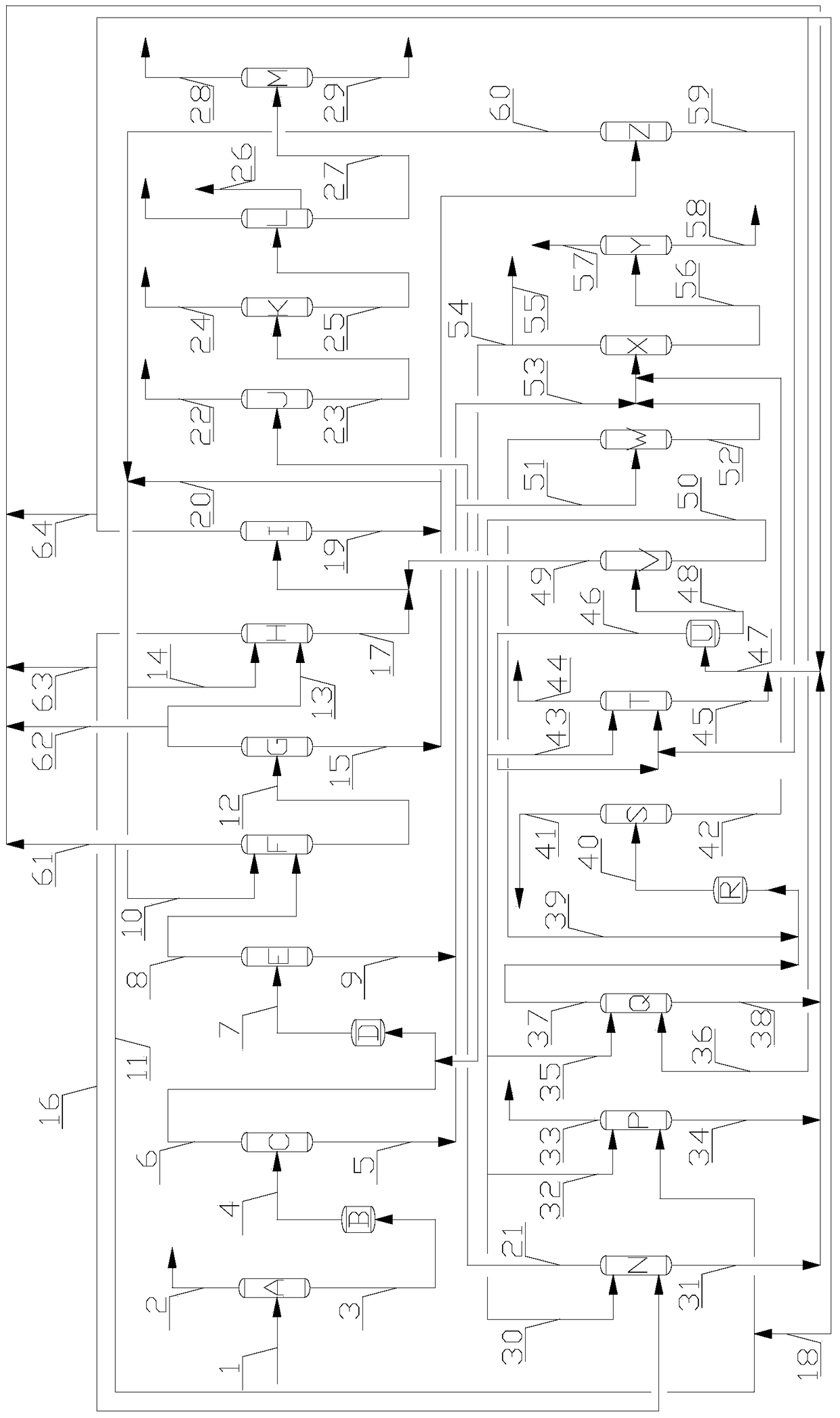
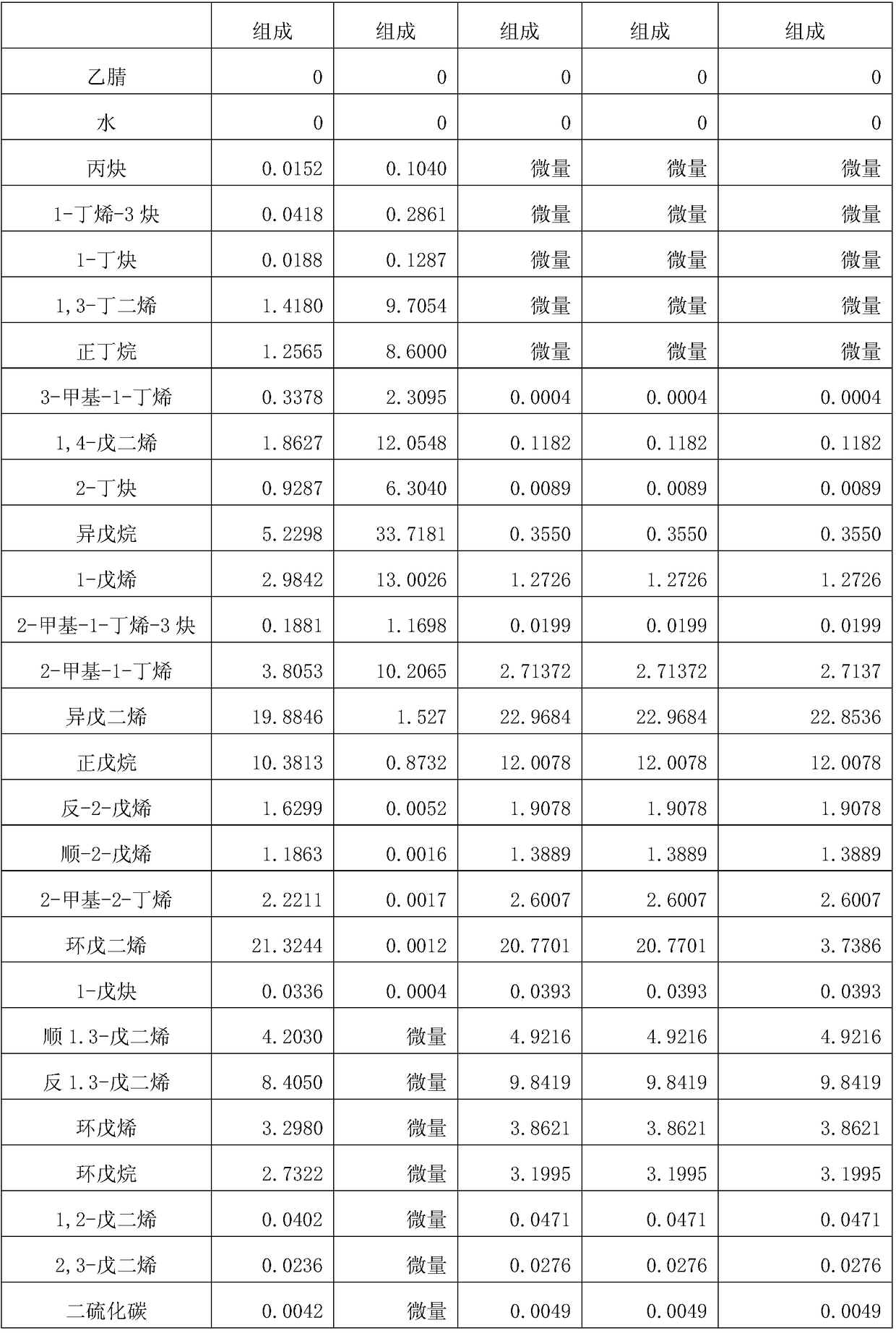
[0237] according to figure 1 The technical process, without using the cyclopentene refining tower L, the cyclopentane refining tower M and the piperylene washing tower Q, can obtain the isoprene product with a purity of 99.9%, and the piperylene with a purity of 77%. product, a dicyclopentadiene product with a purity of 95.7%.
[0238] The first material 1 of the carbon five fraction produced by petroleum cracking is sent to the alkyne removal tower A from the 77th plate, and the second material 2 rich in isopentane and a small amount of isoprene is obtained at the top of the tower, and the column reactor is obtained A third feed 3 containing traces of alkynes. Alkyne removal tower A has 120 trays, feed temperature is 68°C, tower top temperature is 59°C, tower bottom temperature is 87°C, tower top pressure is 0.33MPa, tower bottom pressure is 0.39MPa, reflux The ratio is 17.
[0239] The third material 3 enters the first thermal dimerization reactor B, and the fourth materi...
Embodiment 2
[0300] according to figure 1 The technical process, without using the piperylene crude fractionation tower W, can obtain the isoprene product with a purity of 99.94%, the piperylene product with a purity of 96.5%, the dicyclopentadiene product with a purity of 95.7%, A cyclopentene product with a purity of 99.5%, a cyclopentane product with a purity of 99.8%.
[0301] The first material 1 of the carbon five fraction produced by petroleum cracking is sent from the 82nd plate to the alkyne removal tower A, and the second material 2 rich in isopentane and a small amount of isoprene is obtained at the top of the tower, and the tower reactor is obtained A third feed 3 containing traces of alkynes. Alkyne removal tower A has 123 trays, feed temperature is 62°C, tower top temperature is 59°C, tower bottom temperature is 88°C, tower top pressure is 0.34MPa, tower bottom pressure is 0.40MPa, reflux The ratio is 15.
[0302] The third material 3 enters the first thermal dimerization ...
the structure of the environmentally friendly knitted fabric provided by the present invention; figure 2 Flow chart of the yarn wrapping machine for environmentally friendly knitted fabrics and storage devices; image 3 Is the parameter map of the yarn covering machine
Login to View More
PUM
Login to View More
Abstract
A method for separating a petroleum cracking C5 fraction through an acetonitrile process comprises the following steps: removing most of 2-butyne and 2-methyl-1-butenyl-3-alkyne from the petroleum cracking C5 fraction in advance; adopting a continuous thermal dimerization-rectification-thermal dimerization-rectification process to make a reaction be carried out toward a dicyclopentadiene generation direction, and carrying out a series of separation processes to obtain highly pure polymeric isoprene; and carrying out flash evaporation on water washed acetonitrile, returning the evaporated acetonitrile to a double extraction desorption tower, pumping off parts of a circulating solvent, purifying, and removing polymers in the solvent. The method has the following advantages: the solvent keeps high selectivity; production of an m-pentadiene product with the purity being greater than 70% and an m-pentadiene product with the purity being greater than 95% is realized by adopting same flow according to different uses, and cyclopentene with the purity being greater than 99.5% and cyclopentane with the purity being greater than 99.8% can also be obtained; and long-term stable running of a C5 separation device is guaranteed.
Description
technical field [0001] The invention relates to a method for separating cyclopentadiene, isoprene, piperylene, cyclopentene and cyclopentane in petroleum cracking C5 fractions by using an acetonitrile method. Background technique [0002] The cracked C5 fraction is composed of dozens of components with similar boiling points and easy to form azeotropes with each other, from which dicyclopentadiene, isoprene, piperylene, cyclopentene, Cyclopentane is relatively difficult and the process is complicated. In the prior art, extractive distillation or azeotropic distillation is generally used for separation. In extractive distillation, commonly used solvents include acetonitrile, dimethylformamide (DMF) and N-methylpyrrolidone (NMP), such as the processes disclosed in patents US2993841, US4081332 and US3803258. US4081332 discloses a method for acetonitrile extraction and rectification separation of unsaturated hydrocarbons in carbon five, in order to improve the selectivity of ac...
Claims
the structure of the environmentally friendly knitted fabric provided by the present invention; figure 2 Flow chart of the yarn wrapping machine for environmentally friendly knitted fabrics and storage devices; image 3 Is the parameter map of the yarn covering machine
Login to View More
Application Information
Patent Timeline
Application Date:The date an application was filed.
Publication Date:The date a patent or application was officially published.
First Publication Date:The earliest publication date of a patent with the same application number.
Issue Date:Publication date of the patent grant document.
PCT Entry Date:The Entry date of PCT National Phase.
Estimated Expiry Date:The statutory expiry date of a patent right according to the Patent Law, and it is the longest term of protection that the patent right can achieve without the termination of the patent right due to other reasons(Term extension factor has been taken into account ).
Invalid Date:Actual expiry date is based on effective date or publication date of legal transaction data of invalid patent.



 Login to View More
  Login to View More