
A Non-data-aided Blind Phase Noise Estimation Method for QAM Signals
A non-data-assisted, phase-noise technology, applied in digital transmission systems, baseband system components, multi-carrier systems, etc., can solve problems such as no closed-form solution of the algorithm, difficult real-time processing, and large amount of calculation, and achieve simplification of the estimation process , good estimation performance, and the effect of reducing computational complexity
- Summary
- Abstract
- Description
- Claims
- Application Information
AI Technical Summary
Problems solved by technology
Method used
Image



Examples
Embodiment Construction
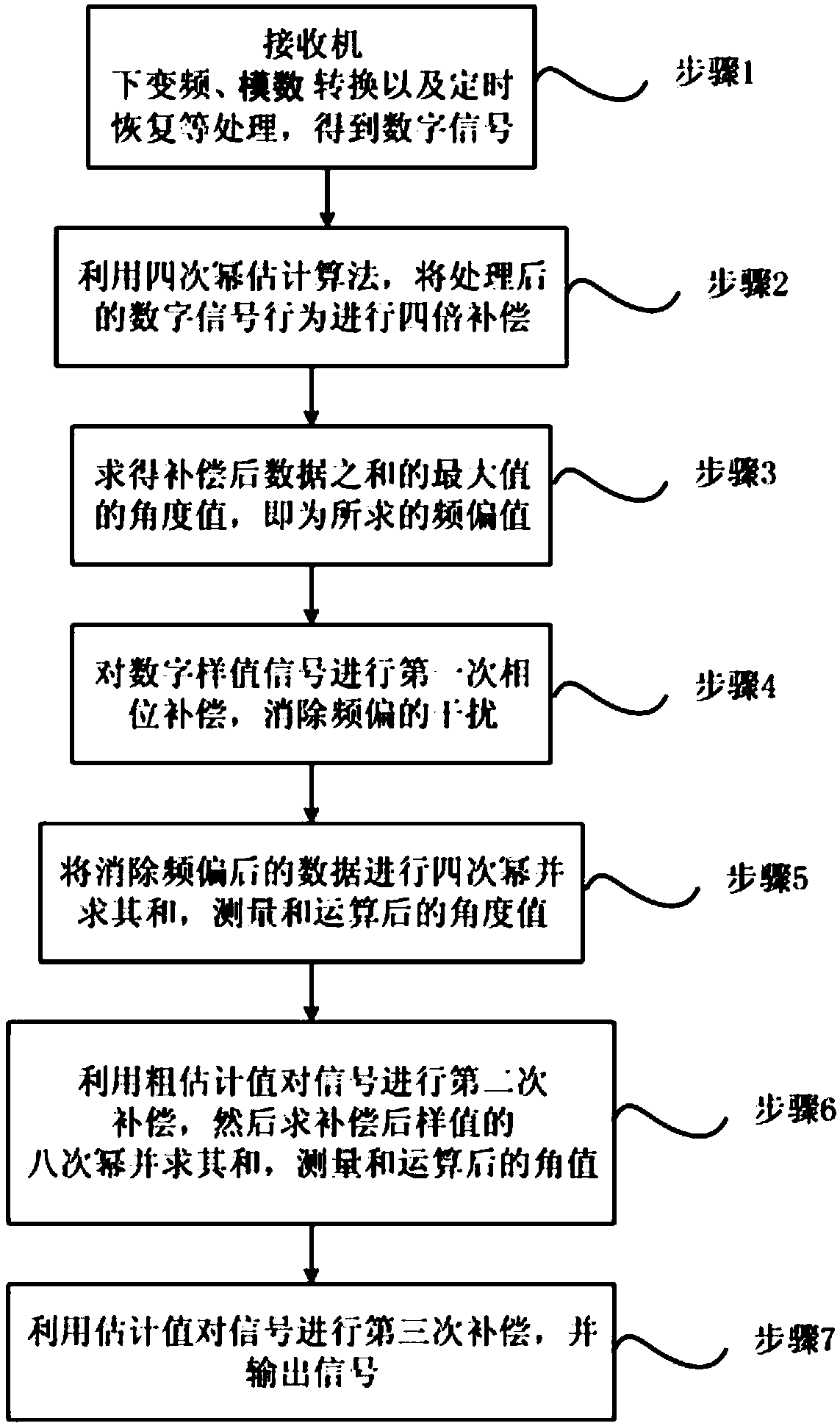
[0036] For the QAM signal demodulation system, the received RF signal is processed by matched filtering, analog-to-digital conversion, and timing recovery frequency offset compensation to obtain a received signal containing carrier phase noise r n :
[0037]
[0038] In formula (1), d n To send a signal, f e is the carrier frequency offset value, T is the symbol period, v n is periodic complex Gaussian stationary noise, and r n Statistically independent, θ is the phase deviation value, n=1,2,...,N, N represents the total number of received signal samples; in formula (1) because f e The existence of and θ will seriously affect the received signal, making it impossible to make a decision. to eliminate f e and θ interference, these two parameters must be estimated, and then the signal is compensated according to the estimated value, thereby eliminating the influence.
[0039] The demodulation of the QAM signal receiving end is as follows: figure 1 As shown, r(t) is the tr...
PUM
 Login to View More
 Abstract
Description
Claims
Application Information
 Login to View More