Four-section dental implant

A dental implant, a four-stage technology, applied in the field of stomatology, can solve the problems of difficult thread fit, poor thread mechanical properties, poor mechanical properties, etc., to reduce replacement costs, ensure connection strength, and improve processing accuracy Effect

CN109172012APending Publication Date: 2019-01-11广东健齿生物科技有限公司
0 Cites 0 Cited by

Patent Information

Authority / Receiving Office
CN · China
Patent Type
Applications(China)
Current Assignee / Owner
Publication Date
2019-01-11

Smart Images

  • Figure 1
    Figure 1
  • Figure 2
    Figure 2
  • Figure 3
    Figure 3
Patent Text Reader

Abstract

The invention discloses a four-section dental implant. The four-section dental implant comprises a bone graft part, a connecting part, an abutment part and a penetrating gingival part, wherein the four-section structure is connected by threads, so that the processing precision can be improved, and the design can facilitate the removal and replacement of only damaged parts when the dental implant is damaged, thereby reducing the replacement cost. In the invention, the degree of freedom is limited by the way that the limiting groove and the limiting protrusion are matched, so as to fix the connecting part of the dental implant, so that the connecting strength of the connecting part and the bone graft part can be effectively ensured.
Need to check novelty before this filing date? Find Prior Art

Description

technical field

[0001] The invention belongs to the technical field of oral medicine, in particular to an oral dental implant. Background technique

[0002] Most of the existing dental implants are made of pure titanium or titanium alloy, and most of them have a two-stage structure, which is integratedly manufactured by machining. After the advent of Selective Laser Melting (SLM), a method for 3D printing to manufacture dental implants was proposed. The advantages of 3D printing can meet the requirements of personalized design and manufacture of dental implants, but 3D printing has the disadvantage of low processing accuracy. At the same time, 3D printing needs to support the suspended parts, but the supported parts will also result in poor mechanical properties.

[0003] The existing machining methods for manufacturing dental implants cannot individualize complex structures. Insufficient precision of 3D printing makes it difficult to fit the thread. At the same time, bec...

Examples

Embodiment 1

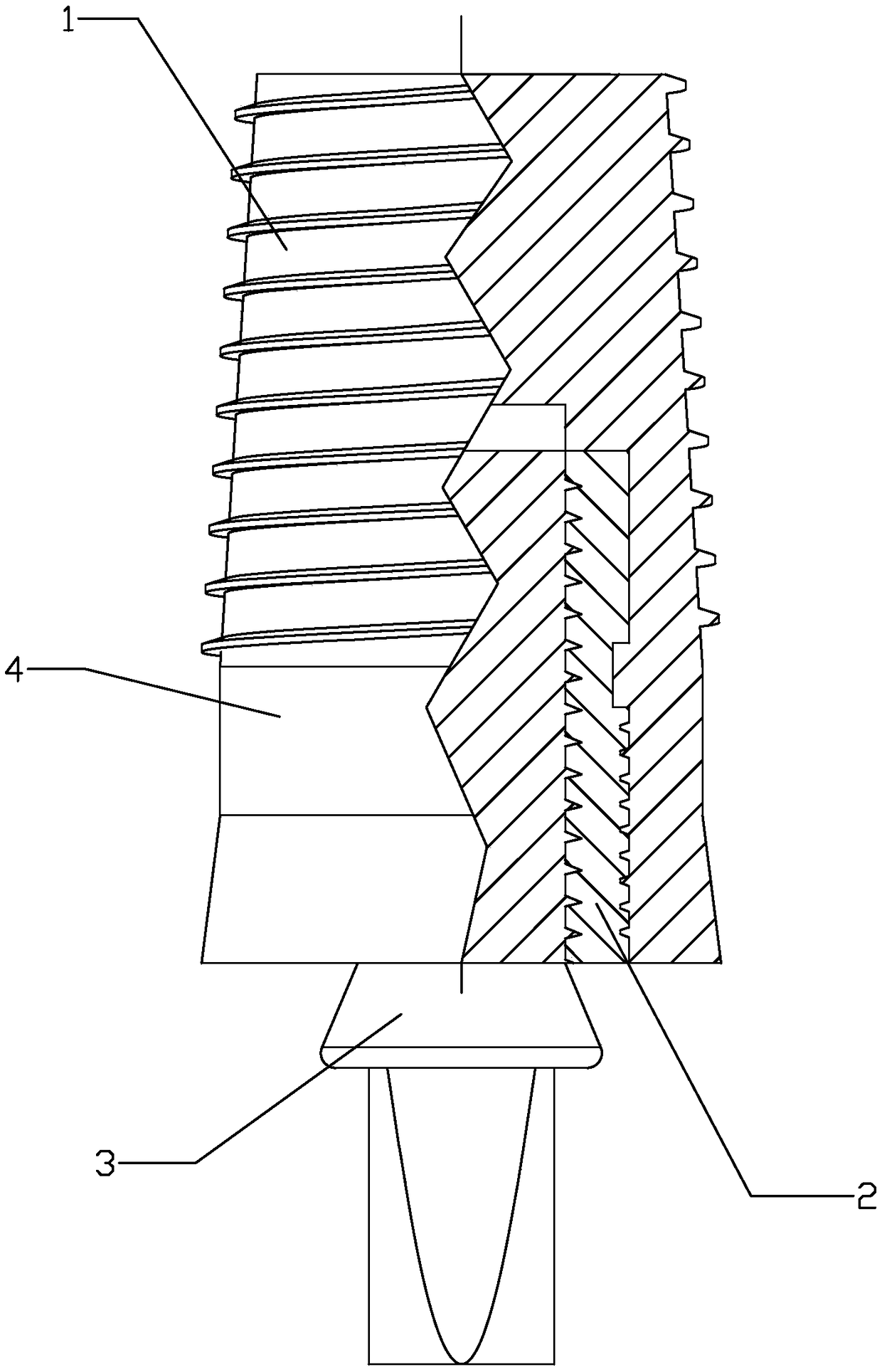
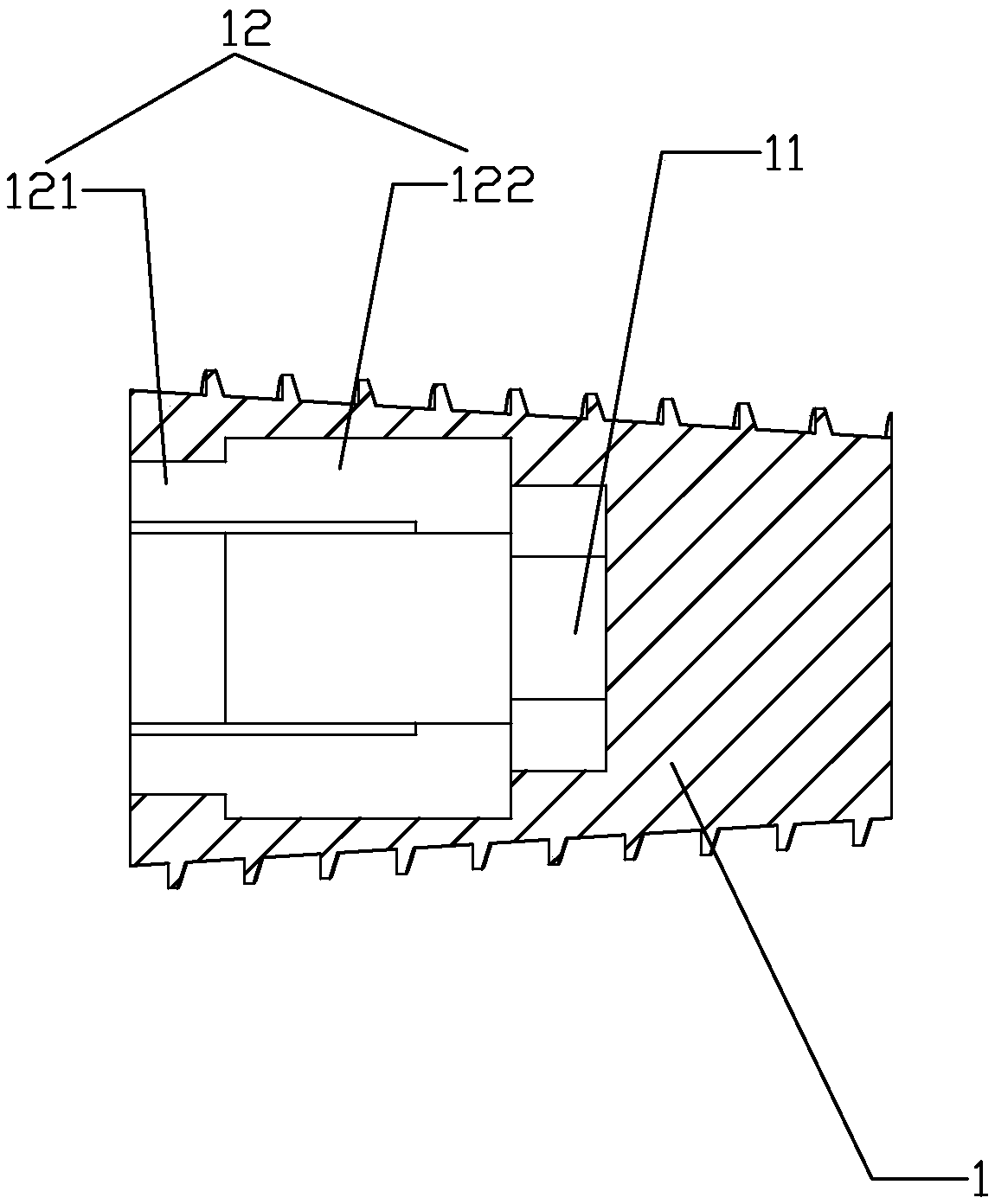
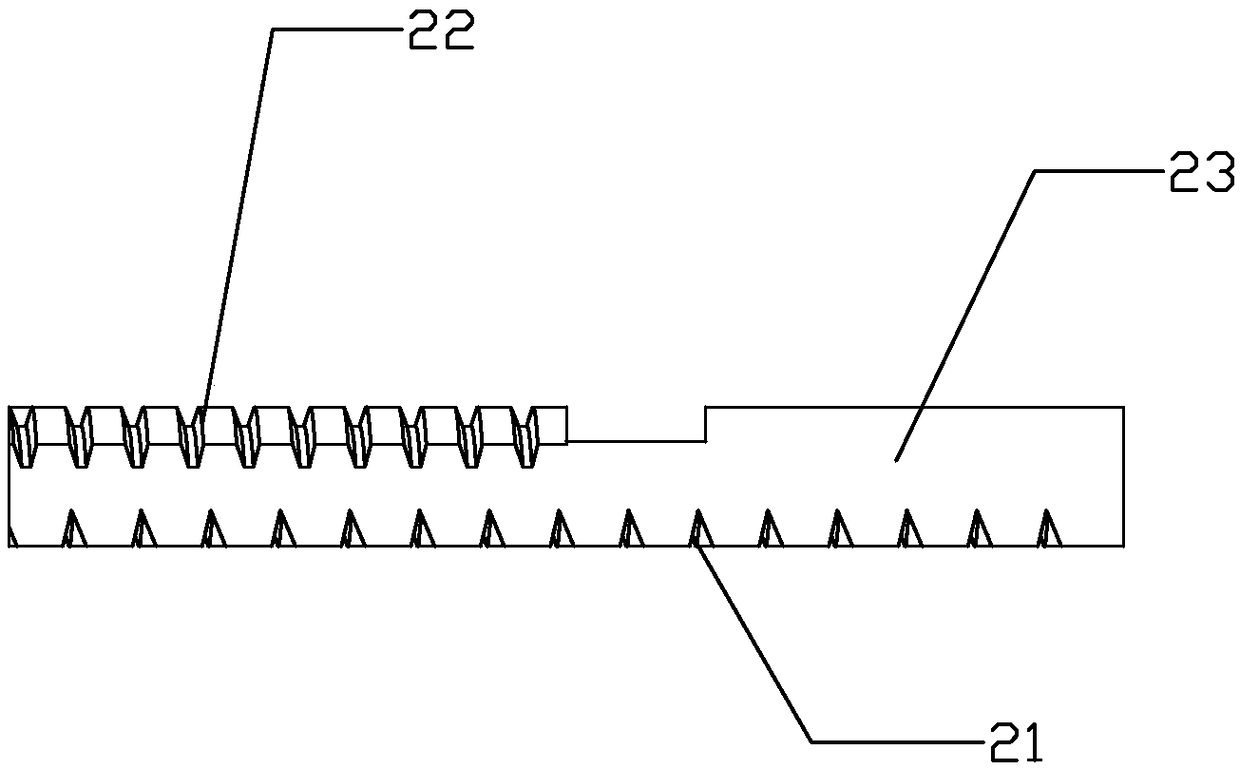
[0025] refer to Figure 1 to Figure 6 , a four-stage dental implant, the dental implant includes a bone graft part 1, a connecting part, an abutment part 3 and a gingival part; the bone graft part 1 is a rotary structure, and the bone graft part 1 There is a connection cavity inside, a groove 11 is provided at the bottom of the connection cavity, and at least two limiting grooves 12 are provided on the inner wall of the connection cavity; the connection part is composed of several connection blocks 2, The number of connecting blocks 2 is the same as the number of limiting grooves 12, the inner side of the connecting block 2 is provided with the abutment connecting threaded section 21, and the outer side of the connecting block 2 is provided with a transgingival connecting threaded section 22 and a limiting protrusion 23, the limiting protrusion 23 is arranged under the gingival connection thread section 22, the limiting protrusion 23 is matched with the limiting groove 12, and...