
Airborne radar radio frequency stealth waveform selection method based on waveform library
An airborne radar and radio frequency stealth technology, which is applied in the direction of radio wave reflection/re-radiation, use of re-radiation, radio wave measurement system, etc., to achieve the effect of improving radio frequency stealth performance, improving target tracking accuracy, and controlling the number of startups
- Summary
- Abstract
- Description
- Claims
- Application Information
AI Technical Summary
Problems solved by technology
Method used
Image



Examples
Embodiment Construction
[0039] The structure and working process of the present invention will be further described below in conjunction with the accompanying drawings.
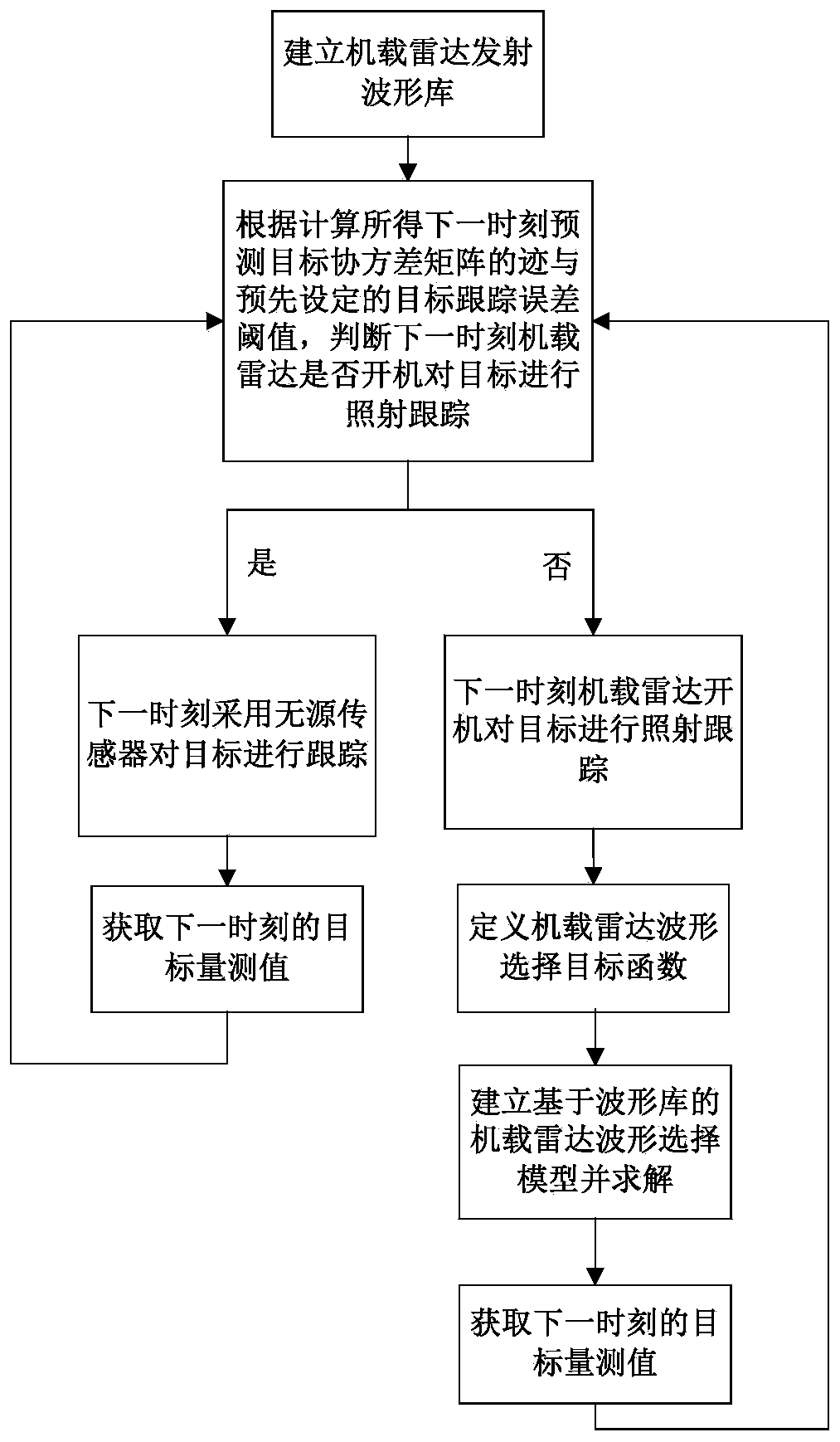
[0040] Starting from practical engineering applications, the present invention proposes a waveform library-based radio frequency stealth waveform selection method for airborne radar. First, the airborne radar transmission waveform library is established. Then, considering the combat scenario where the airborne radar uses the interactive multi-model extended Kalman filter algorithm to track a single target, according to the calculated trace of the predicted target covariance matrix at the next moment and the preset target tracking error threshold, the following Whether or not the airborne radar is turned on to track the target at a moment. If the preset target tracking error threshold is met, the airborne radar will not be turned on at the next moment, and the passive sensor will track the target; if the preset target tracking error ...
PUM
 Login to View More
 Abstract
Description
Claims
Application Information
 Login to View More